Mostrando entradas con la etiqueta Sweden. Mostrar todas las entradas

domingo, 17 de abril de 2016

ANIMALS – INSECTS – BEES – WESTERN HONEY BEE (APIS MELLIFERA)


Animals - Insects - Bees

Western Honey Bee (Apis mellifera)


Scientific Classification:

Kingdom : Animalia
Phylum : Arthropoda
Class : Insecta
Order : Hymenoptera
Family :Apdae
Genus : Apis
Species :
A. Mellifera


Description:

The Western honey beeor European honey bee(Apis mellifera) is a species of honey bee. The genus name Apis is Latin for "bee", and mellifera means "honey-bearing". It has a defined social caste system and complex communication behaviors, such as intricate dance routines to indicate food availability. It is frequently maintained by beekeepers for its honey product. This species is widely distributed and an important pollinator for agriculture, though it is currently threatened by colony collapse disorder. It is also an important organism for scientific studies on social insects, especially as it now has a fully sequenced genome.

The western honey bee isnative to Europe, Asia and Africa. During the early 1600s it was introduced to North America, with other European subspecies introduced two centuries later. Since then, it has spread throughout the Americas.

Western honey bees evolved into geographic races as they spread from Africa into Eurasia, and 28 subspecies based on these geographic variations are recognized. All races are cross-fertile, although reproductive adaptations may make interbreeding unlikely. The subspecies are divided into four major branches, based on work by Ruttner and confirmed by mitochondrial DNA analysis. African subspecies belong to branch A, northwestern European subspecies branch M, southwestern European subspecies branch C and Mideastern subspecies branch O. These subspecies are listed and grouped in the sidebar. Regions with local variations may be identified as subspecies in the future; A. m. pomonella, from the Tian Shan, would be included in the Mideastern subspecies branch.

Geographic isolation led to adaptation as honey bees spread after the last ice age. These adaptations include brood cycles synchronized to the blooming period of local flora, forming a winter cluster in colder climates, migratory swarming in Africa and enhanced foraging behavior in desert areas.


Binomial Name:

Name : Apis mellifera
Taxonomist : Carl Linnaeus (Småland - Sweden)
Year :
1758
Subspecies :
Many
Synonyms :
Apis Mellifica


Conservation Status by IUCN:

Status : Not Evaluated, or not data available


Philatelic Issues


2001 – Uruguay – Bees Series


Issue information:

Country: Uruguay
Date: Septermber 12th, 2001
Printed: 15.000 Copies
Type: Complete 2 Stamp Series
Value:
2 * UYP 12 = UYP 24

Stamp: Rectangular
Size: All 35 mm. x 25 mm.
Perforation: Circular
Gum: Water Activated

domingo, 20 de marzo de 2016

ANIMALS – INSECTS – BUTTERFLIES – BANDED ORANGE HELICONIAN (DRYADULA PHAETUSA)


Animals - Insects - Butterflies

Banded orange heliconian (Dryadula phaetusa)


Scientific Classification:

Kingdom : Animalia
Phylum : Arthropoda
Class : Insecta
Order : Lepidoptera
Family :Nymphalidae
Genus : Dryadula
Species :
D. Phaetusa


Description:

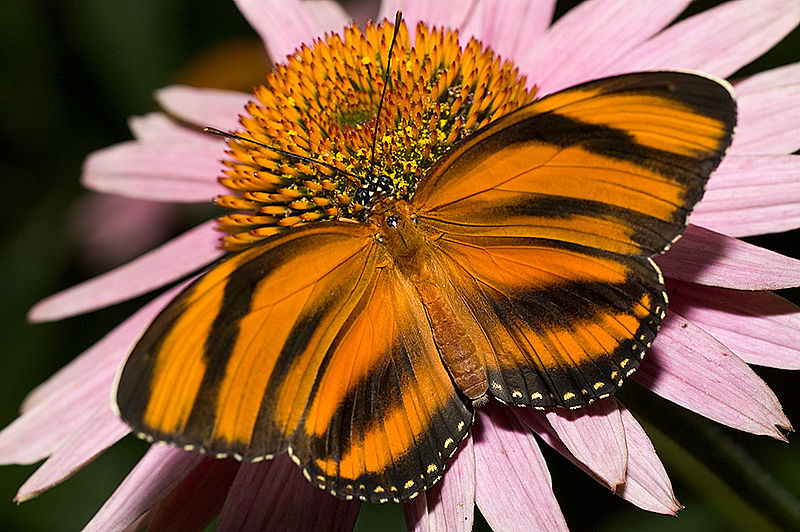
Dryadula is a monotypic genus of the butterflyfamily Nymphalidae. Its single species, Dryadula phaetusa, known as theBanded orange heliconian, Banded orange, or Orange tiger, is native from Brazil to central Mexico, and in summer can be found rarely as far north as central Florida. Its wingspan ranges from 86 to 89 mm, and it is colored a bright orange with thick black stripes in males and a duller orange with fuzzier black stripes in females.

It feeds primarily on the nectar of flowers and on bird droppings; its caterpillar feeds on passion vines including Passiflora tetrastylis. It is generally found in lowland tropical fields and valleys.

This species is unpalatable to birds and belongs to the "orange" Batesian mimicry complex.

Prior to their mating season, males of this species congregate by the hundreds on patches of moist soil that contain mineral salts (mud-puddling). When they cannot find such deposits, the insects visit various animals to drink salty secretions from their skin and nostrils.

The genus Dryadula Michner, 1942, is monotypic; the type species is Papilio phaetusa Linnaeus, 1758 (Syst. Nat. 10 ed., 1: 478). The type locality, given as "Indiis", is supposed to refer to the West Indies or northern South America.


Binomial Name:

Name : Dryadula phaetusa
Taxonomist : Carl Linnaeus (Småland - Sweden)
Year :
1758
Subspecies :
None, or not data available
Synonyms :
None, or not data available


Conservation Status by IUCN:

Status : Not Evaluated, or not data available


Philatelic Issues


2003 – Uruguay – Stamp 3 of 4, from Butterflies Series


Issue information:

Country: Uruguay
Date: March 18th, 2003
Printed: 10.000 Copies
Type: Stamp from Series of 4 Stamps
Value:UYP 12

Stamp: Rectangular
Size: 23 mm. x 35 mm.
Perforation: Circular
Gum: Water Activated

viernes, 18 de marzo de 2016

ANIMALS – INSECTS – BUTTERFLIES – RED POSTMAN (HELICONIUS ERATO)


Animals - Insects - Butterflies

Red Postman (Heliconius erato)


Scientific Classification:

Kingdom : Animalia
Phylum : Arthropoda
Class : Insecta
Order : Lepidoptera
Family :Nymphalidae
Genus : Heliconius
Species :
H. Erato


Description:

The Red postman(Heliconius erato) is one of about 40 Neotropical species of butterfly belonging to the genus Heliconius. It is also commonly known as the small postman, thered passion flower butterfly, or the crimson-patched longwing.

The species is remarkably variable in colour and form throughout northern South America, depending on location, and its various appearances can be difficult to distinguish from various other Heliconius butterflies such as Heliconius sara, also known as the sara longwing. Particularly hard to distinguish is the related Heliconius melpomene, or "the postman", which mimics almost all the colour forms of Heliconius erato; colour forms are synchronized between the two throughout their common habitats. It is likely the clade containing Heliconius erato radiated first, establishing the wing pattern diversity found in both species of butterfly. Two features found on the underside help to distinguish H. erato from H. melpomene—H. erato has four red dots where the wing attaches to the thorax while H. melpomene has three and the yellowish white stripe on the underside reaches the margin of the hindwing in H. erato but ends early in H. melpomene.

Heliconius erato is up to about5.5–8 cm (2.2–3.1 in) in wingspan with a jerky unelegance in flight.

Like Heliconius charithonia, H. erato is one of the few butterflies that collects and digests pollen, conferring considerable longevity to the adults (several months). Adults roost in groups, returning to the same location each night.

Recent Field work has confirmed the relative abundance of this butterfly.

A recent study, using amplified fragment length polymorphism (AFLP) and mitochondrial DNA (mtDNA) data sets, places the origins of H. erato at 2.8 million years ago. H. erato also shows clustering of AFLPs by geography revealing that H. erato originated in western South America.


Binomial Name:

Name : Heliconius erato
Taxonomist : Carl Linnaeus (Småland - Sweden)
Year :
1758
Subspecies :
Many
Synonyms :
Papilio erato


Conservation Status by IUCN:

Status : Not Evaluated, or not data available


Philatelic Issues


2003 – Uruguay – Stamp 1 of 4, from Butterflies Series


Issue information:

Country: Uruguay
Date: March 18th, 2003
Printed: 10.000 Copies
Type: Stamp from Series of 4 Stamps
Value:UYP 12

Stamp: Rectangular
Size: 23 mm. x 35 mm.
Perforation: Circular
Gum: Water Activated

viernes, 4 de marzo de 2016

ANIMALS – BIRDS – SEABIRDS – CAPE PETREL (DAPTION CAPENSE)


Animals - Birds - Seabirds

Cape petrel (Daption capense)


Scientific Classification:

Kingdom : Animalia
Phylum : Chordata
Class : Aves
Order : Procellariiformes
Family : Procellariidae
Genus :Daption 
Species :
D. Capense


Description:

The Cape petrel(Daption capense), also called the Cape pigeon, Pintado petrel, or Cape fulmar, is a common seabirdof the Southern Ocean from the family Procellariidae. It is the only member of the genus Daption, and is allied to the fulmarine petrels, and the giant petrels. They are extremely common seabirds with an estimated population of around 2 million.

The Cape petrel is the only known member of the genus Daption and is in turn a member of the family Procellariidae and order Procellariiformes. There appears to be a subgroup within the family consisting of the giant petrels, the members of Fulmarus, the Antarctic petrel, and the snow petrel.

All Procellariiformes share certain identifying features. First, they have nasal passages that attach to the upper bill called naricorns. The bills of Procellariiformes are also unique in that they are split into between seven and nine horny plates. They produce a stomach oil made up of wax esters and triglycerides that is stored in the proventriculus. This can be sprayed out of their mouths as a defence against predators and as an energy rich food source for chicks and for the adults during their long flights. Finally, they also have a salt gland that is situated above the nasal passage and helps desalinate their bodies, due to the high amount of ocean water that they imbibe. It excretes a high saline solution from their nose.

The Cape petrel is a unique looking petrel. It has a black head and neck, and a white belly, breast, and its underwing is white with a black border. Its back, and upperwings are black and white speckled, as is its tail which also has a band of black. When fully grown, their wings span 86 cm (34 in)and they are 39 cm (15 in) long.


Binomial Name:

Name : Daption capense
Taxonomist :
Carl Linnaeus (Småland - Sweden)
Year :
1758
Subspecies :
2 (Capense, Australe)
Synonyms : 
None, or not data available


Conservation Status by IUCN:

Status :Least Concern

Has been categorized by the International Union for Conservation of Nature as evaluated but not qualified for any other category. As such they do not qualify as threatened, near threatened, or (prior to 2001) conservation dependent.


Philatelic Issues


2004 – Uruguay – Stamp 3 of 4, from Seabirds Series


Issue information:

Country: Uruguay
Date: January 22nd, 20
Printed: 15.000 copies
Type : Stamp from Series of 4 Stamps
Value :
UYP 14

Stamp : Rectangular
Size: 27 mm. x 39 mm.
Perforation: Circular
Gum: Water Activated

miércoles, 27 de enero de 2016

ANIMALS – INSECTS – BUTTERFLIES – SCARLET PEACOCK (ANARTIA AMATHEA)


Animals - Insects - Butterflies

Scarlet Peacock (Anartia amathea)


Scientific Classification:

Kingdom : Animalia
Phylum : Arthropoda
Class : Insecta
Order : Lepidoptera
Family :Nymphalidae
Genus : Anartia
Species :
A. Amathea


Description:

The Scarlet peacock(Anartia amathea), also named Brown Peacock, is a species of nymphalid butterfly, found primarily in South America. The type locality is probably Suriname, and the species is found from Panama to Argentina; Grenada, Barbados, Antigua. It is reported as common in Argentina, Paraguay, Uruguay, the Brazilian highlands, the eastern Amazon, the Guianas, Venezuela, and Panama, as well as Trinidad and other Caribbean islands. North American records are either in error or refer to strays.

Larval host plants are mostly undetermined, but these include the families Acanthaceae and Labiatae.


Binomial Name:

Name : Anartia amathea
Taxonomist : Carl Linnaeus (Småland - Sweden)
Year :
1758
Subspecies :
None, or no data available
Synonyms :
None, or no data available


Conservation Status by IUCN:

Status : Not Evaluated, or not data available


Philatelic Issues


2009 – Uruguay – Stamp 2 of 4, from Spring Series


Issue information:

Country: Uruguay
Date: October 13th, 2009
Printed: 15.000 Copies
Type: Stamp from Series of 4 Stamps
Value: UYP 15

Stamp: Rectangular
Size: 39 mm. x 27 mm.
Perforation: Circular
Gum: Water Activated

martes, 26 de enero de 2016

ANIMALS – INSECTS – BUTTERFLIES – RED CRACKER (HAMADRYAS AMPHINOME)


Animals - Insects - Butterflies

Red Cracker (Hamadryas amphinome)


Scientific Classification:

Kingdom : Animalia
Phylum : Arthropoda
Class : Insecta
Order : Lepidoptera
Family :Nymphalidae
Tribe : Biblidini
Genus : Hamadryas
Species :
H. Amphinome


Description:

The Red Cracker(Hamadryas amphinome) is a species of cracker butterfly in the family Nymphalidae. It is found from Argentina, Mexico south to Amazon Basin and in Guianas, Peru, and Bolivia.

The larvae feed on Dalechampia scandens.


Binomial Name:

Name : Hamadryas amphinome
Taxonomist : Carl Linnaeus (Småland - Sweden)
Year :
1767
Subspecies :
4 (Amphinome, Fumosa, Mazai, Mexicana)
Synonyms :
Papilio amphinome


Conservation Status by IUCN:

Status : Not Evaluated, or not data available


Philatelic Issues


2009 – Uruguay – Stamp 1 of 4, from Spring Series


Issue information:

Country: Uruguay
Date: October 13th, 2009
Printed: 15.000 Copies
Type: Stamp from Series of 4 Stamps
Value: UYP 15

Stamp: Rectangular
Size: 39 mm. x 27 mm.
Perforation: Circular
Gum: Water Activated

martes, 12 de enero de 2016

ANIMALS – INSECTS – BEES – WESTERN HONEY BEE (APIS MELLIFERA)


Animals - Insects - Bees

Western Honey Bee (Apis mellifera)


Scientific Classification:

Kingdom : Animalia
Phylum : Arthropoda
Class : Insecta
Order : Hymenoptera
Family :Apdae
Genus : Apis
Species :
A. Mellifera


Description:

The Western honey beeor European honey bee(Apis mellifera) is a species of honey bee. The genus name Apis is Latin for "bee", and mellifera means "honey-bearing". It has a defined social caste system and complex communication behaviors, such as intricate dance routines to indicate food availability. It is frequently maintained by beekeepers for its honey product. This species is widely distributed and an important pollinator for agriculture, though it is currently threatened by colony collapse disorder. It is also an important organism for scientific studies on social insects, especially as it now has a fully sequenced genome.

The western honey bee isnative to Europe, Asia and Africa. During the early 1600s it was introduced to North America, with other European subspecies introduced two centuries later. Since then, it has spread throughout the Americas.

Western honey bees evolved into geographic races as they spread from Africa into Eurasia, and 28 subspecies based on these geographic variations are recognized. All races are cross-fertile, although reproductive adaptations may make interbreeding unlikely. The subspecies are divided into four major branches, based on work by Ruttner and confirmed by mitochondrial DNA analysis. African subspecies belong to branch A, northwestern European subspecies branch M, southwestern European subspecies branch C and Mideastern subspecies branch O. These subspecies are listed and grouped in the sidebar. Regions with local variations may be identified as subspecies in the future; A. m. pomonella, from the Tian Shan, would be included in the Mideastern subspecies branch.

Geographic isolation led to adaptation as honey bees spread after the last ice age. These adaptations include brood cycles synchronized to the blooming period of local flora, forming a winter cluster in colder climates, migratory swarming in Africa and enhanced foraging behavior in desert areas.


Binomial Name:

Name : Apis mellifera
Taxonomist : Carl Linnaeus (Småland - Sweden)
Year :
1758
Subspecies :
Many
Synonyms :
Apis Mellifica


Conservation Status by IUCN:

Status : Not Evaluated, or not data available


Philatelic Issues


2013 – Uruguay – Stamp 4 of 4, from Spring Series


Issue information:

Country: Uruguay
Date: August 30th, 2013
Printed: 15.000 Copies
Type: Stamp from Series of 4 Stamps
Value: UYP 15

Stamp: Rectangular
Size: 39 mm. x 27 mm.
Perforation: Circular
Gum: Water Activated

miércoles, 6 de enero de 2016

ANIMALS – BIRDS – SEABIRDS - RED KNOT (CALIDRIS CANUTUS)


Animals - Birds - Seabirds

Red Knot (Calidris canutus)


Scientific Classification:

Kingdom : Animalia
Phylum : Chordata
Class : Aves
Order : Charadriiformes
Family :Scolopacidae
Genus : Calidris
Species :
C. Canutus


Description:

The Red knot(Calidris canutus) (just knotin Europe) is amedium-sized shorebird which breeds in tundra and the Arctic Cordillera in the far north of Canada, Europe, and Russia. It is a large member of the Calidris sandpipers, second only to the great knot. Six subspecies are recognised.

Their diet varies according to season; arthropods and larvae are the preferred food items at the breeding grounds, while various hard-shelled molluscs are consumed at other feeding sites at other times. North American breeders migrate to coastal areas in Europe and South America, while the Eurasian populations winter in Africa, Papua New Guinea, Australia, and New Zealand. This species forms enormous flocks when not breeding.

This Red Knot was first described by Linnaeus in the landmark 1758 tenth edition of his Systema Naturae as Tringa canutus. One theory is that it gets its name and species epithet from King Canute, Knot being another form of Canute; the name would refer to the knot's foraging along the tide line and the story of Canute and the tide. Another etymology is that the name is onomatopoeic, based on the bird's grunting call note.


Binomial Name:

Name : Calidris canutus
Taxonomist : Carl Linnaeus (Småland - Sweden)
Year :
1758
Subspecies :
6 (Roselaari, Rufa, Canutus, Islandica, Rogersi, Piersmai)
Synonyms :
Tringa canutus


Conservation Status by IUCN:

Status :Least Concern

Has been categorized by the International Union for Conservation of Nature as evaluated but not qualified for any other category. As such they do not qualify as threatened, near threatened, or (prior to 2001) conservation dependent.

Philatelic Issues


2013 – Uruguay – Stamp 1 of 2, from Tourist Sites:Atlantic Coastline Series


Issue information:

Country: Uruguay
Date: December 4th, 2015
Printed: 15.000 Copies
Type: Stamp from Series of 2 Stamps
Value: UYP 15

Stamp: Rectangular
Size: 27 mm. x 39 mm.
Perforation: Circular
Gum: Water Activated

martes, 5 de enero de 2016

ANIMALS - BIRDS - RATITES - GREATER RHEA (RHEA AMERICANA)


Animals - Birds - Ratites

Greater Rhea (Rhea americana)


Scientific Classification:

Kingdom : Animalia
Phylum : Chordata
Class : Aves
Subclass : Neornithes
Infraclass : Palaeognathae
Order : Rheiformes
Family :Rheidae
Genus : Rhea
Species :
R. Americana


Description:

The Greater rhea(Rhea americana) is a flightless birdfound in eastern South America. Other names for the greater rhea include the grey, common, or American rhea; ñandú (Guaraní); or ema (Portuguese). One of two species in the genus Rhea, in the family Rheidae, the greater rhea is endemic to Argentina, Bolivia, Brazil, Paraguay and Uruguay. It inhabits a variety of open areas, such as grasslands, savanna or grassy wetlands. Weighing 20–27 kilograms (44–60 lb), the greater rhea is the largest bird in South America. In the wild, the greater rhea has a life expectancy of 10.5 years. It is also notable for its reproductive habits, and for the fact that a group has established itself in Germany in recent years. The species is listed as Near Threatened by the IUCN.

The greater rhea derives its scientific name from Rhea, a Greek goddess, and the Latinized form of America. It was originally described by Carolus Linnaeus in his 18th-century work, Systema Naturae under the name Struthio camelus americanus. He identified specimens from Sergipe, and Rio Grande do Norte, Brazil, in 1758. They are from the family Rheidae, and the order Struthioniformes, commonly known as ratites. They are joined in this order by emus, ostriches, cassowaries, and kiwis, along with the extinct forms moas, and elephant birds.

The adults have an average weight of 20–27 kg (44–60 lb) and often measure 127 to 140 cm (50 to 55 in) long from beak to tail; they usually stand about 1.5 m (4.9 ft) tall to the top of the head. The males are generally bigger than the females. Large males can weigh up to 40 kg (88 lb), stand nearly 1.83 m (6.0 ft) tall and measure over 150 cm (59 in) long, although this is rare.


Binomial Name:

Name : Rhea americana
Taxonomist : Carl Linnaeus (Småland - Sweden)
Year :
1758
Subspecies :
5 (Americana, Intermidia, Nobilis, Araneipes, Albescens)
Synonyms :
Struthio camelus americanus, Struthio americanus


Conservation Status by IUCN:

Status : Near-threatened species

A Near-threatened speciesis a species which has been categorized as "Near Threatened" (NT)by the International Union for Conservation of Nature as that may be considered threatened with extinction in the near future, although it does not currently qualify for the threatened status. The IUCN notes the importance of re-evaluating near-threatened taxa at appropriate intervals.

Philatelic Issues


2014 – Uruguay – Unique Stamp, from “Tranqueras” Centenary Series


Issue information:

Country: Uruguay
Date: July 22nd, 2015
Printed: 15.000 Copies
Type: Unique Stamp from Series
Value: UYP 15

Stamp: Rectangular
Size: 39 mm. x 27 mm.
Perforation: Circular
Gum: Water Activated

domingo, 27 de diciembre de 2015

ANIMALS - MAMMALS - RODENTS - CAPYBARA (HYDROCHOERUS HYDROCHAERIS)


Animals - Mammals - Rodents

Capybara (Hydrochoerus hydrochaeris)


Scientific Classification:

Kingdom : Animalia
Phylum : Chordata
Subphylum : Vertebrata
Class : Mammalia
Order : Rodentia
Suborder : Hystricomorpha
Family : Caviidae
Subfamily :Hydrochoerinae
Genus : Hydrochoerus
Species :
H. Hydrochaeris


Description:

The Capybara(Hydrochoerus hydrochaeris) is a large rodent of the genus Hydrochoerus of which the only other extant member is the lesser capybara (Hydrochoerus isthmius). The capybara is the largest rodent in the world. Close relatives are guinea pigs and rock cavies, and it is more distantly related to the agouti, chinchillas, and the coypu. Native to South America, the capybara inhabits savannas and dense forests and lives near bodies of water. It is a highly social species and can be found in groups as large as 100 individuals, but usually lives in groups of 10–20 individuals. The capybara is not a threatened species and is hunted for its meat, hide and also for a grease from its thick fatty skin which is used in the pharmaceutical trade.

Its common name is derived from Tupi ka'apiûara, a complex agglutination of kaá (leaf) + píi (slender) + ú (eat) + ara (a suffix for agent nouns), meaning "one who eats slender leaves", or "grass-eater". The scientific name, both hydrochoerus and hydrochaeris, comes from Greek ὕδωρ (hydor = water) + χοίρος (choiros = pig, hog)

The capybara has a heavy, barrel-shaped body and short head, with reddish-brown fur on the upper part of its body that turns yellowish-brown underneath. Its sweat glands can be found in the surface of the hairy portions of its skin, an unusual trait among rodents. The animal lacks under hair, and guard hair differs little from over hair. Adult capybaras grow to 106 to 134 cm (3.48 to 4.40 ft) in length, stand 50 to 62 cm (20 to 24 in) tall at the withers, and typically weigh 35 to 66 kg (77 to 146 lb), with an average in the Venezuelan llanos of 48.9 kg (108 lb). The top recorded weights are 91 kg (201 lb) for a wild female from Brazil and 73.5 kg (162 lb) for a wild male from Uruguay. Capybaras have slightly webbed feet and vestigial tails. Their hind legs are slightly longer than their forelegs; they have three toes on their rear feet and four toes on their front feet. Their muzzles are blunt, with nostrils, and the eyes and ears are near the top of their heads. Females are slightly heavier than males.

Its karyotypehas 2n = 66 and FN = 102.


Binomial Name:

Name : Hydrochoerus hydrochaeris
Taxonomist : Carl Linnaeus (Småland - Sweden)
Year :
1766
Subspecies : 
None or not data available
Synonyms :
None or not data available


Conservation Status by IUCN:

Status :Least Concern

Has been categorized by the International Union for Conservation of Nature as evaluated but not qualified for any other category. As such they do not qualify as threatened, near threatened, or (prior to 2001) conservation dependent.

Philatelic Issues


2015 - Uruguay - Stamp 6 of 10, from Wetland Animals Series


Issue information:

Country: Uruguay
Date: June 5th, 2015
Printed: 10.000 Copies
Type: Stamp from Series of 10 Stamps
Value: UYP 15

Stamp: Rectangular
Size: 39 mm. x 27 mm.
Perforation: Circular
Gum: Water Activated

domingo, 20 de diciembre de 2015

ANIMALS - BIRDS - SEABIRDS - BLACK SKIMMER (RYNCHOPS NIGER)


Animals - Birds - Seabirds

Black skimmer (Rynchops niger)


Scientific Classification:

Kingdom : Animalia
Phylum : Chordata
Class : Aves
Order : Charadriiformes
Family :Rynchopidae
Genus : Rynchops
Species :
R. Niger


Description:

The Black skimmer(Rynchops niger) is a tern-like seabird, one of three very similar birds species in the skimmer family. It breeds in North and South America. Northern populations winter in the warmer waters of the Caribbean and the tropical and subtropical Pacific coasts, but the South American races make only shorter movements in response to annual floods which extend their feeding areas in the river shallows.

The black skimmer is the largest of the three skimmer species. It measures 40–50 cm (16–20 in) long with a 107–127 cm (42–50 in) wingspan. This species ranges from 212 to 447 g (7.5 to 15.8 oz), with males averaging about 349 g (12.3 oz), as compared to the smaller female’s 254 g (9.0 oz).[3] The basal half of the bill is red, the rest mainly black, and the lower mandible is much-elongated. The eye has a dark brown iris and catlike vertical pupil, unique for a bird. The legs are red. The call is a barking kak-kak-kak.

Adults in breeding plumage have a black crown, nape and upper body. The forehead and underparts are white. The upper wings are black with white on the rear edge, and the tail and rump are dark grey with white edges. The underwing colour varies from white to dusky grey depending on region.

Non-breeding adults have paler and browner upperparts, and a white nape collar. Immature birds have brown upperparts with white feather tips and fringes. The underparts and forehead are white and the underwings as the adult.


Binomial Name:

Name : Rynchops niger
Taxonomist : Carl Linnaeus (Småland - Sweden)
Year :
1758
Subspecies :
3 (Niger, Cinerescens, Intercedens)
Synonyms :
None or not data available


Conservation Status by IUCN:

Status :Least Concern

Has been categorized by the International Union for Conservation of Nature as evaluated but not qualified for any other category. As such they do not qualify as threatened, near threatened, or (prior to 2001) conservation dependent.

Philatelic Issues


2015 - Uruguay - Stamp 2 of 10, from Wetland Animals Series


Issue information:

Country: Uruguay
Date: June 5th, 2015
Printed: 10.000 Copies
Type: Stamp from Series of 10 Stamps
Value: UYP 15

Stamp: Rectangular
Size: 39 mm. x 27 mm.
Perforation: Circular
Gum: Water Activated

viernes, 12 de julio de 2013

URU - 2013 - #007 - SERIE - HARALD EDELSTAM TRIBUTE


Uruguay - 2013 - Tribute to Harald Edelstam


Options:

SERIE --- 4,20 EUR
SERIE [2X2] --- 15,00 EUR
BLOCK --- 35,00 EUR
FDC not Sent --- 5,60 EUR
FDC Sent on First Day --- 9,00 EUR
FDC Sent on First Day [1x2] --- 12,00 EUR
COVER Sent on First Day --- 6,00 EUR

If you are interested in any of this items, or any other items from Uruguay, just make a donation including your e-mail in the description.

I will contact you as soon I receive your donation, we agree on which items do you need, and I will discount the donation done to the amount of your purchase.


Issue information:

Country: Uruguay
Date: March 17th, 2013
Printed: 15.003 copies

Stamp Shape and Size: Rectangular [27 mm. x 39 mm.]
Perforation: Circular
Gum: Water Activated

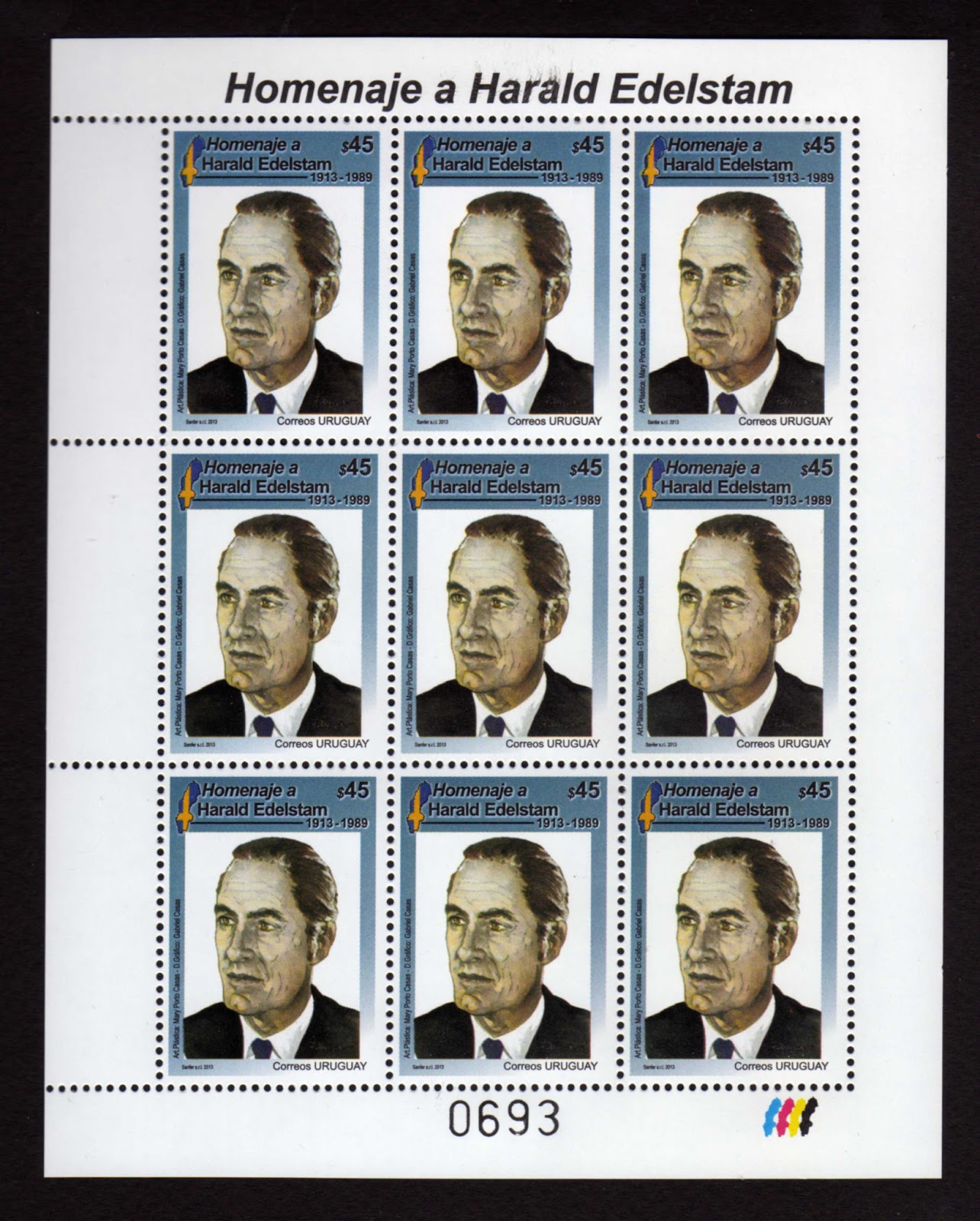
Block Configuration: 9 stamps [3 x 3]
Block Shape and Size: Rectangular [117 mm. x 148 mm.]

FDC Type: Normal
FDC Shape and Size: Rectangular [165 mm. x 105 mm.]
Cover Shape and Size: Rectangular [241 mm. x 159 mm.]

Catalogue information:

Michel: No Data Available
Ivert: No Data Available
Scott: No Data Available
Stanley & Gibbons: No Data Available

Topics:

Issue:

This issue tribute the remarkable courage and moral integrity of swedish diplomat Gustav Harald Edelstam, that through all his career, saved many lives from the threat of different totalitarian regimes. For his work in Chile during Pinochet dictatorship, is particulary remembered in Uruguay, as many citizen of this county were saved by his help.

The stamp was issued the exact day in which Harald Edelstam would have been celebrating his 100 years birthday, if he had not passed away almost 24 years before, suffering cancer.

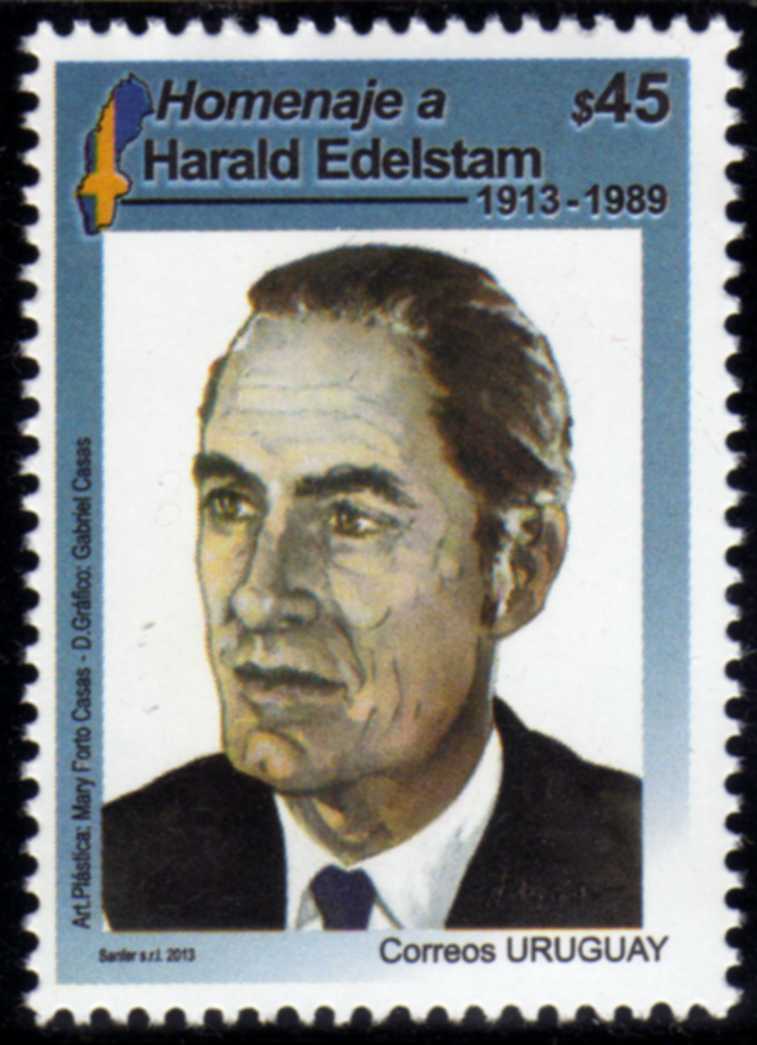
The desing of the stamps shows a nice portrait of Harald Edelstam, surely at age of fifty, wearing suit, shirt, and tie, made by plastic Artist Mary Porto Casas.

Then, besides the legend: "Homenaje a Harald Edelstam", in english "Tribute to Harald Edelstam", and the years of his birth and passed away, it also adds in the top-left corner, the map of Sweeden painted with the yellow over blue cross that shapes the sweedish flag.

Gustav Harald Edelstam, was born on March 17th of 1913, and passed away on April 16th of 1989, was a Swedish diplomat, remembered for his work on Norway during the Second World War, when he protected and rescued people of the Jewish faith and members of the resistance against pro-Nazi regime of Vidkun Quisling, and for his work later, in Chile in 1973, where he rescued and protected many political refugees from Augusto Pinochet's military dictatorship.

During World War II he earned the nickname "Svarta nejlikan", in english: "the Black Pimpernel", as a reference to the "Scarlet Pimpernel", a play and novel written by Baroness Emmuska Orczy, that represent the original hero with a secret identity. Later, he also was named "the Raoul Wallenberg of the seventies", as Raoul Wallenberg was also a Swedish man that is widely celebrated for his successful efforts to rescue tens of thousands to about one hundred thousand Jews in Nazi-occupied Hungary during the Holocaust from Hungarian Fascists and the Nazis during the later stages of World War II.

He came from a noble family in Sweden, his parents were Gustaf Fabian Edelstam-Chamberlain of the Svea Court - and Hilma Dickinson (1866-1945). He studied at the Military Academy Kalberg, graduating with high marks. In 1939 he studied law, graduating as a lawyer at the University of Stockholm. That same year he was recruited as a diplomatic attaché for the Ministry of Foreign Affairs of Sweden and called to make his first official visit to Rome.

In 1941 he was sent to the Swedish embassy in Berlin in Nazi Germany. He was then transferred to Oslo, where he was assigned from 1942 to 1944. It is in these two places where Edelstam demanded the Ministry of Foreign Affairs of Sweden, the right to help Jewish families in Berlin and protect those who fought in the resistance against the collaborationist Norwegian government. There he was given the nickname Black Pimpernel (Svarta nejlikan), who kept the rest of his life.

In 1969 he was sent as ambassador to Guatemala, also representing Sweden in other Central American countries. In those years the country was immersed in an armed conflict and most foreign diplomats feared for their safety. Protected by armed guards Edelstam met with various groups and popular organizations fighting for human rights for better know their living reality, and in order to denounce human rights violations in Guatemala.

He came to Chile in 1972, when he ruled the socialist president Salvador Allende Gossens, who represented the coalition of leftist parties and organizations Chileans. The popular and leftist government headed by Allende began to carry out various social reforms that were viewed negatively by the U.S. government, large corporations, politicians and a large part of Chilean society.

In 1973, Gen. Augusto Pinochet and other Chilean military troops deployed in different cities of Chile, starting a coup. Edelstam looked for ways to help people of Swedish nationality, asking for help from his diplomatic colleagues. Gave asylum to more than 500 Chilean political refugees, saved 40 Uruguayan refugees (including Raul Rodriguez Leles da Silva) to be shot at the National Stadium, developed by the coup government in a concentration camp for political prisoners. Edelstam personally responsible for moving the refugees in the embassy vehicle up to the steps of the plane that brought them out of Chile.

The military dictatorship declared Persona non grata and had to leave Chile in December 1973.

He ended his diplomatic career in Algeria, where he served as ambassador from 1974 to 1979.

One avenue of Montevideo bears his name since 2005.

A film about Edelstam's activities in Chile, named "The Black Pimpernel", was released in September of 2007. The film was directed by Ulf Hultberg, and Edelstam was portrayed by Michael Nyqvist.

Edelstam was married to Agneta Louise von Rosen in 1939-57, with Natascha Michew between 1959 and 1963, and with Christine Colmáin. He had three children from his first marriage: Carl, Hans and Erik . He died of cancer in 1989. His brother is a lawyer and Ambassador Ernst Axel Edestam (1924 -).

Sweden, in Swedish "Sverige", officially "the Kingdom of Sweden", is a Scandinavian country in Northern Europe. Sweden borders Norway and Finland, and is connected to Denmark by a bridge-tunnel across the Øresund.

At 450,295 square kilometres (173,860 sq mi), Sweden is the third-largest country in the European Union by area, with a total population of about 9.5 million. Sweden has a low population density of 21 inhabitants per square kilometre (54 /sq mi) with the population mostly concentrated to the southern half of the country. About 85% of the population live in urban areas. Sweden's capital city is Stockholm, which is also the largest city.

Since the early 19th century Sweden has been at peace and has avoided war.

Today, Sweden is a constitutional monarchy with a parliamentary democracy form of government and a highly developed economy. Sweden has the world's eighth-highest per capita income. In 2011, it ranked fourth in the world in The Economist's Democracy Index, seventh in the 2013 United Nations' Human Development Index (third on the inequality-adjusted HDI) and third on the 2012 Legatum Prosperity Index.

In 2012, the World Economic Forum ranked Sweden as the fourth-most competitive country in the world. According to the United Nations, it has the third-lowest infant mortality rate in the world. In 2010, Sweden also had one of the lowest Gini coefficients of all developed countries (0.25), making Sweden one of the world's most equal countries in terms of income. Sweden's wealth, however, is distributed much less equally than its income, with a wealth Gini coefficient of 0.85, which is higher than the European average of 0.8.

In 2013, The Economist declared that the Nordic countries "are probably the best-governed in the world," with Sweden in first place. Also in 2013, The Reputation Institute declared Sweden to be the 2nd most reputable country on earth.

The flag of Sweden is a Scandinavian cross that extends to the edges of the flag. This Scandinavian cross represents Christianity. The design and colours of the Swedish flag are believed to have been inspired by the present Coat of arms of Sweden of 1442, which is blue divided quarterly by a cross pattée of gold, and modelled on the Danish flag. Blue and yellow have been used as Swedish colours at least since King Magnus III's royal coat of arms of 1275.

Scandinavian cross is the term for a type of cross in vexillology, proliferent in the Nordic Cross flags, hence the name. However, Scandinavian crosses do not only appear in flags in the Nordic countries but all around the world and the term is used universally by vexillologists.

The cross design, which represents Christianity, is depicted extending to the edges of the flag with the vertical part of the cross shifted to the hoist side, rather than centred on the flag.

The first flag with the design was the Danish Dannebrog; thereafter, Sweden, Norway, Finland, Iceland, and some of their subdivisions used this as inspiration for their own flags. The Norwegian flag was the first Nordic cross flag with three colours. Though the flags share this pattern, they have individual histories and symbolism.

Mary Porto Casas, whose complete name is "María Esther Porto Casas" was born in Montevideo on December 22, 1960, and at a young age begins his first works in drawing and painting.

She took courses of Graphic advertising at the School of Applied Arts "Pedro Figari", getting there first prize with the creation of a logo for "Administración de Ferrocarriles del Estado (AFE)", the Goverment Railway Administration.

He also worked for the Church of Montevideo "St. Madeleine Sophie Barbat" (biblical themes).

Then, invited by "Junta Departamental de Montevideo", the Departmental Board of Montevideo, integrates with other painters an exhibition to honor the Afro-Uruguayans.

Also, for several years, holds a permanent exhibition in the "Mercado Central “Mundo Afro”", and in "Asociación Cultural Social Uruguay Negro (ACSUN)", two uruguayan Social and Cultural Association of afro-american people.

And provided his drawings for the book "Los Tambores del Candombe", in englis "Candombe drums" of Luis Ferreira and the cover of the book "Yeninyanya" of Oscar Montaño.


Block:

The block only decoration is the four maps of Sweeden to show the inks used in printing the issue, and the same legend that appears in the stamp "Homenaje a Harald Edelstam".


FDC:

The desing of the First Day Cancelation, shows a nice fusion of the Uruguayan and Swedish Flags inside a dotted oval, and besides the legend that appears in both, the stamp and the block, it also includes the phrase "Simplemente no tolero las injusticias", that in english means: "Simply I do not tolerate injustices", that is a well known quotation of Harald Edelstam, and surely the fuel of all of his heroic acts.


If you consider that there are another topics in this stamp, that were not spot in this review, you are encouraged to telling me about them, so please do not hesitate to post a comment. I would appreciate your help very much.

URU - 2013 - #007 - COVER Sent on First Day - HARALD EDELSTAM TRIBUTE


Uruguay - 2013 - Tribute to Harald Edelstam


If you are interested in any of this items, or any other items from Uruguay, just make a donation including your e-mail in the description.

I will contact you as soon I receive your donation, we agree on which items do you need, and I will discount the donation done to the amount of your purchase.


URU - 2013 - #007 - BLOCK - HARALD EDELSTAM TRIBUTE


Uruguay - 2013 - Tribute to Harald Edelstam


If you are interested in any of this items, or any other items from Uruguay, just make a donation including your e-mail in the description.

I will contact you as soon I receive your donation, we agree on which items do you need, and I will discount the donation done to the amount of your purchase.


URU - 2013 - #007 - FDC not Sent - HARALD EDELSTAM TRIBUTE


Uruguay - 2013 - Tribute to Harald Edelstam


If you are interested in any of this items, or any other items from Uruguay, just make a donation including your e-mail in the description.

I will contact you as soon I receive your donation, we agree on which items do you need, and I will discount the donation done to the amount of your purchase.


URU - 2013 - #007 - FDC Sent on First Day - HARALD EDELSTAM TRIBUTE


Uruguay - 2013 - Tribute to Harald Edelstam


If you are interested in any of this items, or any other items from Uruguay, just make a donation including your e-mail in the description.

I will contact you as soon I receive your donation, we agree on which items do you need, and I will discount the donation done to the amount of your purchase.


URU - 2013 - #007 - FDC Sent on First Day [1x2] - HARALD EDELSTAM TRIBUTE


Uruguay - 2013 - Tribute to Harald Edelstam


If you are interested in any of this items, or any other items from Uruguay, just make a donation including your e-mail in the description.

I will contact you as soon I receive your donation, we agree on which items do you need, and I will discount the donation done to the amount of your purchase.


URU - 2013 - #007 - SERIE [2X2] - HARALD EDELSTAM TRIBUTE


Uruguay - 2013 - Tribute to Harald Edelstam


If you are interested in any of this items, or any other items from Uruguay, just make a donation including your e-mail in the description.

I will contact you as soon I receive your donation, we agree on which items do you need, and I will discount the donation done to the amount of your purchase.


URU - 2013 - #007 - SERIE - HARALD EDELSTAM TRIBUTE


Uruguay - 2013 - Tribute to Harald Edelstam


Options:

SERIE --- 4,20 EUR
SERIE [2X2] --- 15,00 EUR
BLOCK --- 35,00 EUR
FDC not Sent --- 5,60 EUR
FDC Sent on First Day --- 9,00 EUR
FDC Sent on First Day [1x2] --- 12,00 EUR
COVER Sent on First Day --- 6,00 EUR

If you are interested in any of this items, or any other items from Uruguay, just make a donation including your e-mail in the description.

I will contact you as soon I receive your donation, we agree on which items do you need, and I will discount the donation done to the amount of your purchase.


Issue information:

Country: Uruguay
Date: March 17th, 2013
Printed: 15.003 copies

Stamp Shape and Size: Rectangular [27 mm. x 39 mm.]
Perforation: Circular
Gum: Water Activated

Block Configuration: 9 stamps [3 x 3]
Block Shape and Size: Rectangular [117 mm. x 148 mm.]

FDC Type: Normal
FDC Shape and Size: Rectangular [165 mm. x 105 mm.]
Cover Shape and Size: Rectangular [241 mm. x 159 mm.]

Catalogue information:

Michel: No Data Available
Ivert: No Data Available
Scott: No Data Available
Stanley & Gibbons: No Data Available

Topics:

Issue:

This issue tribute the remarkable courage and moral integrity of swedish diplomat Gustav Harald Edelstam, that through all his career, saved many lives from the threat of different totalitarian regimes. For his work in Chile during Pinochet dictatorship, is particulary remembered in Uruguay, as many citizen of this county were saved by his help.

The stamp was issued the exact day in which Harald Edelstam would have been celebrating his 100 years birthday, if he had not passed away almost 24 years before, suffering cancer.

The desing of the stamps shows a nice portrait of Harald Edelstam, surely at age of fifty, wearing suit, shirt, and tie, made by plastic Artist Mary Porto Casas.

Then, besides the legend: "Homenaje a Harald Edelstam", in english "Tribute to Harald Edelstam", and the years of his birth and passed away, it also adds in the top-left corner, the map of Sweeden painted with the yellow over blue cross that shapes the sweedish flag.

Gustav Harald Edelstam, was born on March 17th of 1913, and passed away on April 16th of 1989, was a Swedish diplomat, remembered for his work on Norway during the Second World War, when he protected and rescued people of the Jewish faith and members of the resistance against pro-Nazi regime of Vidkun Quisling, and for his work later, in Chile in 1973, where he rescued and protected many political refugees from Augusto Pinochet's military dictatorship.

During World War II he earned the nickname "Svarta nejlikan", in english: "the Black Pimpernel", as a reference to the "Scarlet Pimpernel", a play and novel written by Baroness Emmuska Orczy, that represent the original hero with a secret identity. Later, he also was named "the Raoul Wallenberg of the seventies", as Raoul Wallenberg was also a Swedish man that is widely celebrated for his successful efforts to rescue tens of thousands to about one hundred thousand Jews in Nazi-occupied Hungary during the Holocaust from Hungarian Fascists and the Nazis during the later stages of World War II.

He came from a noble family in Sweden, his parents were Gustaf Fabian Edelstam-Chamberlain of the Svea Court - and Hilma Dickinson (1866-1945). He studied at the Military Academy Kalberg, graduating with high marks. In 1939 he studied law, graduating as a lawyer at the University of Stockholm. That same year he was recruited as a diplomatic attaché for the Ministry of Foreign Affairs of Sweden and called to make his first official visit to Rome.

In 1941 he was sent to the Swedish embassy in Berlin in Nazi Germany. He was then transferred to Oslo, where he was assigned from 1942 to 1944. It is in these two places where Edelstam demanded the Ministry of Foreign Affairs of Sweden, the right to help Jewish families in Berlin and protect those who fought in the resistance against the collaborationist Norwegian government. There he was given the nickname Black Pimpernel (Svarta nejlikan), who kept the rest of his life.

In 1969 he was sent as ambassador to Guatemala, also representing Sweden in other Central American countries. In those years the country was immersed in an armed conflict and most foreign diplomats feared for their safety. Protected by armed guards Edelstam met with various groups and popular organizations fighting for human rights for better know their living reality, and in order to denounce human rights violations in Guatemala.

He came to Chile in 1972, when he ruled the socialist president Salvador Allende Gossens, who represented the coalition of leftist parties and organizations Chileans. The popular and leftist government headed by Allende began to carry out various social reforms that were viewed negatively by the U.S. government, large corporations, politicians and a large part of Chilean society.

In 1973, Gen. Augusto Pinochet and other Chilean military troops deployed in different cities of Chile, starting a coup. Edelstam looked for ways to help people of Swedish nationality, asking for help from his diplomatic colleagues. Gave asylum to more than 500 Chilean political refugees, saved 40 Uruguayan refugees (including Raul Rodriguez Leles da Silva) to be shot at the National Stadium, developed by the coup government in a concentration camp for political prisoners. Edelstam personally responsible for moving the refugees in the embassy vehicle up to the steps of the plane that brought them out of Chile.

The military dictatorship declared Persona non grata and had to leave Chile in December 1973.

He ended his diplomatic career in Algeria, where he served as ambassador from 1974 to 1979.

One avenue of Montevideo bears his name since 2005.

A film about Edelstam's activities in Chile, named "The Black Pimpernel", was released in September of 2007. The film was directed by Ulf Hultberg, and Edelstam was portrayed by Michael Nyqvist.

Edelstam was married to Agneta Louise von Rosen in 1939-57, with Natascha Michew between 1959 and 1963, and with Christine Colmáin. He had three children from his first marriage: Carl, Hans and Erik . He died of cancer in 1989. His brother is a lawyer and Ambassador Ernst Axel Edestam (1924 -).

Sweden, in Swedish "Sverige", officially "the Kingdom of Sweden", is a Scandinavian country in Northern Europe. Sweden borders Norway and Finland, and is connected to Denmark by a bridge-tunnel across the Øresund.

At 450,295 square kilometres (173,860 sq mi), Sweden is the third-largest country in the European Union by area, with a total population of about 9.5 million. Sweden has a low population density of 21 inhabitants per square kilometre (54 /sq mi) with the population mostly concentrated to the southern half of the country. About 85% of the population live in urban areas. Sweden's capital city is Stockholm, which is also the largest city.

Since the early 19th century Sweden has been at peace and has avoided war.

Today, Sweden is a constitutional monarchy with a parliamentary democracy form of government and a highly developed economy. Sweden has the world's eighth-highest per capita income. In 2011, it ranked fourth in the world in The Economist's Democracy Index, seventh in the 2013 United Nations' Human Development Index (third on the inequality-adjusted HDI) and third on the 2012 Legatum Prosperity Index.

In 2012, the World Economic Forum ranked Sweden as the fourth-most competitive country in the world. According to the United Nations, it has the third-lowest infant mortality rate in the world. In 2010, Sweden also had one of the lowest Gini coefficients of all developed countries (0.25), making Sweden one of the world's most equal countries in terms of income. Sweden's wealth, however, is distributed much less equally than its income, with a wealth Gini coefficient of 0.85, which is higher than the European average of 0.8.

In 2013, The Economist declared that the Nordic countries "are probably the best-governed in the world," with Sweden in first place. Also in 2013, The Reputation Institute declared Sweden to be the 2nd most reputable country on earth.

The flag of Sweden is a Scandinavian cross that extends to the edges of the flag. This Scandinavian cross represents Christianity. The design and colours of the Swedish flag are believed to have been inspired by the present Coat of arms of Sweden of 1442, which is blue divided quarterly by a cross pattée of gold, and modelled on the Danish flag. Blue and yellow have been used as Swedish colours at least since King Magnus III's royal coat of arms of 1275.

Scandinavian cross is the term for a type of cross in vexillology, proliferent in the Nordic Cross flags, hence the name. However, Scandinavian crosses do not only appear in flags in the Nordic countries but all around the world and the term is used universally by vexillologists.

The cross design, which represents Christianity, is depicted extending to the edges of the flag with the vertical part of the cross shifted to the hoist side, rather than centred on the flag.

The first flag with the design was the Danish Dannebrog; thereafter, Sweden, Norway, Finland, Iceland, and some of their subdivisions used this as inspiration for their own flags. The Norwegian flag was the first Nordic cross flag with three colours. Though the flags share this pattern, they have individual histories and symbolism.

Mary Porto Casas, whose complete name is "María Esther Porto Casas" was born in Montevideo on December 22, 1960, and at a young age begins his first works in drawing and painting.

She took courses of Graphic advertising at the School of Applied Arts "Pedro Figari", getting there first prize with the creation of a logo for "Administración de Ferrocarriles del Estado (AFE)", the Goverment Railway Administration.

He also worked for the Church of Montevideo "St. Madeleine Sophie Barbat" (biblical themes).

Then, invited by "Junta Departamental de Montevideo", the Departmental Board of Montevideo, integrates with other painters an exhibition to honor the Afro-Uruguayans.

Also, for several years, holds a permanent exhibition in the "Mercado Central “Mundo Afro”", and in "Asociación Cultural Social Uruguay Negro (ACSUN)", two uruguayan Social and Cultural Association of afro-american people.

And provided his drawings for the book "Los Tambores del Candombe", in englis "Candombe drums" of Luis Ferreira and the cover of the book "Yeninyanya" of Oscar Montaño.


Block:

The block only decoration is the four maps of Sweeden to show the inks used in printing the issue, and the same legend that appears in the stamp "Homenaje a Harald Edelstam".


FDC:

The desing of the First Day Cancelation, shows a nice fusion of the Uruguayan and Swedish Flags inside a dotted oval, and besides the legend that appears in both, the stamp and the block, it also includes the phrase "Simplemente no tolero las injusticias", that in english means: "Simply I do not tolerate injustices", that is a well known quotation of Harald Edelstam, and surely the fuel of all of his heroic acts.


If you consider that there are another topics in this stamp, that were not spot in this review, you are encouraged to telling me about them, so please do not hesitate to post a comment. I would appreciate your help very much.