Mostrando entradas con la etiqueta Aves. Mostrar todas las entradas

domingo, 22 de mayo de 2016

ANIMALS – BIRDS – SONGBIRDS – MANY-COLOURED RUSH TYRANT (TACHURIS RUBRIGASTRA) #2


Animals - Birds - Songbirds

Many-coloured Rush Tyrant (Tachuris rubrigastra)


Scientific Classification:

Kingdom : Animalia
Phylum : Chordata
Class : Aves
Order : Passeriformes
Family :Tyrannidae
Genus : Tachuris
Species :
T. Rubrigastra


Description:

The Many-coloured rush tyrant (Tachuris rubrigastra) or Many-colored rush tyrant is a small passerine bird of South America belonging to the tyrant flycatcher family. It is the only member of the genus Tachurisand its relationships with the other members of the family are uncertain. It inhabits marshland and reedbeds around lakes and rivers. It is particularly associated with stands of Scirpus. The nest is built among plant stems.

There are four subspecies: T. r. rubrigastra is the most widespread, occurring from south-east Brazil to southern Argentina and central Chile. T. r. alticola is found in the Andes of south-east Peru, west Bolivia and north-west Argentina. T. r. libertatis is found in coastal Peru while T. r. loaensis is restricted to Antofagasta Region in northern Chile.

It is a small bird, 10.5 cm in length. The tail is short, the wings are short and rounded and the bill is slender. As the bird's name suggests, the plumage is very colorful. The back and rump are green while the underparts are yellow apart from the white throat, black breastband and red undertail-coverts. The face is dark blue-grey, there is a yellow stripe over the eye and the crown is dark with a red patch that is often concealed. The wings and tail are dark with a white wingbar and white outer tail-feathers. Juveniles are considerably duller than the adults.


Binomial Name:

Name : Tachuris rubrigastra
Taxonomist : Louis Jean Pierre Vieillot (Yvetot - France)
Year :
1817
Subspecies :
4 (Rubigastra, Alticola, Libertatis, Ioaensis)
Synonyms :
Sylvia rubrigastra


Conservation Status by IUCN:

Status : Least Concern

Has been categorized by the International Union for Conservation of Nature as evaluated but not qualified for any other category. As such they do not qualify as threatened, near threatened, or (prior to 2001) conservation dependent.


Philatelic Issues


1999 - Uruguay - Stamp 4 of 4, from Birds and Trees Series


Issue information:

Country: Uruguay
Date: April 14th, 1999
Printed: 35.000 Copies
Type: Stamp from Series of 4 Stamps
Value:UYP 7

Stamp: Rectangular
Size: 39 mm. x 27 mm.
Perforation: Circular
Gum: Water Activated

sábado, 21 de mayo de 2016

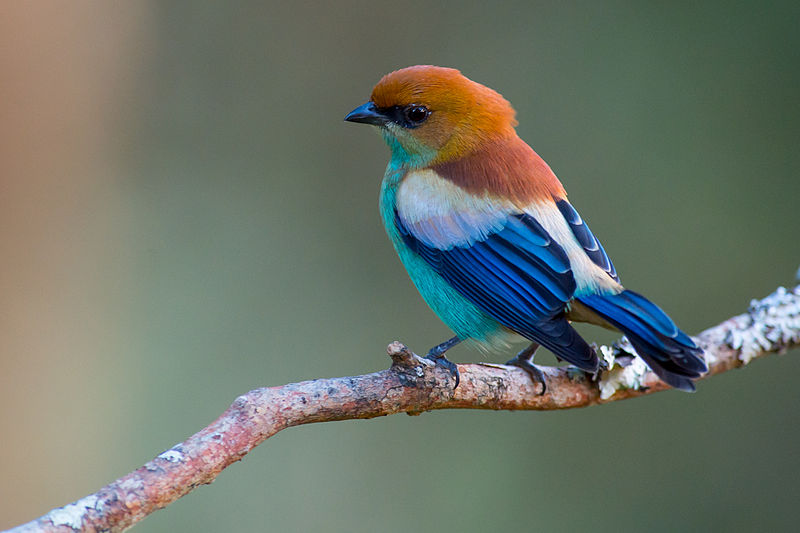
ANIMALS – BIRDS – SONGBIRDS – CHESTNUT-BACKED TANAGER (TANGARA PRECIOSA)


Animals - Birds - Songbirds

Chestnut-backed tanager (Tangara preciosa)


Scientific Classification:

Kingdom : Animalia
Phylum : Chordata
Class : Aves
Order : Passeriformes
Family :Thraupidae
Genus : Tangara
Species :
T. Preciosa


Description:

The Chestnut-backed tanager (Tangara preciosa) is a species of bird in the family Thraupidae. It is found in Atlantic Forest in south-eastern Brazil, north-eastern Argentina, eastern Paraguay, and Uruguay. It is closely related to the rarer black-backed tanager, and females of the two species are indistinguishable. This bird is characterized by its green breast, and chesnut colored back. Before research was completed, this animal was often mistaken for a result of a mutated black-backed tanager ("Tangara peruviana"). It is now known that this is not the case, and though the two species are related, they are not in fact the same species. The tanager is not in any danger, and is plentiful in the areas that it resides in. Further studies show that this animal is non-invasive, which simply means that it will not invade areas other than its own region.


Binomial Name:

Name : Tangara preciosa
Taxonomist : Jean Louis Cabanis (Berlin - Germany)
Year :
1850
Subspecies :
None, or not data available
Synonyms :
None, or not data available


Conservation Status by IUCN:

Status :Least Concern

Has been categorized by the International Union for Conservation of Nature as evaluated but not qualified for any other category. As such they do not qualify as threatened, near threatened, or (prior to 2001) conservation dependent.

Philatelic Issues


1999 - Uruguay - Stamp 3 of 4, from Birds and Trees Series


Issue information:

Country: Uruguay
Date: April 14th, 1999
Printed: 35.000 Copies
Type: Stamp from Series of 4 Stamps
Value:UYP 7

Stamp: Rectangular
Size: 39 mm. x 27 mm.
Perforation: Circular
Gum: Water Activated
viernes, 20 de mayo de 2016

ANIMALS – BIRDS – HUMMINGBIRDS – GLITTERING-BELLIED EMERALD (CHLOROSTILBON LUCIDUS)


Animals - Birds - Songbirds

Glittering-bellied emerald (Chlorostilbon lucidus)


Scientific Classification:

Kingdom : Animalia
Phylum : Chordata
Class : Aves
Order : Apodiformes
Family :Trochilidae
Genus : Chlorostilbon
Species :
C. Lucidus


Description:

The Fawn-breasted tanager (Pipraeidea melanonota) is a species of tanager with a blue head and yellow breast. It is in the genus Pipraeidea, along with the Blue-and-yellow tanager. It occurs in the Andes of northwestern Argentina, Bolivia, Colombia, Ecuador, Peru and Venezuela, as well as in the highlands of northeastern Argentina, south Brazil, Paraguay and Uruguay.


Binomial Name:

Name : Chlorostilbon lucidus
Taxonomist : George Shaw (Bierton - England)
Year :
1812
Subspecies :
None, or not data available
Synonyms :
Chlorostilbon aureoventris


Conservation Status by IUCN:

Status :Least Concern

Has been categorized by the International Union for Conservation of Nature as evaluated but not qualified for any other category. As such they do not qualify as threatened, near threatened, or (prior to 2001) conservation dependent.

Philatelic Issues


1999 - Uruguay - Stamp 2 of 4, from Birds and Trees Series


Issue information:

Country: Uruguay
Date: April 14th, 1999
Printed: 35.000 Copies
Type: Stamp from Series of 4 Stamps
Value:UYP 7

Stamp: Rectangular
Size: 39 mm. x 27 mm.
Perforation: Circular
Gum: Water Activated

jueves, 19 de mayo de 2016

ANIMALS – BIRDS – SONGBIRDS – FAWN-BREASTED TANAGER (PIPRAEIDEA MELANONOTA)


Animals - Birds - Songbirds

Fawn-breasted tanager (Pipraeidea melanonota)


Scientific Classification:

Kingdom : Animalia
Phylum : Chordata
Class : Aves
Order : Passeriformes
Family :Thraupidae
Genus : Pipraeidea
Species :
P. Melanonota


Description:

The Fawn-breasted tanager (Pipraeidea melanonota) is a species of tanager with a blue head and yellow breast. It is in the genus Pipraeidea, along with the Blue-and-yellow tanager. It occurs in the Andes of northwestern Argentina, Bolivia, Colombia, Ecuador, Peru and Venezuela, as well as in the highlands of northeastern Argentina, south Brazil, Paraguay and Uruguay.


Binomial Name:

Name : Pipraeidea melanonota
Taxonomist : Louis Jean Pierre Vieillot (Yvetot - France)
Year :
1819
Subspecies :
None, or not data available
Synonyms :
None, or not data available


Conservation Status by IUCN:

Status :Least Concern

Has been categorized by the International Union for Conservation of Nature as evaluated but not qualified for any other category. As such they do not qualify as threatened, near threatened, or (prior to 2001) conservation dependent.

Philatelic Issues


1999 - Uruguay - Stamp 1 of 4, from Birds and Trees Series


Issue information:

Country: Uruguay
Date: April 14th, 1999
Printed: 35.000 Copies
Type: Stamp from Series of 4 Stamps
Value:UYP 7

Stamp: Rectangular
Size: 39 mm. x 27 mm.
Perforation: Circular
Gum: Water Activated

jueves, 12 de mayo de 2016

ANIMALS – BIRDS – SONGBIRDS – GOLDEN-WINGED CACIQUE (CACICUS CHRYSOPTERUS)


Animals - Birds - Songbirds

Golden-winged cacique (Cacicus chrysopterus)


Scientific Classification:

Kingdom : Animalia
Phylum : Chordata
Class : Aves
Order : Passeriformes
Family :Icteridae
Genus : Cacicus
Species :
C. Chrysopterus


Description:

The Golden-winged cacique(Cacicus chrysopterus) is a species of birdin the family Icteridae. It is found in Argentina, Bolivia, Brazil, Paraguay, and Uruguay.

Its natural habitats are subtropical or tropical moist lowland forests and subtropical or tropical moist montane forests.


Binomial Name:

Name : Cacicus chrysopterus
Taxonomist : Nicholas Aylward Vigors (Old Leighlin - Ireland)
Year :
1825
Subspecies :
None, or not data available
Synonyms :
None, or not data available


Conservation Status by IUCN:

Status :Least Concern

Has been categorized by the International Union for Conservation of Nature as evaluated but not qualified for any other category. As such they do not qualify as threatened, near threatened, or (prior to 2001) conservation dependent.

Philatelic Issues


2000 - Uruguay - Stamp 4 of 4, from Birds Series


Issue information:

Country: Uruguay
Date: September 27th, 2000
Printed: 25.000 Copies
Type: Stamp from Series of 4 Stamps
Value:UYP 5

Stamp: Rectangular
Size: 35 mm. x 22 mm.
Perforation: Circular
Gum: Water Activated

miércoles, 11 de mayo de 2016

ANIMALS – BIRDS – SONGBIRDS – FRECKLE-BREASTED THORNBIRD (PHACELLODOMUS STRIATICOLLIS)


Animals - Birds - Songbirds

Freckle-breasted thornbird (Phacellodomus striaticollis)


Scientific Classification:

Kingdom : Animalia
Phylum : Chordata
Class : Aves
Order : Passeriformes
Family :Furnariidae
Genus : Phacellodomus
Species :
P. Striaticollis


Description:

The Freckle-breasted thornbird (Phacellodomus striaticollis) is a species of bird in the Furnariidae family. It is found in Argentina, Bolivia, Brazil, and Uruguay. Its natural habitats are subtropical or tropical moist lowland forests, subtropical or tropical dry shrubland, and subtropical or tropical moist shrubland.


Binomial Name:

Name : Phacellodomus striaticollis
Taxonomist : Alcide d'Orbigny (Couëron - France) & Frédéric de Lafresnaye (Falaise - France)
Year :
1838
Subspecies :
None, or not data available
Synonyms :
None, or not data available


Conservation Status by IUCN:

Status :Least Concern

Has been categorized by the International Union for Conservation of Nature as evaluated but not qualified for any other category. As such they do not qualify as threatened, near threatened, or (prior to 2001) conservation dependent.

Philatelic Issues


2000 - Uruguay - Stamp 3 of 4, from Birds Series


Issue information:

Country: Uruguay
Date: September 27th, 2000
Printed: 25.000 Copies
Type: Stamp from Series of 4 Stamps
Value:UYP 4

Stamp: Rectangular
Size: 35 mm. x 22 mm.
Perforation: Circular
Gum: Water Activated

martes, 10 de mayo de 2016

ANIMALS – BIRDS – SONGBIRDS – COMMON MINER (GEOSITTA CUNICULARIA)


Animals - Birds - Songbirds

Common miner (Geositta cunicularia)


Scientific Classification:

Kingdom : Animalia
Phylum : Chordata
Class : Aves
Order : Passeriformes
Family :Furnariidae
Genus : Geositta
Species :
G. Cunicularia


Description:

The Common miner(Geositta cunicularia) is a passerine birdof South America, belonging to the ovenbird family. It is a ground-dwelling bird which feeds on insects and seeds. It has about 9 different subspecies, some of which may be better treated as separate species.

It is 14 to 16 cm long with a fairly long, slightly downcurved bill. The plumage varies geographically but is basically brown above and pale below with a streaked breast, pale stripe over the eye, dark edge to the ear-coverts and pale rufous bar across the wing. The tail is dark with a buff base and variable amounts of buff on the outer feathers. The trilling song is often given in flight and also varies geographically.

The species occurs in open habitats such as grassland, sand dunes and beaches from sea-level to high in the Andes. It is widespread and sometimes common across much of Chile, Argentina and Uruguay, parts of Peru and Bolivia and in southernmost Brazil. In winter there is some northward migration by southern birds with a few reaching Paraguay.

The bird lays two or three white eggs in a chamber at the end of a tunnel, up to 3 metres long, dug into an earth bank or sand dune.


Binomial Name:

Name : Geositta cunicularia
Taxonomist : Louis Jean Pierre Vieillot (Yvetot - France)
Year :
1816
Subspecies :
None, or not data available
Synonyms :
None, or not data available


Conservation Status by IUCN:

Status :Least Concern

Has been categorized by the International Union for Conservation of Nature as evaluated but not qualified for any other category. As such they do not qualify as threatened, near threatened, or (prior to 2001) conservation dependent.

Philatelic Issues


2000 - Uruguay - Stamp 2 of 4, from Birds Series


Issue information:

Country: Uruguay
Date: September 27th, 2000
Printed: 25.000 Copies
Type: Stamp from Series of 4 Stamps
Value:UYP 4

Stamp: Rectangular
Size: 35 mm. x 22 mm.
Perforation: Circular
Gum: Water Activated

lunes, 9 de mayo de 2016

ANIMALS – BIRDS – SONGBIRDS – LONG-TAILED REED FINCH (DONACOSPIZA ALBIFRONS)


Animals - Birds - Songbirds

Long-tailed reed finch (Donacospiza albifrons)


Scientific Classification:

Kingdom : Animalia
Phylum : Chordata
Class : Aves
Order : Passeriformes
Family :Emberizidae
Genus : Donacospiza
Species :
D. Albifrons


Description:

The Long-tailed reed finch(Donacospiza albifrons) is a species of birdtraditionally placed in the Emberizidaefamily. It has been suggested though that its nearest relations may be the finch-like tanagers of the genus Poospiza in the family Thraupidae. It is the only member of its genus, Donacospiza.

It is found in Argentina, Bolivia, Brazil, Paraguay, and Uruguay. Its natural habitats are temperate grassland, subtropical or tropical seasonally wet or flooded lowland grassland, and swamps.


Binomial Name:

Name : Donacospiza albifrons
Taxonomist : Louis Jean Pierre Vieillot (Yvetot - France)
Year :
1817
Subspecies :
None, or not data available
Synonyms :
None, or not data available


Conservation Status by IUCN:

Status :Least Concern

Has been categorized by the International Union for Conservation of Nature as evaluated but not qualified for any other category. As such they do not qualify as threatened, near threatened, or (prior to 2001) conservation dependent.

Philatelic Issues


2000 - Uruguay - Stamp 1 of 4, from Birds Series


Issue information:

Country: Uruguay
Date: September 27th, 2000
Printed: 25.000 Copies
Type: Stamp from Series of 4 Stamps
Value:UYP 5

Stamp: Rectangular
Size: 35 mm. x 22 mm.
Perforation: Circular
Gum: Water Activated

sábado, 5 de marzo de 2016

ANIMALS – BIRDS – SEABIRDS – BLACK-BROWED ALBATROSS (THALASSARCHE MELANOPHRIS)


Animals - Birds - Seabirds

Black-browed Albatross (Thalassarche melanophris)


Scientific Classification:

Kingdom : Animalia
Phylum : Chordata
Class : Aves
Order : Procellariiformes
Family : Diomedeidae
Genus : Thalassarche
Species :
T. Melanophris


Description:


The Black-browed albatross(Thalassarche melanophris), also known as theBlack-browed mollymawk, is a large seabird of the albatross family Diomedeidae; it is the most widespread and common member of its family.

Mollymawks are albatrosses in the family Diomedeidae and order Procellariiformes, which also includes shearwaters, fulmars, storm petrels, and diving petrels. These birds share certain identifying features. They have nasal passages that attach to the upper bill called naricorns, although the nostrils on the albatross are on the sides of the bill. The bills of Procellariiformes are also unique in that they are split into between seven and nine horny plates. They produce a stomach oil made up of wax esters and triglycerides that is stored in the proventriculus. This is used against predators as well as being an energy-rich food source for chicks and also for the adults during their long flights. The albatross also has a salt gland above the nasal passage which helps to remove salt from the ocean water that they imbibe. The gland excretes a high saline solution through the bird's nose.

The black-browed albatross was first described as Diomedea melanophrisby Coenraad Jacob Temminck, in 1828, based on a specimen from the Cape of Good Hope.

The black-browed albatross is a medium-sized albatross, at 80 to 95 cm (31–37 in) longwith a 200 to 240 cm (79–94 in) wingspan and an average weight of 2.9 to 4.7 kg (6.4–10.4 lb). It can have a natural lifespan of over 70 years. It has a dark grey saddle and upperwings that contrast with the white rump, and underparts. The underwing is predominantly white with broad, irregular, black margins. It has a dark eyebrow and a yellow-orange bill with a darker reddish-orange tip. Juveniles have dark horn-colored bills with dark tips, and a grey head and collar. They also have dark underwings. The features that distinguish it from other mollymawks (except the closely related Campbell albatross) are the dark eyestripe which gives it its name, a broad black edging to the white underside of its wings, white head and orange bill, tipped darker orange.


Binomial Name:

Name : Thalassarche melanophris
Taxonomist :
Coenraad Jacob Temminck (Amsterdam - Netherlands)
Year :
1828
Subspecies : 
None, or not data available
Synonyms :
Diomedea melanophris


Conservation Status by IUCN:

Status : Near-threatened species

A Near-threatened speciesis a species which has been categorized as "Near Threatened" (NT)by the International Union for Conservation of Nature as that may be considered threatened with extinction in the near future, although it does not currently qualify for the threatened status. The IUCN notes the importance of re-evaluating near-threatened taxa at appropriate intervals.


Philatelic Issues


2004 – Uruguay – Stamp 4 of 4, from Seabirds Series


Issue information:

Country: Uruguay
Date: January 22nd, 20
Printed: 15.000 copies
Type : Stamp from Series of 4 Stamps
Value :
UYP 14

Stamp : Rectangular
Size: 27 mm. x 39 mm.
Perforation: Circular
Gum: Water Activated

viernes, 4 de marzo de 2016

ANIMALS – BIRDS – SEABIRDS – CAPE PETREL (DAPTION CAPENSE)


Animals - Birds - Seabirds

Cape petrel (Daption capense)


Scientific Classification:

Kingdom : Animalia
Phylum : Chordata
Class : Aves
Order : Procellariiformes
Family : Procellariidae
Genus :Daption 
Species :
D. Capense


Description:

The Cape petrel(Daption capense), also called the Cape pigeon, Pintado petrel, or Cape fulmar, is a common seabirdof the Southern Ocean from the family Procellariidae. It is the only member of the genus Daption, and is allied to the fulmarine petrels, and the giant petrels. They are extremely common seabirds with an estimated population of around 2 million.

The Cape petrel is the only known member of the genus Daption and is in turn a member of the family Procellariidae and order Procellariiformes. There appears to be a subgroup within the family consisting of the giant petrels, the members of Fulmarus, the Antarctic petrel, and the snow petrel.

All Procellariiformes share certain identifying features. First, they have nasal passages that attach to the upper bill called naricorns. The bills of Procellariiformes are also unique in that they are split into between seven and nine horny plates. They produce a stomach oil made up of wax esters and triglycerides that is stored in the proventriculus. This can be sprayed out of their mouths as a defence against predators and as an energy rich food source for chicks and for the adults during their long flights. Finally, they also have a salt gland that is situated above the nasal passage and helps desalinate their bodies, due to the high amount of ocean water that they imbibe. It excretes a high saline solution from their nose.

The Cape petrel is a unique looking petrel. It has a black head and neck, and a white belly, breast, and its underwing is white with a black border. Its back, and upperwings are black and white speckled, as is its tail which also has a band of black. When fully grown, their wings span 86 cm (34 in)and they are 39 cm (15 in) long.


Binomial Name:

Name : Daption capense
Taxonomist :
Carl Linnaeus (Småland - Sweden)
Year :
1758
Subspecies :
2 (Capense, Australe)
Synonyms : 
None, or not data available


Conservation Status by IUCN:

Status :Least Concern

Has been categorized by the International Union for Conservation of Nature as evaluated but not qualified for any other category. As such they do not qualify as threatened, near threatened, or (prior to 2001) conservation dependent.


Philatelic Issues


2004 – Uruguay – Stamp 3 of 4, from Seabirds Series


Issue information:

Country: Uruguay
Date: January 22nd, 20
Printed: 15.000 copies
Type : Stamp from Series of 4 Stamps
Value :
UYP 14

Stamp : Rectangular
Size: 27 mm. x 39 mm.
Perforation: Circular
Gum: Water Activated

jueves, 3 de marzo de 2016

ANIMALS – BIRDS – SEABIRDS – NORTHERN GIANT PETREL (MACRONECTES HALLI)


Animals - Birds - Seabirds

Northern giant petrel (Macronectes halli)


Scientific Classification:

Kingdom : Animalia
Phylum : Chordata
Class : Aves
Order : Procellariiformes
Family : Procellariidae
Genus : Macronectes
Species :
M. Halli


Description:

The Northern giant petrel (Macronectes halli), also known as the Hall's giant petrel, is a large predatory seabird of the southern oceans. Its distribution overlaps broadly with the similar southern giant petrel, though it overall is centred slightly further north.

The northern giant petrel along with its counterpart, the southern giant petrel, make up the Macronectes genus. They come from the Procellariiformes order, which are referred to as tube-nosed seabirds, due to their unique nose structure. All tube-noses have tubular nostrils, and all Procellariidae have the openings on top of the upper portion of the bill. Procellariiformes also have between seven and nine distinct horny plates for their bill, and petrels have one of these plates that form the hooked portion of their upper bill called their maxillary unguis. They produce a stomach oil made up of wax esters and triglycerides that is stored in the proventriculus. This can be sprayed out of their mouths as a defence against predators as well as an energy rich food source for chicks and for the adults during their long flights. Finally, they also have a salt gland that is situated above the nasal passage and helps desalinate their bodies, due to the high amount of ocean water that they imbibe. It excretes a concentrated saline solution from their nostrils.

The northern giant petrel averages 90 cm (35 in) in length, with a range of 80 to 95 cm (31 to 37 in), possessing a wingspan of 150 to 210 cm (59 to 83 in). Size is somewhat variable and this species is broadly the same size as its southern sister species. The largest-bodied colony is in the South Georgia Islands, where 56 males averaged 4.9 kg (11 lb) and 43 females average 3.72 kg (8.2 lb). The smallest-bodied are on the Chatham Islands, where 19 males averaged 3.66 kg (8.1 lb) and 21 females averaged 2.83 kg (6.2 lb). Overall, weight for the species can range from 2.5 to 5.8 kg (5.5 to 12.8 lb). Its plumage consists of grey-brown body with lighter colored forehead, sides of face, and chin. Its bill is between 90 and 110 mm (3.5–4.3 in) long, being slightly longer on average than the southern giant petrel, and is pinkish yellow with a brown tip, and its eyes are grey.


Binomial Name:

Name : Macronectes halli
Taxonomist :
Gregory Mathews (Australia)
Year :
1912
Subspecies : 
None, or not data available
Synonyms :
None, or not data available

Conservation Status by IUCN:

Status :Least Concern

Has been categorized by the International Union for Conservation of Nature as evaluated but not qualified for any other category. As such they do not qualify as threatened, near threatened, or (prior to 2001) conservation dependent.


Philatelic Issues


2004 – Uruguay – Stamp 2 of 4, from Seabirds Series


Issue information:

Country: Uruguay
Date: January 22nd, 20
Printed: 15.000 copies
Type : Stamp from Series of 4 Stamps
Value :
UYP 14

Stamp : Rectangular
Size: 27 mm. x 39 mm.
Perforation: Circular
Gum: Water Activated

martes, 1 de marzo de 2016

ANIMALS – BIRDS – SEABIRDS – GREAT SHEARWATER (ARDENNA GRAVIS)


Animals - Birds - Seabirds

Great shearwater (Ardenna gravis)


Scientific Classification:

Kingdom : Animalia
Phylum : Chordata
Class : Aves
Order : Procellariiformes
Family : Procellariidae
Genus : Ardenna
Species :
A. Gravis


Description:

The Great shearwater(Ardenna gravis; formerly Puffinus gravis) is a large shearwater in the seabirdfamily Procellariidae. Its relationships are unclear. It belongs in the group of large species that have been separated as genus Ardenna (Penhallurick & Wink 2004); within these, it might be allied with the other black-billed, blunt-tailed species, the short-tailed shearwater and especially the sooty shearwater (Austin 1996, Heidrich et al. 1998). Alternatively (Austin 1996, Austin et al. 2004), it could be a monotypic subgenus (Ardenna sensu stricto), an Atlantic representative of the light-billed Hemipuffinus group (pink-footed shearwater and flesh-footed shearwater).

This species breeds on Nightingale Island, Inaccessible Island, Tristan da Cunha, and Gough Island. It is one of only a few bird species to migrate from breeding grounds in the Southern Hemisphere to the Northern Hemisphere, the normal pattern being the other way round. This shearwater nests in large colonies, laying one white egg in a small burrow or in the open grass. These nests are visited only at night to avoid predation by large gulls.

This shearwater is 43–51 cm in length with a 105–122 cm wingspan. It is identifiable by its size, dark upperparts, and underparts white except for a brown belly patch and dark shoulder markings. It has a black cap, black bill, and a white "horseshoe" on the base of the tail. The stiff flight, like a large Manx shearwater, is also distinctive. The only other large shearwater in its range is the all-dark sooty shearwater.


Binomial Name:

Name : Ardenna gravis
Taxonomist :
O'Reilly
Year :
1818
Subspecies : 
None or not data available
Synonyms :
Puffinus gravis, Procellaria gravis


Conservation Status by IUCN:

Status :Least Concern

Has been categorized by the International Union for Conservation of Nature as evaluated but not qualified for any other category. As such they do not qualify as threatened, near threatened, or (prior to 2001) conservation dependent.


Philatelic Issues


2004 – Uruguay – Stamp 1 of 4, from Seabirds Series


Issue information:

Country: Uruguay
Date: January 22nd, 20
Printed: 15.000 copies
Type : Stamp from Series of 4 Stamps
Value :
UYP 14

Stamp : Rectangular
Size: 27 mm. x 39 mm.
Perforation: Circular
Gum: Water Activated

sábado, 6 de febrero de 2016

ANIMALS – BIRDS – SONGBIRDS – PLUSH-CRESTED JAY (CYANOCORAX CHRYSOPS)


Animals - Birds - Songbirds

Plush-crested jay (Cyanocorax chrysops)


Scientific Classification:

Kingdom : Animalia
Phylum : Chordata
Class : Aves
Order : Passeriformes
Family :Corvidae
Genus : Cyanocorax
Species :
C. Chrysops


Description:

The Plush-crested jay(Cyanocorax chrysops) is a jay of the family Corvidae(which includes the crows and their many allies). It is found in central-southern South America: in southwestern Brazil, Bolivia, Paraguay, Uruguay, and northeastern Argentina, including southern regions of the Amazon Basin river systems bordering the Pantanal.

This is an elegant medium-sized bird, dark plumaged with a cream-yellow breast; the bulky tail is also cream colored, top and underneath, for the lower half.

The range of the plush-crested jay extends from the Southern Region, Brazil with Uruguay and approaches the South Atlantic coast, but avoids the coast, approximating a 400 to 150 km coastal strip; the coastal-inland range extends 3500 km from São Paulo south to Rio Grande do Sul bordering Uruguay. The inland range continues in northwestern Uruguay and extends northwest through northern Argentina, Paraguay–Bolivia, and through the pantanal at the southern cerrado; the range extends in two arms, to the northwest to northern Bolivia, and northeastwards to headwaters of the Amazon Basin Tapajós River.

In the Amazon Basin, central Bolivia is the northwest range limit, the headwater tributaries to the north-northeast flowing Madeira River; the next range skips the Guaporé River, (a northwest-flowing tributary to the Madeira), eastwards on the Brazil–Bolivia border, and is next found at the headwaters of the Tapajós River, and joins on the east the extreme headwaters of the Xingu River.

A disjunct range occurs downstream on the Tapajós and east towards the Xingu River, a block 850 by 750 kilometres (530 mi × 470 mi). Two other localized populations occur in the Amazon Basin, one on the Amazon River, the other on the downstream Madeira River.


Binomial Name:

Name : Cyanocorax chrysops
Taxonomist : Louis Jean Pierre Vieillot (Yvetot - France)
Year :
1818
Subspecies :
None, or no data available
Synonyms : None, or no data available


Conservation Status by IUCN:

Status : Least Concern

Has been categorized by the International Union for Conservation of Nature as evaluated but not qualified for any other category. As such they do not qualify as threatened, near threatened, or (prior to 2001) conservation dependent.


Philatelic Issues


2008 – Uruguay – Stamp 2 of 2, from Mercosur Series


Issue information:

Country: Uruguay
Date: June 20th, 2008
Printed: 15.000 Copies
Type: Stamp from Series of 2 Stamps
Value: UYP 37

Stamp: Rectangular
Size: 27 mm. x 39 mm.
Perforation: Circular
Gum: Water Activated

viernes, 5 de febrero de 2016

ANIMALS – BIRDS – SONGBIRDS – HEPATIC TANAGER (PIRANGA FLAVA)


Animals - Birds - Songbirds

Hepatic Tanager (Piranga flava)


Scientific Classification:

Kingdom : Animalia
Phylum : Chordata
Class : Aves
Order : Passeriformes
Family :Cardinalidae
Genus : Piranga
Species :
P. Flava


Description:

The Hepatic tanager(Piranga flava) is a medium-sized American songbird. Formerly placed in the tanager family (Thraupidae), it and other members of its genus are now classified in the cardinal family (Cardinalidae). The species's plumage and vocalizations are similar to other members of the cardinal family.

The common name hepatic means "liver-coloured", namely, brownish-red. The specific name flāva is Latin for yellow or golden.

The habits of the hepatic tanager are similar to those of the western tanager. It ranges from the southwestern United States (Arizona, New Mexico, and locally in southern California and Colorado) to northern Argentina.

Members of the northern group are larger and stockier than other Piranga tanagers and have a relatively short tail and a stout bill. Its brightest color is always on its forehead and throat. In all plumages, it has gray flanks, dusky cheeks, and a dark eye streak. The female is yellow, and the male is red. Its average weight is 38 g (1.3 oz). Its average wingspan is 31.8 cm (12.5 in) andlength is 20.3 cm (8.0 in).

Its call is a low, dry chup like the hermit thrush. Its song is clearer than Thraupidae tanagers and far more similar to the song of the black-headed grosbeak, another member of the Cardinalidae. The flight call is a husky and rising weet.

It looks for food in the foliage of trees, moving slowly and methodically; different individuals use different strategies. In summer, the northern form largely eats insects, spiders and some fruit. In Mexico, it has been observed to eat nectar. From Oaxaca south, it follows swarms of army ants.


Binomial Name:

Name : Piranga flava
Taxonomist : Louis Jean Pierre Vieillot (Yvetot - France)
Year :
1822
Subspecies :
None, or no data available
Synonyms : Piranga hepatica


Conservation Status by IUCN:

Status : Least Concern

Has been categorized by the International Union for Conservation of Nature as evaluated but not qualified for any other category. As such they do not qualify as threatened, near threatened, or (prior to 2001) conservation dependent.


Philatelic Issues


2008 – Uruguay – Stamp 1 of 2, from Mercosur Series


Issue information:

Country: Uruguay
Date: June 20th, 2008
Printed: 15.000 Copies
Type: Stamp from Series of 2 Stamps
Value: UYP 12

Stamp: Rectangular
Size: 39 mm. x 27 mm.
Perforation: Circular
Gum: Water Activated

miércoles, 3 de febrero de 2016

ANIMALS – BIRDS – SEABIRDS – BROWN SKUA (STERCORARIUS ANTARCTICUS)


Animals - Birds - Seabirds

Brown skua (Stercorarius antarcticus)


Scientific Classification:

Kingdom : Animalia
Phylum : Chordata
Class : Aves
Order : Charadriiiformes
Family :Stercoriidae
Genus : Stercorarius
Species :
S. Antarcticus


Description:

The Brown skua(Stercorarius antarcticus), also known as the Antarctic skua, subantarctic skua, southern great skua, southern skua, or hākoakoa (Māori), is a large seabird that breeds in the subantarctic and Antarctic zones and moves further north when not breeding. Its taxonomy is highly complex and a matter of dispute, with some splitting it into two or three species: Falkland skua (S. antarcticus), Tristan skua (S. hamiltoni), and subantarctic skua (S. lönnbergi). To further confuse, it hybridizes with both the south polar and Chilean skuas, and the entire group has been considered to be a subspecies of the great skua, a species otherwise restricted to the Northern Hemisphere.

It feeds on fish (often via kleptoparasitism), other birds, small mammals, eggs and carrion.

This is the heaviest species of skua and rivals the largest gulls, the great black-backed gull and glaucous gull, as the heaviest species in the shorebird order although not as large in length or wingspan. It is 52–64 cm (20–25 in) in length, 126–160 cm (50–63 in) in wingspan and has abody mass of 1.2–2.18 kg (2.6–4.8 lb). S. a. hamiltoni measured on Gough Island, weighed an average of 1.43 kg (3.2 lb) in 9 males and 1.65 kg (3.6 lb) in 9 females. S. a. lönnbergi measured in the Chatham Islands weighed an average of 1.73 kg (3.8 lb) in 30 males and an average of 1.93 kg (4.3 lb) in 32 females. The latter is the highest colony mean body mass for any living species of shorebird.


Binomial Name:

Name : Stercorarius antarcticus
Taxonomist : René Primevère Lesson (Rochefort - France)
Year :
1831
Subspecies :
3 (Antarticus, Hamiltoni, Ionnbergi)
Synonyms :
Catharacta antarctica


Conservation Status by IUCN:

Status : Least Concern

Has been categorized by the International Union for Conservation of Nature as evaluated but not qualified for any other category. As such they do not qualify as threatened, near threatened, or (prior to 2001) conservation dependent.


Philatelic Issues


2008 – Uruguay – Stamp 1 of 2, from Spring Series


Issue information:

Country: Uruguay
Date: October 7th, 2008
Printed: 10.000 Copies
Type: Stamp from Series of 2 Stamps
Value:UYP 20

Stamp: Rectangular
Size: 35 mm. x 22 mm.
Perforation: Circular
Gum: Water Activated

sábado, 30 de enero de 2016

ANIMALS – BIRDS – WOODPECKERS – GREEN-BARRED WOODPECKER (COLAPTES MELANOCHLOROS)


Animals - Birds - Woodpeckers

Green-barred woodpecker (Colaptes melanochloros)


Scientific Classification:

Kingdom : Animalia
Phylum : Chordata
Class : Aves
Order : Piciiformes
Family :Picidae
Genus : Colaptes
Species :
C. Melanochloros


Description:

The Green-barred woodpecker (Colaptes melanochloros) is a species of bird in the Picidae family. The scientific name melanochloros derives from the Greek melanos, meaning "black", and chloros, "pale green", the principal colors of this bird. The golden-breasted woodpecker is sometimes included here as the southern group of subspecies and sometimes treated as a distinct species, C. melanolaimus.

C. melanochloros (including the golden-breasted woodpecker) is found in Argentina, Bolivia, Brazil, Paraguay, and Uruguay. Its natural habitats are subtropical or tropical dry forests and subtropical or tropical moist lowland forests.


Binomial Name:

Name : Colaptes melanochloros
Taxonomist : Johann Friedrich Gmelin (Tübingen - Germany)
Year :
1788
Subspecies :
None or not data available
Synonyms :
None or not data available


Conservation Status by IUCN:

Status : Least Concern

Has been categorized by the International Union for Conservation of Nature as evaluated but not qualified for any other category. As such they do not qualify as threatened, near threatened, or (prior to 2001) conservation dependent.


Philatelic Issues


2009 – Uruguay – Stamp 4 of 4, from Spring Series


Issue information:

Country: Uruguay
Date: October 13th, 2009
Printed: 15.000 Copies
Type: Stamp from Series of 4 Stamps
Value: UYP 12

Stamp: Rectangular
Size: 39 mm. x 27 mm.
Perforation: Circular
Gum: Water Activated

viernes, 29 de enero de 2016

ANIMALS – BIRDS – SONGBIRDS – MANY-COLOURED RUSH TYRANT (TACHURIS RUBRIGASTRA)


Animals - Birds - Songbirds

Many-coloured Rush Tyrant (Tachuris rubrigastra)


Scientific Classification:

Kingdom : Animalia
Phylum : Chordata
Class : Aves
Order : Passeriformes
Family :Tyrannidae
Genus : Tachuris
Species :
T. Rubrigastra


Description:

The Many-coloured rush tyrant (Tachuris rubrigastra) or Many-colored rush tyrant is a small passerine bird of South America belonging to the tyrant flycatcher family. It is the only member of the genus Tachurisand its relationships with the other members of the family are uncertain. It inhabits marshland and reedbeds around lakes and rivers. It is particularly associated with stands of Scirpus. The nest is built among plant stems.

There are four subspecies: T. r. rubrigastra is the most widespread, occurring from south-east Brazil to southern Argentina and central Chile. T. r. alticola is found in the Andes of south-east Peru, west Bolivia and north-west Argentina. T. r. libertatis is found in coastal Peru while T. r. loaensis is restricted to Antofagasta Region in northern Chile.

It is a small bird, 10.5 cm in length. The tail is short, the wings are short and rounded and the bill is slender. As the bird's name suggests, the plumage is very colorful. The back and rump are green while the underparts are yellow apart from the white throat, black breastband and red undertail-coverts. The face is dark blue-grey, there is a yellow stripe over the eye and the crown is dark with a red patch that is often concealed. The wings and tail are dark with a white wingbar and white outer tail-feathers. Juveniles are considerably duller than the adults.


Binomial Name:

Name : Tachuris rubrigastra
Taxonomist : Louis Jean Pierre Vieillot (Yvetot - France)
Year :
1817
Subspecies :
4 (Rubigastra, Alticola, Libertatis, Ioaensis)
Synonyms :
Sylvia rubrigastra


Conservation Status by IUCN:

Status : Least Concern

Has been categorized by the International Union for Conservation of Nature as evaluated but not qualified for any other category. As such they do not qualify as threatened, near threatened, or (prior to 2001) conservation dependent.


Philatelic Issues


2009 – Uruguay – Stamp 3 of 4, from Spring Series


Issue information:

Country: Uruguay
Date: October 13th, 2009
Printed: 15.000 Copies
Type: Stamp from Series of 4 Stamps
Value: UYP 15

Stamp: Rectangular
Size: 39 mm. x 27 mm.
Perforation: Circular
Gum: Water Activated

lunes, 25 de enero de 2016

ANIMALS – BIRDS – CUCKOOS – GUIRA CUCKOO (GUIRA GUIRA)


Animals - Birds - Cuckoos

Guira cuckoo (Guira guira)


Scientific Classification:

Kingdom : Animalia
Phylum : Chordata
Class : Aves
Order : Cuculiformes
Family :Cuculidae
Genus : Guira
Species :
G. Guira


Description:

The Guira cuckoo (Guira guira) is a social, non-parasitic cuckoo found widely in open and semi-open habitats of eastern and southern Brazil, Uruguay, Paraguay, Bolivia, and north-eastern Argentina. It is monotypic within the genus Guira, and is related to the anis.

The species has whitish-buff underparts and rump, dark brownish upperparts, a broadly white-tipped dark tail that is relatively long, an orange-rufous crest, bare yellow ocular-skin (commonly fades in captivity), and a relatively heavy, orange-yellow bill. It is generally rather shaggy-looking and has a total length of approximately 34 cm (13 in). Like other members of the subfamily Crotophaginae, the guira cuckoo gives off a strong, pungent odour.

The guira cuckoo is arboreal, but can frequently be seen on the ground, usually in flocks of 6 to 18 individuals. It is sometimes seen with other birds such as the smooth-billed ani (Crotophaga ani) whose behavior is similar.


Binomial Name:

Name : Guira guira
Taxonomist : Johann Friedrich Gmelin (Tübingen - Germany)
Year :
1788
Subspecies :
5 (Rufus, Albogularis, Commersoni, Paraguayae, Schumacheri)
Synonyms :
None or not data available


Conservation Status by IUCN:

Status :Least Concern

Has been categorized by the International Union for Conservation of Nature as evaluated but not qualified for any other category. As such they do not qualify as threatened, near threatened, or (prior to 2001) conservation dependent.


Philatelic Issues


2010 - Uruguay - Stamp 3 of 4, from Spring Series


Issue information:

Country: Uruguay
Date: September 30th, 2010
Printed: 15.000 Copies
Type: Stamp from Series of 4 Stamps
Value: UYP 12

Stamp: Rectangular
Size: 39 mm. x 27 mm.
Perforation: Circular
Gum: Water Activated