Mostrando entradas con la etiqueta Arthropoda. Mostrar todas las entradas

domingo, 17 de abril de 2016

ANIMALS – INSECTS – BEES – WESTERN HONEY BEE (APIS MELLIFERA)


Animals - Insects - Bees

Western Honey Bee (Apis mellifera)


Scientific Classification:

Kingdom : Animalia
Phylum : Arthropoda
Class : Insecta
Order : Hymenoptera
Family :Apdae
Genus : Apis
Species :
A. Mellifera


Description:

The Western honey beeor European honey bee(Apis mellifera) is a species of honey bee. The genus name Apis is Latin for "bee", and mellifera means "honey-bearing". It has a defined social caste system and complex communication behaviors, such as intricate dance routines to indicate food availability. It is frequently maintained by beekeepers for its honey product. This species is widely distributed and an important pollinator for agriculture, though it is currently threatened by colony collapse disorder. It is also an important organism for scientific studies on social insects, especially as it now has a fully sequenced genome.

The western honey bee isnative to Europe, Asia and Africa. During the early 1600s it was introduced to North America, with other European subspecies introduced two centuries later. Since then, it has spread throughout the Americas.

Western honey bees evolved into geographic races as they spread from Africa into Eurasia, and 28 subspecies based on these geographic variations are recognized. All races are cross-fertile, although reproductive adaptations may make interbreeding unlikely. The subspecies are divided into four major branches, based on work by Ruttner and confirmed by mitochondrial DNA analysis. African subspecies belong to branch A, northwestern European subspecies branch M, southwestern European subspecies branch C and Mideastern subspecies branch O. These subspecies are listed and grouped in the sidebar. Regions with local variations may be identified as subspecies in the future; A. m. pomonella, from the Tian Shan, would be included in the Mideastern subspecies branch.

Geographic isolation led to adaptation as honey bees spread after the last ice age. These adaptations include brood cycles synchronized to the blooming period of local flora, forming a winter cluster in colder climates, migratory swarming in Africa and enhanced foraging behavior in desert areas.


Binomial Name:

Name : Apis mellifera
Taxonomist : Carl Linnaeus (Småland - Sweden)
Year :
1758
Subspecies :
Many
Synonyms :
Apis Mellifica


Conservation Status by IUCN:

Status : Not Evaluated, or not data available


Philatelic Issues


2001 – Uruguay – Bees Series


Issue information:

Country: Uruguay
Date: Septermber 12th, 2001
Printed: 15.000 Copies
Type: Complete 2 Stamp Series
Value:
2 * UYP 12 = UYP 24

Stamp: Rectangular
Size: All 35 mm. x 25 mm.
Perforation: Circular
Gum: Water Activated

lunes, 28 de marzo de 2016

ANIMALS – INSECTS – BUTTERFLIES – BUNICHUS PARIDES (PARIDES BUNICHUS)


Animals - Insects - Butterflies

Bunichus Parides (Parides bunichus)


Scientific Classification:

Kingdom : Animalia
Phylum : Arthropoda
Class : Insecta
Order : Lepidoptera
Family :Paplionidae
Genus : Parides
Species :
P. Bunichus


Description:

The Bunichus Parides(Parides bunichus) is a butterflyof the family Papilionidae. It is found in Brazil, Paraguay, Argentina and Uruguay.

The larva is brownish black, with an oblique white band, extending laterally from the 6th segment to the tubercle on the 7th. The pupal stage lasts three weeks.

The butterfly is very common and is one of the earliest spring species (August). From August to April there are at least three generations.


Binomial Name:

Name : Parides bunichus
Taxonomist : Jacob Hübner (Augsburg - Germany)
Year :
1821
Subspecies :
5 (Bunichus, Chamissonia, Damocrates, Diodorus, Perrhebus)
Synonyms : Many


Conservation Status by IUCN:

Status : Not Evaluated, or not data available


Philatelic Issues


2003 – Uruguay – Stamp 4 of 4, from Butterflies Series


Issue information:

Country: Uruguay
Date: March 18th, 2003
Printed: 10.000 Copies
Type: Stamp from Series of 4 Stamps
Value:UYP 12

Stamp: Rectangular
Size: 23 mm. x 35 mm.
Perforation: Circular
Gum: Water Activated

domingo, 20 de marzo de 2016

ANIMALS – INSECTS – BUTTERFLIES – BANDED ORANGE HELICONIAN (DRYADULA PHAETUSA)


Animals - Insects - Butterflies

Banded orange heliconian (Dryadula phaetusa)


Scientific Classification:

Kingdom : Animalia
Phylum : Arthropoda
Class : Insecta
Order : Lepidoptera
Family :Nymphalidae
Genus : Dryadula
Species :
D. Phaetusa


Description:

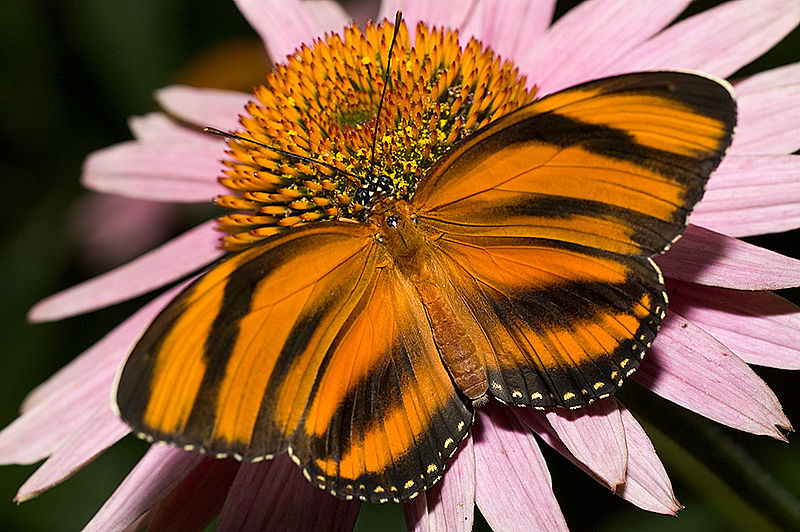
Dryadula is a monotypic genus of the butterflyfamily Nymphalidae. Its single species, Dryadula phaetusa, known as theBanded orange heliconian, Banded orange, or Orange tiger, is native from Brazil to central Mexico, and in summer can be found rarely as far north as central Florida. Its wingspan ranges from 86 to 89 mm, and it is colored a bright orange with thick black stripes in males and a duller orange with fuzzier black stripes in females.

It feeds primarily on the nectar of flowers and on bird droppings; its caterpillar feeds on passion vines including Passiflora tetrastylis. It is generally found in lowland tropical fields and valleys.

This species is unpalatable to birds and belongs to the "orange" Batesian mimicry complex.

Prior to their mating season, males of this species congregate by the hundreds on patches of moist soil that contain mineral salts (mud-puddling). When they cannot find such deposits, the insects visit various animals to drink salty secretions from their skin and nostrils.

The genus Dryadula Michner, 1942, is monotypic; the type species is Papilio phaetusa Linnaeus, 1758 (Syst. Nat. 10 ed., 1: 478). The type locality, given as "Indiis", is supposed to refer to the West Indies or northern South America.


Binomial Name:

Name : Dryadula phaetusa
Taxonomist : Carl Linnaeus (Småland - Sweden)
Year :
1758
Subspecies :
None, or not data available
Synonyms :
None, or not data available


Conservation Status by IUCN:

Status : Not Evaluated, or not data available


Philatelic Issues


2003 – Uruguay – Stamp 3 of 4, from Butterflies Series


Issue information:

Country: Uruguay
Date: March 18th, 2003
Printed: 10.000 Copies
Type: Stamp from Series of 4 Stamps
Value:UYP 12

Stamp: Rectangular
Size: 23 mm. x 35 mm.
Perforation: Circular
Gum: Water Activated

sábado, 19 de marzo de 2016

ANIMALS – INSECTS – BUTTERFLIES – MANGROVE BUCKEYE (JUNONIA EVARETE)


Animals - Insects - Butterflies

Mangrove buckeye (Junonia evarete)


Scientific Classification:

Kingdom : Animalia
Phylum : Arthropoda
Class : Insecta
Order : Lepidoptera
Family :Nymphalidae
Genus : Junonia
Species :
J. Evarete


Description:

The Mangrove buckeye(Junonia evarete) also called West Indian buckeye or tropical buckeye, is a neotropical nymphalid butterfly found from Florida and the Caribbean, Mexico, Central America, to tropical and subtropical South America. The type locality is Surinam, and numerous subspecies have been described. The synonymy is extensive, and older literature must be used with caution. The butterfly is easily confused with Junonia genoveva, which is also known as the mangrove buckeye.


Binomial Name:

Name : Junonia evarete
Taxonomist : Pieter Cramer (Amsterdam - Netherlands)
Year :
17779
Subspecies :
Many
Synonyms :
Many


Conservation Status by IUCN:

Status : Not Evaluated, or not data available


Philatelic Issues


2003 – Uruguay – Stamp 2 of 4, from Butterflies Series


Issue information:

Country: Uruguay
Date: March 18th, 2003
Printed: 10.000 Copies
Type: Stamp from Series of 4 Stamps
Value:UYP 12

Stamp: Rectangular
Size: 23 mm. x 35 mm.
Perforation: Circular
Gum: Water Activated
viernes, 18 de marzo de 2016

ANIMALS – INSECTS – BUTTERFLIES – RED POSTMAN (HELICONIUS ERATO)


Animals - Insects - Butterflies

Red Postman (Heliconius erato)


Scientific Classification:

Kingdom : Animalia
Phylum : Arthropoda
Class : Insecta
Order : Lepidoptera
Family :Nymphalidae
Genus : Heliconius
Species :
H. Erato


Description:

The Red postman(Heliconius erato) is one of about 40 Neotropical species of butterfly belonging to the genus Heliconius. It is also commonly known as the small postman, thered passion flower butterfly, or the crimson-patched longwing.

The species is remarkably variable in colour and form throughout northern South America, depending on location, and its various appearances can be difficult to distinguish from various other Heliconius butterflies such as Heliconius sara, also known as the sara longwing. Particularly hard to distinguish is the related Heliconius melpomene, or "the postman", which mimics almost all the colour forms of Heliconius erato; colour forms are synchronized between the two throughout their common habitats. It is likely the clade containing Heliconius erato radiated first, establishing the wing pattern diversity found in both species of butterfly. Two features found on the underside help to distinguish H. erato from H. melpomene—H. erato has four red dots where the wing attaches to the thorax while H. melpomene has three and the yellowish white stripe on the underside reaches the margin of the hindwing in H. erato but ends early in H. melpomene.

Heliconius erato is up to about5.5–8 cm (2.2–3.1 in) in wingspan with a jerky unelegance in flight.

Like Heliconius charithonia, H. erato is one of the few butterflies that collects and digests pollen, conferring considerable longevity to the adults (several months). Adults roost in groups, returning to the same location each night.

Recent Field work has confirmed the relative abundance of this butterfly.

A recent study, using amplified fragment length polymorphism (AFLP) and mitochondrial DNA (mtDNA) data sets, places the origins of H. erato at 2.8 million years ago. H. erato also shows clustering of AFLPs by geography revealing that H. erato originated in western South America.


Binomial Name:

Name : Heliconius erato
Taxonomist : Carl Linnaeus (Småland - Sweden)
Year :
1758
Subspecies :
Many
Synonyms :
Papilio erato


Conservation Status by IUCN:

Status : Not Evaluated, or not data available


Philatelic Issues


2003 – Uruguay – Stamp 1 of 4, from Butterflies Series


Issue information:

Country: Uruguay
Date: March 18th, 2003
Printed: 10.000 Copies
Type: Stamp from Series of 4 Stamps
Value:UYP 12

Stamp: Rectangular
Size: 23 mm. x 35 mm.
Perforation: Circular
Gum: Water Activated

domingo, 14 de febrero de 2016

ANIMALS – INSECTS – BUTTERFLIES – MARCELLA MARPESIA (MARPESIA MARCELLA)


Animals - Insects - Butterflies

Marcella marpesia (Marpesia marcella)


Scientific Classification:

Kingdom : Animalia
Phylum : Arthropoda
Class : Insecta
Order : Lepidoptera
Family :Nymphalidae
Genus : Marpesia
Species :
M. Marcella


Description:

The Marcella marpesia(Marpesia marcella) is a butterfly of the Nymphalidaefamily. It is found in the Neotropic ecozone and the Nearctic ecozone.


Binomial Name:

Name : Marpesia marcella
Taxonomist : Baron Cajetan von Felder (Wieden - Austria) and Rudolf Felder (Austria)
Year :
1861
Subspecies :
None, or not data available
Synonyms :
None, or not data available


Conservation Status by IUCN:

Status : Not Evaluated, or not data available


Philatelic Issues


2007 – Uruguay – Stamp 4 of 4, from Butterflies Series


Issue information:

Country: Uruguay
Date: October 26th, 2009
Printed: 15.000 Copies
Type: Stamp from Series of 4 Stamps
Value:UYP 20

Stamp: Rectangular
Size: 39 mm. x 27 mm.
Perforation: Circular
Gum: Water Activated

viernes, 12 de febrero de 2016

ANIMALS – INSECTS – BUTTERFLIES – CLAUDINA AGRIAS (AGRIAS CLAUDINA)


Animals - Insects - Butterflies

Claudina Agrias (Agrias claudina)


Scientific Classification:

Kingdom : Animalia
Phylum : Arthropoda
Class : Insecta
Order : Lepidoptera
Family :Nymphalidae
Genus : Agrias
Species :
A. Claudina


Description:

The Claudina Agrias(Agrias claudina) is a butterflyof the Nymphalidaefamily. It is found from Venezuela and Guyana to Bolivia. The subspecies sardanapalus is found in Ecuador, Brazil and Peru. It is found in primary and secondary rainforest at altitudes between 200 and 600 meters.

The larvae feed on Erythroxylum species. Adults feed on decomposing fruit and rotting fish.


Binomial Name:

Name : Agrias claudina
Taxonomist : Jean-Baptiste Godart (Origny - France)
Year :
1824
Subspecies :
8 (Claudina, Annetta, Sardanapalus, … )
Synonyms :
Nymphalis claudina, Papilio claudia, Agrias sahlkei, Agrias claudianus


Conservation Status by IUCN:

Status : Not Evaluated, or not data available


Philatelic Issues


2007 – Uruguay – Stamp 3 of 4, from Butterflies Series


Issue information:

Country: Uruguay
Date: October 26th, 2009
Printed: 15.000 Copies
Type: Stamp from Series of 4 Stamps
Value:UYP 15

Stamp: Rectangular
Size: 39 mm. x 27 mm.
Perforation: Circular
Gum: Water Activated

jueves, 11 de febrero de 2016

ANIMALS – INSECTS – BUTTERFLIES – SUPERB NUMBERWING (CALLICORE EXCELSIOR)


Animals - Insects - Butterflies

Superb Numberwing (Callicore excelsior)


Scientific Classification:

Kingdom : Animalia
Phylum : Arthropoda
Class : Insecta
Order : Lepidoptera
Family :Nymphalidae
Genus : Callicore
Species :
C. Excelsior


Description:

The Superb Numberwingor Excelsior Eighty-eight(Callicore excelsior) is a species of butterflyof the Nymphalidaefamily. It is found in Colombia, Ecuador, Peru, Brazil, and Bolivia.

Adults are black on the upper surface of the wings, with a metallic deep blue sheen on the hindwings, and a broad arc of orange or red on the forewings.


Binomial Name:

Name : Callicore excelsior
Taxonomist : William Chapman Hewitson (Newcastle upon Tyne - England)
Year :
1858
Subspecies :
12 (Excelsior, Inferior, Pastazza, … )
Synonyms :
Many (Catagramma excelsior, ... )


Conservation Status by IUCN:

Status : Not Evaluated, or not data available


Philatelic Issues


2007 – Uruguay – Stamp 2 of 4, from Butterflies Series


Issue information:

Country: Uruguay
Date: October 26th, 2009
Printed: 15.000 Copies
Type: Stamp from Series of 4 Stamps
Value:UYP 10

Stamp: Rectangular
Size: 39 mm. x 27 mm.
Perforation: Circular
Gum: Water Activated

martes, 9 de febrero de 2016

ANIMALS – INSECTS – BUTTERFLIES – BLUE-WINGED EUYRBIA (EURYBIA LYCISCA)


Animals - Insects - Butterflies

Blue-winged Euyrbia (Eurybia lycisca)


Scientific Classification:

Kingdom : Animalia
Phylum : Arthropoda
Class : Insecta
Order : Lepidoptera
Family :Riodinidae
Genus : Eurybia
Species :
E. Lycisca


Description:

The Blue-winged Euyrbia(Eurybia lycisca) is a butterflyof the Riodinidaefamily. It is found in from Mexico to Ecuador, including some Caribbean Islands.

Larvae feen on Calathea lutea, C. crotalifera, C. inocephala, C. latifolia, C. warsczewisczia, and Ischnosiphon pruniosus.


Binomial Name:

Name : Eurybia lycisca
Taxonomist : John Obadiah Westwood (Sheffield - England)
Year :
1851
Subspecies :
None, or no data available
Synonyms :
Eurybia lamia, Eurybia lamia lamia, Eurybia caerulescens palikourea


Conservation Status by IUCN:

Status : Not Evaluated, or not data available


Philatelic Issues


2007 – Uruguay – Stamp 1 of 4, from Butterflies Series


Issue information:

Country: Uruguay
Date: October 26th, 2007
Printed: 15.000 Copies
Type: Stamp from Series of 4 Stamps
Value:UYP 5

Stamp: Rectangular
Size: 39 mm. x 27 mm.
Perforation: Circular
Gum: Water Activated

miércoles, 27 de enero de 2016

ANIMALS – INSECTS – BUTTERFLIES – SCARLET PEACOCK (ANARTIA AMATHEA)


Animals - Insects - Butterflies

Scarlet Peacock (Anartia amathea)


Scientific Classification:

Kingdom : Animalia
Phylum : Arthropoda
Class : Insecta
Order : Lepidoptera
Family :Nymphalidae
Genus : Anartia
Species :
A. Amathea


Description:

The Scarlet peacock(Anartia amathea), also named Brown Peacock, is a species of nymphalid butterfly, found primarily in South America. The type locality is probably Suriname, and the species is found from Panama to Argentina; Grenada, Barbados, Antigua. It is reported as common in Argentina, Paraguay, Uruguay, the Brazilian highlands, the eastern Amazon, the Guianas, Venezuela, and Panama, as well as Trinidad and other Caribbean islands. North American records are either in error or refer to strays.

Larval host plants are mostly undetermined, but these include the families Acanthaceae and Labiatae.


Binomial Name:

Name : Anartia amathea
Taxonomist : Carl Linnaeus (Småland - Sweden)
Year :
1758
Subspecies :
None, or no data available
Synonyms :
None, or no data available


Conservation Status by IUCN:

Status : Not Evaluated, or not data available


Philatelic Issues


2009 – Uruguay – Stamp 2 of 4, from Spring Series


Issue information:

Country: Uruguay
Date: October 13th, 2009
Printed: 15.000 Copies
Type: Stamp from Series of 4 Stamps
Value: UYP 15

Stamp: Rectangular
Size: 39 mm. x 27 mm.
Perforation: Circular
Gum: Water Activated

martes, 26 de enero de 2016

ANIMALS – INSECTS – BUTTERFLIES – RED CRACKER (HAMADRYAS AMPHINOME)


Animals - Insects - Butterflies

Red Cracker (Hamadryas amphinome)


Scientific Classification:

Kingdom : Animalia
Phylum : Arthropoda
Class : Insecta
Order : Lepidoptera
Family :Nymphalidae
Tribe : Biblidini
Genus : Hamadryas
Species :
H. Amphinome


Description:

The Red Cracker(Hamadryas amphinome) is a species of cracker butterfly in the family Nymphalidae. It is found from Argentina, Mexico south to Amazon Basin and in Guianas, Peru, and Bolivia.

The larvae feed on Dalechampia scandens.


Binomial Name:

Name : Hamadryas amphinome
Taxonomist : Carl Linnaeus (Småland - Sweden)
Year :
1767
Subspecies :
4 (Amphinome, Fumosa, Mazai, Mexicana)
Synonyms :
Papilio amphinome


Conservation Status by IUCN:

Status : Not Evaluated, or not data available


Philatelic Issues


2009 – Uruguay – Stamp 1 of 4, from Spring Series


Issue information:

Country: Uruguay
Date: October 13th, 2009
Printed: 15.000 Copies
Type: Stamp from Series of 4 Stamps
Value: UYP 15

Stamp: Rectangular
Size: 39 mm. x 27 mm.
Perforation: Circular
Gum: Water Activated

lunes, 18 de enero de 2016

ANIMALS – INSECTS – BEES – YELLOW MANGANGÁ (XYLOCOPA AUGUSTI)


Animals - Insects - Bees

Yellow Mangangá (Xylocopa augusti)


Scientific Classification:

Kingdom : Animalia
Phylum : Arthropoda
Class : Insecta
Order : Hymenoptera
Suborder : Apócrita
Superfamily : Apoidea
Family : Apidae
Subfamily :Xylocopinae
Tribe : Xylocopini
Genus :Xylocopa
Species :
X. Augusti


Description:

The Yellow Mangangá(Xylocopa augusti) is a species of carpenter bee, genus Xylocopa, that can reach a length of about 25–30 millimetres (0.98–1.18 in). These large and robust carpenter bees show a black body integument with conspicuous lateral ferruginous setae. Wings are dark brown with violet iridescence. Males are tawny, with two tufts of setae on the ventral surface of the metatibia. They can be encountered from December to March. They nest in wood and tree trunks.

They are commonly associated to flowers of Passiflora species, but also of Agapanthus praecox, Alstroemeria pulchra, Cleome spinosa, Parkinsonia aculeatam, Quillaja saponaria, Robinia pseudoacacia, Solanum crispum, Styphnolobium japonicum, Eucalyptus sp. and Amaryllis sp.

This species can be found in Argentina, Chile, Brasil, Paraguay and Uruguay.


Binomial Name:

Name : Xylocopa augusti
Taxonomist : Amédée Louis Michel le Peletier, comte de Saint-Fargeau (Paris - France)
Year : 1841
Subspecies : 
None or not data available
Synonyms :
Xylocopa ferruginea, Xylocopa augusti pterochloris, Xylocopa guaranitica Brèthes


Conservation Status by IUCN:

Status : Not Evaluated, or not data available


Philatelic Issues


2015 - Uruguay - Stamp 4 of 4, from Spring Series


Issue information:

Country: Uruguay
Date: August 31st, 2012
Printed: 15.000 Copies
Type: Stamp from Series of 4 Stamps
Value: UYP 12

Stamp: Rectangular
Size: 39 mm. x 27 mm.
Perforation: Circular
Gum: Water Activated

martes, 12 de enero de 2016

ANIMALS – INSECTS – BEES – WESTERN HONEY BEE (APIS MELLIFERA)


Animals - Insects - Bees

Western Honey Bee (Apis mellifera)


Scientific Classification:

Kingdom : Animalia
Phylum : Arthropoda
Class : Insecta
Order : Hymenoptera
Family :Apdae
Genus : Apis
Species :
A. Mellifera


Description:

The Western honey beeor European honey bee(Apis mellifera) is a species of honey bee. The genus name Apis is Latin for "bee", and mellifera means "honey-bearing". It has a defined social caste system and complex communication behaviors, such as intricate dance routines to indicate food availability. It is frequently maintained by beekeepers for its honey product. This species is widely distributed and an important pollinator for agriculture, though it is currently threatened by colony collapse disorder. It is also an important organism for scientific studies on social insects, especially as it now has a fully sequenced genome.

The western honey bee isnative to Europe, Asia and Africa. During the early 1600s it was introduced to North America, with other European subspecies introduced two centuries later. Since then, it has spread throughout the Americas.

Western honey bees evolved into geographic races as they spread from Africa into Eurasia, and 28 subspecies based on these geographic variations are recognized. All races are cross-fertile, although reproductive adaptations may make interbreeding unlikely. The subspecies are divided into four major branches, based on work by Ruttner and confirmed by mitochondrial DNA analysis. African subspecies belong to branch A, northwestern European subspecies branch M, southwestern European subspecies branch C and Mideastern subspecies branch O. These subspecies are listed and grouped in the sidebar. Regions with local variations may be identified as subspecies in the future; A. m. pomonella, from the Tian Shan, would be included in the Mideastern subspecies branch.

Geographic isolation led to adaptation as honey bees spread after the last ice age. These adaptations include brood cycles synchronized to the blooming period of local flora, forming a winter cluster in colder climates, migratory swarming in Africa and enhanced foraging behavior in desert areas.


Binomial Name:

Name : Apis mellifera
Taxonomist : Carl Linnaeus (Småland - Sweden)
Year :
1758
Subspecies :
Many
Synonyms :
Apis Mellifica


Conservation Status by IUCN:

Status : Not Evaluated, or not data available


Philatelic Issues


2013 – Uruguay – Stamp 4 of 4, from Spring Series


Issue information:

Country: Uruguay
Date: August 30th, 2013
Printed: 15.000 Copies
Type: Stamp from Series of 4 Stamps
Value: UYP 15

Stamp: Rectangular
Size: 39 mm. x 27 mm.
Perforation: Circular
Gum: Water Activated

lunes, 11 de enero de 2016

ANIMALS – INSECTS – BEETLES – COPROPHAGIC BEETLE (SULCOPHANAEUS MENELAS)


Animals - Insects - Beetles

Coprophagic Beetle (Sulcophanaeus menelas)


Scientific Classification:

Kingdom : Animalia
Phylum : Arthropoda
Class : Insecta
Order : Coleoptera
Family :Scarabaeidae
Genus : Sulcophanaeus
Species :
S. Menelas


Description:

The Coprophagic Beetle(Sulcophanaeusmenelas) is a Species of the Genus Sulcophanaeus, a genus of beetles belonging to the family Scarabaeidae. This genus has a Neotropical distribution (Central and Southern America)

Species within this genus can reach a length of 20–25 millimeters (0.79–0.98 in). They are short and powerful dung beetles. This genus includes some particularly colorful species, many have metallic colors, and others are black. Especially the males tend to have horns and outgrowths of various kinds of head and pronotum. Often male has a long, curved horns on his forehead. Pronotum is much broader than long. Elytra are short and broad with deep longitudinal wrinkles. They are diurnal, coprophagous species.


Binomial Name:

Name : Sulcophanaeus menelas
Taxonomist : Francis de Laporte de Castelnau (London - England)
Year :
1924
Subspecies :
None, or no data available
Synonyms :
None, or no data available


Conservation Status by IUCN:

Status : Not Evaluated, or not data available


Philatelic Issues


2013 – Uruguay – Stamp 3 of 4, from Spring Series


Issue information:

Country: Uruguay
Date: August 30th, 2013
Printed: 15.000 Copies
Type: Stamp from Series of 4 Stamps
Value: UYP 15

Stamp: Rectangular
Size: 39 mm. x 27 mm.
Perforation: Circular
Gum: Water Activated

domingo, 10 de enero de 2016

ANIMALS – INSECTS – BEETLES – BICHO TORITO (DILOBODERUS ABDERUS)


Animals - Insects - Beetles

Bicho Torito (Diloboderus abderus)


Scientific Classification:

Kingdom : Animalia
Phylum : Arthropoda
Class : Insecta
Order : Coleoptera
Family :Scarabaeidae
Subfamily :Dynastinae
Genus : Diloboderus
Species :
D. Abderusi


Description:

Bicho Torito (Diloboderus abderus) is a species from the Subfamily Dynastinaeor rhinoceros beetles, that is a subfamily of the scarab beetle family (Scarabaeidae). Other common names – some for particular groups of rhinoceros beetles – are for example Hercules beetles, unicorn beetles or horn beetles. Over 300 species of rhinoceros beetles are known.

The Dynastinae are among the largest of beetles, reaching more than 150 mm (6 in) in length, but are completely harmless to humans because they cannot bite or sting. Some species have been anecdotally claimed to lift up to 850 times their own weight. Their common names refer to the characteristic horns borne only by the males of most species in the group. Each has a horn on the head and another horn pointing forward from the center of the thorax. The horns are used in fighting other males during mating season, and for digging. The size of the horn is a good indicator of nutrition and physical health.


Binomial Name:

Name : Diloboderus abderus
Taxonomist : Sturm
Year :
1826
Subspecies :
None, or no data available
Synonyms :
None, or no data available


Conservation Status by IUCN:

Status : Not Evaluated, or not data available


Philatelic Issues


2013 – Uruguay – Stamp 2 of 4, from Spring Series


Issue information:

Country: Uruguay
Date: August 30th, 2013
Printed: 15.000 Copies
Type: Stamp from Series of 4 Stamps
Value: UYP 15

Stamp: Rectangular
Size: 39 mm. x 27 mm.
Perforation: Circular
Gum: Water Activated

sábado, 9 de enero de 2016

ANIMALS – INSECTS – LOCUSTS – TUCURA LOCUST (BORELLIA BRUNERI)


Animals - Insects - Locusts

Tucura Locust (Borellia bruneri)


Scientific Classification:

Kingdom : Animalia
Phylum : Arthropoda
Class : Insecta
Order : Orthoptera
Suborder : Caelifera
Superfamily :Acridoidea
Family : Acrididae
Genus : Borellia
Species :
B. Bruneri


Description:

The Tucura Locust(Borellia bruneri), is a species from the family Acrididae, the predominant family of grasshoppers, comprising some 10,000 of the 11,000 species of the entire suborder Caelifera. The Acrididae are best known because all locusts (swarming grasshoppers) are of the Acrididae. The subfamily Oedipodinae is sometimes classified as a distinct family Oedipodidae in the superfamily Acridoidea. Acrididae grasshoppers are characterized by relatively short and stout antennae, and tympana on the side of the first abdominal segment.

The name Acrididae is derived from Greek akris, meaning locust.


Binomial Name:

Name : Borellia bruneri
Taxonomist : J.A.G. Rehn
Year :
1906
Subspecies :
None, or no data available
Synonyms :
None, or no data available


Conservation Status by IUCN:

Status : Not Evaluated, or not data available


Philatelic Issues


2013 – Uruguay – Stamp 1 of 4, from Spring Series


Issue information:

Country: Uruguay
Date: August 30th, 2013
Printed: 15.000 Copies
Type: Stamp from Series of 4 Stamps
Value: UYP 15

Stamp: Rectangular
Size: 39 mm. x 27 mm.
Perforation: Circular
Gum: Water Activated

martes, 29 de diciembre de 2015

ANIMALS - CRUSTACEANS - CRABS - BURROWING CRAB (NEOHELICE GRANULATA)


Animals - Crustaceans - Crabs

Burrowing crab (Neohelice granulata)


Scientific Classification:

Kingdom : Animalia
Phylum : Arthropoda
Subphylum : Crustacea
Class : Malacostraca
Order : Decapoda
Infraorder : Brachyura
Family : Varunidae
Genus : Neohelice
Species :
N. Granulata


Description:

The Burrowing crab(Neohelice granulata) is a species of crabin the family Varunidae, and the only species in the genus Neohelice. In 2009, it was estimated that N. granulata was the sixth most studied species of crab.

Neohelice is found in the south-western Atlantic Ocean, from the Golfo San José (on the north side of the Valdes Peninsula in Patagonia, Argentina) to the Laguna Araruama in Rio de Janeiro state, Brazil. The diet of Neohelice in the wild most consists of sediment, Spartina and plant-derived detritus.

The first report of Neohelice was probably that made by Alcide d’Orbignyduring an expedition to South America between 1826 and 1834. He included details of the crab's ecology, including their burrows, but did not name the species. The first person to described the species taxonomically was James Dwight Dana, who named it Chasmagnathus granulatus in his 1851 work reporting the results of the United States Exploring Expedition (also known as the "Wilkes expedition"). In 1918, Mary J. Rathbun redescribed the species under the modified name "Chasmagnathus granulata", which remained in occasional use along Dana's name until 2006, when Katushi Sakai, Michael Türkay and Si-Liang Yang revised the genera Helice and Chasmagnathus. They restricted both genera to those species occurring in East Asia, and erected a new genus for C. granulatus, which thus became Neohelice granulata, as well as the genera Austrohelice and Pseudohelice.

Neohelice granulata has emerged since the 1980s as a model species in a variety of biological fields. Much of the scientific research has focused on the species' tolerance of both fresh water and brine (euryhalinity) and its semiterrestrial habit. It has also been investigated for research into neurophysiology, toxicology and ecosystem dynamics. Such breadth of study is unusual for a model organism.


Binomial Name:

Name : Neohelice granulata
Taxonomist : James Dwight Dana (Utica - United States of America)
Year :
1851
Subspecies :
None or not data available
Synonyms : Chasmagnathus granulata, Helice gaudichaudi


Conservation Status by IUCN:

Status : Not Evaluated, or not data available


Philatelic Issues


2015 - Uruguay - Stamp 9 of 10, from Wetland Animals Series


Issue information:

Country: Uruguay
Date: June 5th, 2015
Printed: 10.000 Copies
Type: Stamp from Series of 10 Stamps
Value: UYP 15

Stamp: Rectangular
Size: 39 mm. x 27 mm.
Perforation: Circular
Gum: Water Activated