Mostrando entradas con la etiqueta Chordata. Mostrar todas las entradas

domingo, 22 de mayo de 2016

ANIMALS – BIRDS – SONGBIRDS – MANY-COLOURED RUSH TYRANT (TACHURIS RUBRIGASTRA) #2


Animals - Birds - Songbirds

Many-coloured Rush Tyrant (Tachuris rubrigastra)


Scientific Classification:

Kingdom : Animalia
Phylum : Chordata
Class : Aves
Order : Passeriformes
Family :Tyrannidae
Genus : Tachuris
Species :
T. Rubrigastra


Description:

The Many-coloured rush tyrant (Tachuris rubrigastra) or Many-colored rush tyrant is a small passerine bird of South America belonging to the tyrant flycatcher family. It is the only member of the genus Tachurisand its relationships with the other members of the family are uncertain. It inhabits marshland and reedbeds around lakes and rivers. It is particularly associated with stands of Scirpus. The nest is built among plant stems.

There are four subspecies: T. r. rubrigastra is the most widespread, occurring from south-east Brazil to southern Argentina and central Chile. T. r. alticola is found in the Andes of south-east Peru, west Bolivia and north-west Argentina. T. r. libertatis is found in coastal Peru while T. r. loaensis is restricted to Antofagasta Region in northern Chile.

It is a small bird, 10.5 cm in length. The tail is short, the wings are short and rounded and the bill is slender. As the bird's name suggests, the plumage is very colorful. The back and rump are green while the underparts are yellow apart from the white throat, black breastband and red undertail-coverts. The face is dark blue-grey, there is a yellow stripe over the eye and the crown is dark with a red patch that is often concealed. The wings and tail are dark with a white wingbar and white outer tail-feathers. Juveniles are considerably duller than the adults.


Binomial Name:

Name : Tachuris rubrigastra
Taxonomist : Louis Jean Pierre Vieillot (Yvetot - France)
Year :
1817
Subspecies :
4 (Rubigastra, Alticola, Libertatis, Ioaensis)
Synonyms :
Sylvia rubrigastra


Conservation Status by IUCN:

Status : Least Concern

Has been categorized by the International Union for Conservation of Nature as evaluated but not qualified for any other category. As such they do not qualify as threatened, near threatened, or (prior to 2001) conservation dependent.


Philatelic Issues


1999 - Uruguay - Stamp 4 of 4, from Birds and Trees Series


Issue information:

Country: Uruguay
Date: April 14th, 1999
Printed: 35.000 Copies
Type: Stamp from Series of 4 Stamps
Value:UYP 7

Stamp: Rectangular
Size: 39 mm. x 27 mm.
Perforation: Circular
Gum: Water Activated

sábado, 21 de mayo de 2016

ANIMALS – BIRDS – SONGBIRDS – CHESTNUT-BACKED TANAGER (TANGARA PRECIOSA)


Animals - Birds - Songbirds

Chestnut-backed tanager (Tangara preciosa)


Scientific Classification:

Kingdom : Animalia
Phylum : Chordata
Class : Aves
Order : Passeriformes
Family :Thraupidae
Genus : Tangara
Species :
T. Preciosa


Description:

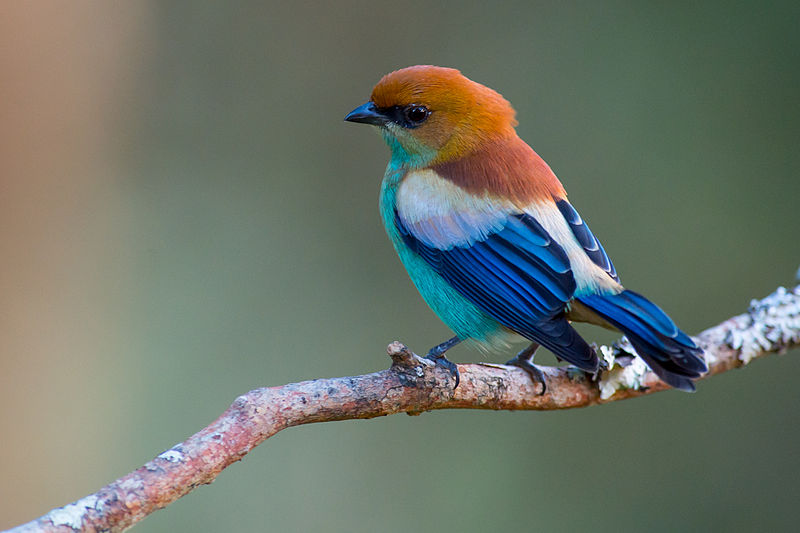
The Chestnut-backed tanager (Tangara preciosa) is a species of bird in the family Thraupidae. It is found in Atlantic Forest in south-eastern Brazil, north-eastern Argentina, eastern Paraguay, and Uruguay. It is closely related to the rarer black-backed tanager, and females of the two species are indistinguishable. This bird is characterized by its green breast, and chesnut colored back. Before research was completed, this animal was often mistaken for a result of a mutated black-backed tanager ("Tangara peruviana"). It is now known that this is not the case, and though the two species are related, they are not in fact the same species. The tanager is not in any danger, and is plentiful in the areas that it resides in. Further studies show that this animal is non-invasive, which simply means that it will not invade areas other than its own region.


Binomial Name:

Name : Tangara preciosa
Taxonomist : Jean Louis Cabanis (Berlin - Germany)
Year :
1850
Subspecies :
None, or not data available
Synonyms :
None, or not data available


Conservation Status by IUCN:

Status :Least Concern

Has been categorized by the International Union for Conservation of Nature as evaluated but not qualified for any other category. As such they do not qualify as threatened, near threatened, or (prior to 2001) conservation dependent.

Philatelic Issues


1999 - Uruguay - Stamp 3 of 4, from Birds and Trees Series


Issue information:

Country: Uruguay
Date: April 14th, 1999
Printed: 35.000 Copies
Type: Stamp from Series of 4 Stamps
Value:UYP 7

Stamp: Rectangular
Size: 39 mm. x 27 mm.
Perforation: Circular
Gum: Water Activated
viernes, 20 de mayo de 2016

ANIMALS – BIRDS – HUMMINGBIRDS – GLITTERING-BELLIED EMERALD (CHLOROSTILBON LUCIDUS)


Animals - Birds - Songbirds

Glittering-bellied emerald (Chlorostilbon lucidus)


Scientific Classification:

Kingdom : Animalia
Phylum : Chordata
Class : Aves
Order : Apodiformes
Family :Trochilidae
Genus : Chlorostilbon
Species :
C. Lucidus


Description:

The Fawn-breasted tanager (Pipraeidea melanonota) is a species of tanager with a blue head and yellow breast. It is in the genus Pipraeidea, along with the Blue-and-yellow tanager. It occurs in the Andes of northwestern Argentina, Bolivia, Colombia, Ecuador, Peru and Venezuela, as well as in the highlands of northeastern Argentina, south Brazil, Paraguay and Uruguay.


Binomial Name:

Name : Chlorostilbon lucidus
Taxonomist : George Shaw (Bierton - England)
Year :
1812
Subspecies :
None, or not data available
Synonyms :
Chlorostilbon aureoventris


Conservation Status by IUCN:

Status :Least Concern

Has been categorized by the International Union for Conservation of Nature as evaluated but not qualified for any other category. As such they do not qualify as threatened, near threatened, or (prior to 2001) conservation dependent.

Philatelic Issues


1999 - Uruguay - Stamp 2 of 4, from Birds and Trees Series


Issue information:

Country: Uruguay
Date: April 14th, 1999
Printed: 35.000 Copies
Type: Stamp from Series of 4 Stamps
Value:UYP 7

Stamp: Rectangular
Size: 39 mm. x 27 mm.
Perforation: Circular
Gum: Water Activated

jueves, 19 de mayo de 2016

ANIMALS – BIRDS – SONGBIRDS – FAWN-BREASTED TANAGER (PIPRAEIDEA MELANONOTA)


Animals - Birds - Songbirds

Fawn-breasted tanager (Pipraeidea melanonota)


Scientific Classification:

Kingdom : Animalia
Phylum : Chordata
Class : Aves
Order : Passeriformes
Family :Thraupidae
Genus : Pipraeidea
Species :
P. Melanonota


Description:

The Fawn-breasted tanager (Pipraeidea melanonota) is a species of tanager with a blue head and yellow breast. It is in the genus Pipraeidea, along with the Blue-and-yellow tanager. It occurs in the Andes of northwestern Argentina, Bolivia, Colombia, Ecuador, Peru and Venezuela, as well as in the highlands of northeastern Argentina, south Brazil, Paraguay and Uruguay.


Binomial Name:

Name : Pipraeidea melanonota
Taxonomist : Louis Jean Pierre Vieillot (Yvetot - France)
Year :
1819
Subspecies :
None, or not data available
Synonyms :
None, or not data available


Conservation Status by IUCN:

Status :Least Concern

Has been categorized by the International Union for Conservation of Nature as evaluated but not qualified for any other category. As such they do not qualify as threatened, near threatened, or (prior to 2001) conservation dependent.

Philatelic Issues


1999 - Uruguay - Stamp 1 of 4, from Birds and Trees Series


Issue information:

Country: Uruguay
Date: April 14th, 1999
Printed: 35.000 Copies
Type: Stamp from Series of 4 Stamps
Value:UYP 7

Stamp: Rectangular
Size: 39 mm. x 27 mm.
Perforation: Circular
Gum: Water Activated

jueves, 12 de mayo de 2016

ANIMALS – BIRDS – SONGBIRDS – GOLDEN-WINGED CACIQUE (CACICUS CHRYSOPTERUS)


Animals - Birds - Songbirds

Golden-winged cacique (Cacicus chrysopterus)


Scientific Classification:

Kingdom : Animalia
Phylum : Chordata
Class : Aves
Order : Passeriformes
Family :Icteridae
Genus : Cacicus
Species :
C. Chrysopterus


Description:

The Golden-winged cacique(Cacicus chrysopterus) is a species of birdin the family Icteridae. It is found in Argentina, Bolivia, Brazil, Paraguay, and Uruguay.

Its natural habitats are subtropical or tropical moist lowland forests and subtropical or tropical moist montane forests.


Binomial Name:

Name : Cacicus chrysopterus
Taxonomist : Nicholas Aylward Vigors (Old Leighlin - Ireland)
Year :
1825
Subspecies :
None, or not data available
Synonyms :
None, or not data available


Conservation Status by IUCN:

Status :Least Concern

Has been categorized by the International Union for Conservation of Nature as evaluated but not qualified for any other category. As such they do not qualify as threatened, near threatened, or (prior to 2001) conservation dependent.

Philatelic Issues


2000 - Uruguay - Stamp 4 of 4, from Birds Series


Issue information:

Country: Uruguay
Date: September 27th, 2000
Printed: 25.000 Copies
Type: Stamp from Series of 4 Stamps
Value:UYP 5

Stamp: Rectangular
Size: 35 mm. x 22 mm.
Perforation: Circular
Gum: Water Activated

miércoles, 11 de mayo de 2016

ANIMALS – BIRDS – SONGBIRDS – FRECKLE-BREASTED THORNBIRD (PHACELLODOMUS STRIATICOLLIS)


Animals - Birds - Songbirds

Freckle-breasted thornbird (Phacellodomus striaticollis)


Scientific Classification:

Kingdom : Animalia
Phylum : Chordata
Class : Aves
Order : Passeriformes
Family :Furnariidae
Genus : Phacellodomus
Species :
P. Striaticollis


Description:

The Freckle-breasted thornbird (Phacellodomus striaticollis) is a species of bird in the Furnariidae family. It is found in Argentina, Bolivia, Brazil, and Uruguay. Its natural habitats are subtropical or tropical moist lowland forests, subtropical or tropical dry shrubland, and subtropical or tropical moist shrubland.


Binomial Name:

Name : Phacellodomus striaticollis
Taxonomist : Alcide d'Orbigny (Couëron - France) & Frédéric de Lafresnaye (Falaise - France)
Year :
1838
Subspecies :
None, or not data available
Synonyms :
None, or not data available


Conservation Status by IUCN:

Status :Least Concern

Has been categorized by the International Union for Conservation of Nature as evaluated but not qualified for any other category. As such they do not qualify as threatened, near threatened, or (prior to 2001) conservation dependent.

Philatelic Issues


2000 - Uruguay - Stamp 3 of 4, from Birds Series


Issue information:

Country: Uruguay
Date: September 27th, 2000
Printed: 25.000 Copies
Type: Stamp from Series of 4 Stamps
Value:UYP 4

Stamp: Rectangular
Size: 35 mm. x 22 mm.
Perforation: Circular
Gum: Water Activated

martes, 10 de mayo de 2016

ANIMALS – BIRDS – SONGBIRDS – COMMON MINER (GEOSITTA CUNICULARIA)


Animals - Birds - Songbirds

Common miner (Geositta cunicularia)


Scientific Classification:

Kingdom : Animalia
Phylum : Chordata
Class : Aves
Order : Passeriformes
Family :Furnariidae
Genus : Geositta
Species :
G. Cunicularia


Description:

The Common miner(Geositta cunicularia) is a passerine birdof South America, belonging to the ovenbird family. It is a ground-dwelling bird which feeds on insects and seeds. It has about 9 different subspecies, some of which may be better treated as separate species.

It is 14 to 16 cm long with a fairly long, slightly downcurved bill. The plumage varies geographically but is basically brown above and pale below with a streaked breast, pale stripe over the eye, dark edge to the ear-coverts and pale rufous bar across the wing. The tail is dark with a buff base and variable amounts of buff on the outer feathers. The trilling song is often given in flight and also varies geographically.

The species occurs in open habitats such as grassland, sand dunes and beaches from sea-level to high in the Andes. It is widespread and sometimes common across much of Chile, Argentina and Uruguay, parts of Peru and Bolivia and in southernmost Brazil. In winter there is some northward migration by southern birds with a few reaching Paraguay.

The bird lays two or three white eggs in a chamber at the end of a tunnel, up to 3 metres long, dug into an earth bank or sand dune.


Binomial Name:

Name : Geositta cunicularia
Taxonomist : Louis Jean Pierre Vieillot (Yvetot - France)
Year :
1816
Subspecies :
None, or not data available
Synonyms :
None, or not data available


Conservation Status by IUCN:

Status :Least Concern

Has been categorized by the International Union for Conservation of Nature as evaluated but not qualified for any other category. As such they do not qualify as threatened, near threatened, or (prior to 2001) conservation dependent.

Philatelic Issues


2000 - Uruguay - Stamp 2 of 4, from Birds Series


Issue information:

Country: Uruguay
Date: September 27th, 2000
Printed: 25.000 Copies
Type: Stamp from Series of 4 Stamps
Value:UYP 4

Stamp: Rectangular
Size: 35 mm. x 22 mm.
Perforation: Circular
Gum: Water Activated

lunes, 9 de mayo de 2016

ANIMALS – BIRDS – SONGBIRDS – LONG-TAILED REED FINCH (DONACOSPIZA ALBIFRONS)


Animals - Birds - Songbirds

Long-tailed reed finch (Donacospiza albifrons)


Scientific Classification:

Kingdom : Animalia
Phylum : Chordata
Class : Aves
Order : Passeriformes
Family :Emberizidae
Genus : Donacospiza
Species :
D. Albifrons


Description:

The Long-tailed reed finch(Donacospiza albifrons) is a species of birdtraditionally placed in the Emberizidaefamily. It has been suggested though that its nearest relations may be the finch-like tanagers of the genus Poospiza in the family Thraupidae. It is the only member of its genus, Donacospiza.

It is found in Argentina, Bolivia, Brazil, Paraguay, and Uruguay. Its natural habitats are temperate grassland, subtropical or tropical seasonally wet or flooded lowland grassland, and swamps.


Binomial Name:

Name : Donacospiza albifrons
Taxonomist : Louis Jean Pierre Vieillot (Yvetot - France)
Year :
1817
Subspecies :
None, or not data available
Synonyms :
None, or not data available


Conservation Status by IUCN:

Status :Least Concern

Has been categorized by the International Union for Conservation of Nature as evaluated but not qualified for any other category. As such they do not qualify as threatened, near threatened, or (prior to 2001) conservation dependent.

Philatelic Issues


2000 - Uruguay - Stamp 1 of 4, from Birds Series


Issue information:

Country: Uruguay
Date: September 27th, 2000
Printed: 25.000 Copies
Type: Stamp from Series of 4 Stamps
Value:UYP 5

Stamp: Rectangular
Size: 35 mm. x 22 mm.
Perforation: Circular
Gum: Water Activated

jueves, 5 de mayo de 2016

ANIMALS – AMPHIBIANS – FROGS – SQUALIROSTRIS SCINAX (SCINAX SQUALIROSTRIS)


Animals - Amphibians - Frogs

Squalirostris Scinax (Scinax squalirostris)


Scientific Classification:

Kingdom : Animalia
Phylum : Chordata
Class : Amphibia
Order : Anura
Family :Hylidae
Genus : Scinax
Species :
S. Squalirostris


Description:

The Squalirostris Scinax (Scinax squalirostris) is a species of frog in the Hylidae family. It is found in Argentina, Bolivia, Brazil, Paraguay, Uruguay, and possibly Peru. Its natural habitats are subtropical or tropical moist lowland forests, moist savanna, subtropical or tropical moist shrubland, temperate grassland, subtropical or tropical dry lowland grassland, subtropical or tropical seasonally wet or flooded lowland grassland, intermittent freshwater marshes, pastureland, rural gardens, heavily degraded former forest, ponds, and canals and ditches.


Binomial Name:

Name : Scinax squalirostris
Taxonomist : Adolpho Lutz (Rio de Janeiro - Brazil)
Year : 1925
Subspecies : 
None or not data available
Synonyms : 
None or not data available


Conservation Status by IUCN:

Status : Not Evaluated, or not data available


Philatelic Issues


2001 - Uruguay - Stamp 4 of 4, from Amphibians and Reptiles Series


Issue information:

Country: Uruguay
Date: February 15th, 2001
Printed: 15.000 Copies
Type: Stamp from Series of 4 Stamps
Value: UYP 11

Stamp: Rectangular
Size: 22 mm. x 35 mm.
Perforation: Circular
Gum: Water Activated

martes, 3 de mayo de 2016

ANIMALS – REPTILES – TURTLES – HILAIRE’S TOADHEAD TURTLE (PHRYNOPS HILARII)


Animals - Reptiles - Turtles

Hilaire’s toadhead turtle (Phrynops hilarii)


Scientific Classification:

Kingdom : Animalia
Phylum : Chordata
Class : Reptilia
Order : Testudines
Family :Chelidae
Genus : Phrynops
Species :
P. Hilarii


Description:

The Hilaire’s toadhead turtle or Hilaire’s side-necked turtle (Phrynops hilarii), is a species of turtle endemic to South America.

The specific name, hilarii, is in honor of French zoologist Isidore Geoffroy Saint-Hilaire.

P. hilarii is found in southern Brazil (Santa Catarina and Rio Grande do Sul) southward and westward into Uruguay and Argentina; possibly also in Paraguay and Bolivia.


Binomial Name:

Name : Phrynops hilarii
Taxonomist : André Marie Constant Duméril (Amiens - France) and Gabriel Bibron (Paris - France)
Year : 1835
Subspecies : 
None, or not data available
Synonyms :
Many


Conservation Status by IUCN:

Status : Near-threatened species

A Near-threatened speciesis a species which has been categorized as "Near Threatened" (NT)by the International Union for Conservation of Nature as that may be considered threatened with extinction in the near future, although it does not currently qualify for the threatened status. The IUCN notes the importance of re-evaluating near-threatened taxa at appropriate intervals.


Philatelic Issues


2001 - Uruguay - Stamp 3 of 4, from Amphibians and Reptiles Series


Issue information:

Country: Uruguay
Date: February 15th, 2001
Printed: 15.000 Copies
Type: Stamp from Series of 4 Stamps
Value: UYP 11

Stamp: Rectangular
Size: 22 mm. x 35 mm.
Perforation: Circular
Gum: Water Activated

lunes, 2 de mayo de 2016

ANIMALS – REPTILES – TURTLES – BLACK SPINE-NECK SWAMP TURTLE (ACANTHOCHELYS SPIXII)


Animals - Reptiles - Turtles

Black spine-neck swamp turtle (Acanthochelys spixii)


Scientific Classification:

Kingdom : Animalia
Phylum : Chordata
Class : Reptilia
Order : Testudines
Family :Chelidae
Genus : Acanthochelys
Species :
A. Spixii


Description:

The Black spine-neck swamp turtle, Spiny-neck turtle or Spix's sideneck turtle (Acanthochelys spixii) is a species of turtle in the Chelidae family. It is found in Argentina, Brazil, Uruguay, and possibly Paraguay.


Binomial Name:

Name : Acanthochelys spixii
Taxonomist : André Marie Constant Duméril (Amiens - France) and Gabriel Bibron (Paris - France)
Year : 1835
Subspecies : 
None or not data available
Synonyms :
Emys depressa Spix, Emys aspera Gray, Platemys spixii


Conservation Status by IUCN:

Status : Near-threatened species

A Near-threatened speciesis a species which has been categorized as "Near Threatened" (NT)by the International Union for Conservation of Nature as that may be considered threatened with extinction in the near future, although it does not currently qualify for the threatened status. The IUCN notes the importance of re-evaluating near-threatened taxa at appropriate intervals.


Philatelic Issues


2001 - Uruguay - Stamp 2 of 4, from Amphibians and Reptiles Series


Issue information:

Country: Uruguay
Date: February 15th, 2001
Printed: 15.000 Copies
Type: Stamp from Series of 4 Stamps
Value: UYP 11

Stamp: Rectangular
Size: 22 mm. x 35 mm.
Perforation: Circular
Gum: Water Activated

domingo, 1 de mayo de 2016

ANIMALS – AMPHIBIANS – FROGS – MONKEY FROG (PHYLLOMEDUSA IHERINGII)


Animals - Amphibians - Frogs

Monkey Frog (Phyllomedusa iheringii)


Scientific Classification:

Kingdom : Animalia
Phylum : Chordata
Class : Amphibia
Order : Anura
Family :Hylidae
Genus : Phyllomedusa
Species :
P. Iheringii


Description:

The Monkey Frog(Phyllomedusa iheringii) is a species of frog in the Hylidaefamily, found in Brazil and Uruguay. Its natural habitats are temperate shrubland and intermittent freshwater marshes, and is threatened by habitat loss.


Binomial Name:

Name : Phyllomedusa iheringii
Taxonomist : George Albert Boulenger (Brussels - Belgium)
Year :
1885
Subspecies : 
None or not data available
Synonyms : 
None or not data available


Conservation Status by IUCN:

Status :Least Concern

Has been categorized by the International Union for Conservation of Nature as evaluated but not qualified for any other category. As such they do not qualify as threatened, near threatened, or (prior to 2001) conservation dependent.


Philatelic Issues


2001 - Uruguay - Stamp 1 of 4, from Amphibians and Reptiles Series


Issue information:

Country: Uruguay
Date: February 15th, 2001
Printed: 15.000 Copies
Type: Stamp from Series of 4 Stamps
Value: UYP 11

Stamp: Rectangular
Size: 22 mm. x 35 mm.
Perforation: Circular
Gum: Water Activated

martes, 19 de abril de 2016

ANIMALS – REPTILES – SNAKES – CROSSED PIT VIPER (BOTHROPS ALTERNATUS)


Animals - Reptiles - Snakes

Crossed Pit Viper (Bothrops alternatus)


Scientific Classification:

Kingdom : Animalia
Phylum : Chordata
Subphylum : Vertebrata
Class : Reptilia
Order : Squamata
Suborder : Serpentes
Family : Viperidae
Subfamily :Crotalinae
Genus : Bothrops
Species :
B. Alternatus


Description:

The Crossed Pit Viper(Bothrops alternatus) is a venomous pit viperspecies found in Brazil, Paraguay, Uruguay and Argentina. Within its range, it is an important cause of snakebite. The specific name, alternatus, which is Latin for "alternating", is apparently a reference to the staggered markings along the body. No subspecies are currently recognized.

Large and stout, this terrestrial species reportedly exceeds 2 m (6.6 ft) in total length, although the verified maximum is 169 cm (67 in). Most specimens are 80–120 cm (31–47 in) in total length, with females being significantly longer and heavier than males.

Occurs in tropical and semitropical forests, as well as temperate deciduous forests. According to Gallardo (1977), it prefers marshes, low-lying swamps, riparian zones and other humid habitats. It is also said to be common in sugarcane plantations. It is found in a variety of habitats depending on the latitude, including open fields and rocky areas in the Sierra de Achiras in Córdoba and the Sierra de la Ventana in Buenos Aires in Argentina, fluvial areas, grasslands and cerrado. However, it is usually absent in dry environments.

An important cause of snakebite within its range, bites are rarely fatal but frequently cause severe local tissue damage. Although Spix and Martius (1824) found that it had a reputation for being one of the most venomous snakes in Brazil, its bite "said to occasion almost certain death", the statistics tell a different story. In his survey of 6,601 snakebite cases in Central and South America, Fonseca (1949) found that 384 were attributed to this species and that, of that number, only eight were fatal (2%).


Binomial Name:

Name : Bothrops alternatus
Taxonomist : André Marie Constant Duméril (Amiens - France), Gabriel Bibron (Paris - France), Auguste Henri André Duméril (Paris - France)
Year :
1854
Subspecies :
None, or not data available
Synonyms :
Many


Conservation Status by IUCN:

Status : Not Evaluated, or not data available


Philatelic Issues


2001 - Uruguay - Stamp 2 of 2, from Snakes Series


Issue information:

Country: Uruguay
Date: May 28th, 2001
Printed: 15.000 Copies
Type: Stamp from Series of 2 Stamps
Value: UYP 11

Stamp: Rectangular
Size: 39 mm. x 27 mm.
Perforation: Circular
Gum: Water Activated

lunes, 18 de abril de 2016

ANIMALS - REPTILES - SNAKES - SOUTH AMERICAN GREEN RACER (PHILODRYAS AESTIVA)


Animals - Reptiles - Snakes

South American Green Racer (Philodryas olfersii)


Scientific Classification:

Kingdom : Animalia
Phylum : Chordata
Subphylum : Vertebrata
Class : Reptilia
Order : Squamata
Suborder : Serpentes
Family : Colubridae
Subfamily :Xenodontinae
Genus : Philodryas
Species :
P. Olfersii


Description:

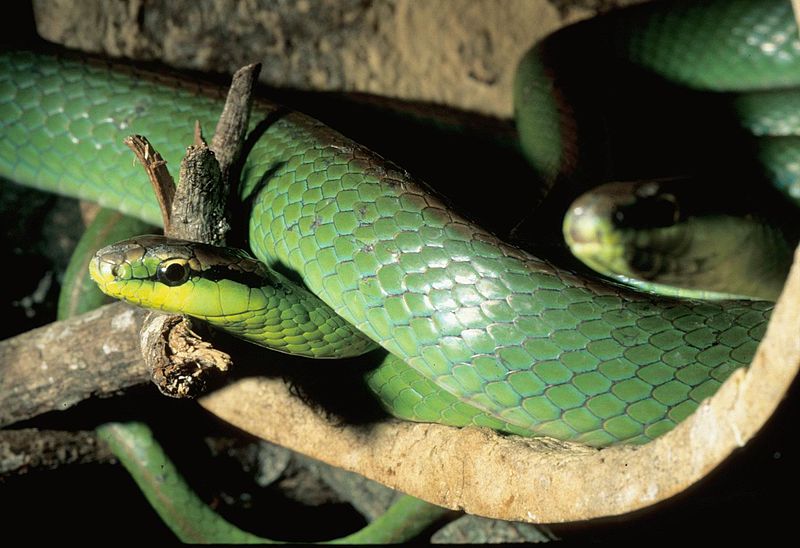
South American Green Racer(Philodryas olfersii) is a species of colubrid snake, endemic to South America, known also by the common names Lichtenstein's green racer, and eastern green whiptail, and in Brazil, cobra-cipó, cobra de São João, cobra-facão, cobra-verde, and mboi-obi.

The specific name, olfersii, is in honor of German naturalist Ignaz von Olfers.

It is native to much of South America, including Brazil, Peru, Bolivia, Paraguay, Uruguay, Argentina, Colombia, French Guiana, and Venezuela.

P. olfersii reaches 1 to 1.5 meters (about 40 to 60 inches) in maximum total length.

Dorsally, it is green in color; ventrally, it is yellowish.

The dorsal scales are smooth, without apical pits, and are arranged in 19 rows at midbody.

It can be found in many habitat types, including the Cerrado, Caatinga, forests, forest transition, and restinga.

This species is often arboreal, but it also forages on the ground. It is diurnal, though it has been observed mating late in the evening.

Prey items include rodents, lizards, amphibians, and birds, especially nestlings. They will also eat other snakes, including ones almost as large as themselves.

The egg of the snake measures about 5 centimeters (about 2 inches). The clutch size is 4 to 11 eggs, with larger females producing more eggs than smaller ones.


Binomial Name:

Name : Philodryas olfersii
Taxonomist : Martin Hinrich Carl Lichtenstein (Hamburg - Germany)
Year :
1823
Subspecies :
3 (Herbeus, Iatirostris, Olfersii)
Synonyms :
Coluber olfersii, Herpetodryas olfersii, Dryophylax olfersii, Philodryas olfersii


Conservation Status by IUCN:

Status : Not Evaluated, or not data available


Philatelic Issues


2001 - Uruguay - Stamp 1 of 2, from Snakes Series


Issue information:

Country: Uruguay
Date: May 28th, 2001
Printed: 15.000 Copies
Type: Stamp from Series of 2 Stamps
Value: UYP 11

Stamp: Rectangular
Size: 39 mm. x 27 mm.
Perforation: Circular
Gum: Water Activated

sábado, 2 de abril de 2016

ANIMALS – MAMMALS – EQUIDS – WILD HORSE (EQUUS FERUS) #2


Animals - Mammals - Equids

Wild Horse (Equus ferus)


Scientific Classification:

Kingdom : Animalia
Phylum : Chordata
Class : Mammalia
Order : Perissodactyla
Family : Equidae
Genus : Equus
Species :
E. Ferus


Description:

The Wild horse(Equus ferus) is a species of the genus Equus, which includes as subspecies the modern domesticated horse (Equus ferus caballus) as well as the undomesticated tarpan (Equus ferus ferus), now extinct, and the endangered Przewalski's horse (Equus ferus przewalskii). Przewalski's horse was saved from the brink of extinction and reintroduced successfully to the wild. The tarpan became extinct in the 19th century, though it was a possible ancestor of the domestic horse, and roamed the steppes of Eurasia at the time of domestication. However, other subspecies of Equus ferus may have existed and could have been the stock from which domesticated horses are descended.

The horse family Equidaeand the genus Equusevolved in North America, before the species moved into the Eastern Hemisphere. Studies using ancient DNA, as well as DNA of recent individuals, shows the presence of two closely related horse species in North America, the wild horse and the "New World stilt-legged horse”. Currently, three subspecies that lived during recorded human history are recognized. The widespread domestic horse (Equus ferus caballus), the recently extinct tarpan (E. f. ferus) and the endangered Przewalski's horse (E. f. przewalskii). Genetically, the predomestication horse, E. f. ferus, and domesticated horse, E. f. caballus, form a single homogeneous group (clade) and are genetically indistinguishable from each other. Przewalski's horse has several unique genetic differences that distinguish it from the other subspecies, including 66 instead of 64 chromosomes, unique Y-chromosome gene haplotypes, and unique mtDNA haplotypes. Besides genetic differences, osteological evidence from across the Eurasian wild horse range, based on cranial and metacarpal differences, indicates the presence of only two subspecies in postglacial times, the tarpan and Przewalski's horse.


Binomial Name:

Name : Equus ferus
Taxonomist : Pieter Boddaert (Middelburg - Netherlands)
Year :
1785
Subspecies :
3 (Caballus, Przewalskii, Ferus)
Synonyms : 
None, or not data available


Conservation Status by IUCN:

Status : Endangered

An Endangered (EN)species is a species which has been categorized by the International Union for Conservation of Nature (IUCN) Red List as likely to become extinct."Endangered" is the second most severe conservation status for wild populations in the IUCN's schema after Critically Endangered (CR).

Many nations have laws that protect conservation-reliant species: for example, forbidding hunting, restricting land development or creating preserves. Population numbers, trends and species' conservation status can be found in the lists of organisms by population.


Philatelic Issues


2016 – Uruguay – Stamp 2 of 3, from Remarkable Women Series


Issue information:

Country: Uruguay
Date: March 8th, 2016
Printed: 15.000 Copies
Type: Stamps Series
Value:UYP 20

Stamp: Rectangular
Size: 27 mm. x 39 mm.
Perforation: Circular
Gum: Water Activated

jueves, 17 de marzo de 2016

ANIMALS – REPTILES – CROCODILES – BROAD-SNOUTED CAIMAN (CAIMAN LATIROSTRIS) #2


Animals - Reptiles - Crocodiles

Broad-Snouted Caiman (Caiman latirostris)


Scientific Classification:

Kingdom : Animalia
Phylum : Chordata
Class : Reptilia
Order : Crocodylomorpha
Order : Crocodilia
Family :Alligatoridae
Genus : Caiman
Species :
C. Latirostris


Description:

The Broad-snouted caiman(Caiman latirostris) is a crocodilian reptilefound in eastern and central South America, including southeastern Brazil, northern Argentina, Uruguay, Paraguay, and Bolivia. It is found mostly in freshwater marshes, swamps, and mangroves, usually in still or very slow-moving waters. It will often use man-made cow ponds.

In the wild, adults normally grow to 2 to 2.5 m (6.6 to 8.2 ft) in length, but a few old males have been recorded to reach up to 3.5 m (11 ft). Captive adults were found to have weighed 29.2 to 62 kg (64 to 137 lb). Most tend to be of a light olive-green color. A few individuals have spots on their faces. The most notable physical characteristic is the broad snout from which its name is derived. The snout is well adapted to rip through the dense vegetation of the marshes. Due to this, they swallow some of the dense vegetation while foraging for food.


Binomial Name:

Name : Caiman latirostris
Taxonomist : François Marie Daudin (Paris - France)
Year :
1801
Subspecies : 
None or not data available
Synonyms :
None or not data available


Conservation Status by IUCN:

Status :Least Concern

Has been categorized by the International Union for Conservation of Nature as evaluated but not qualified for any other category. As such they do not qualify as threatened, near threatened, or (prior to 2001) conservation dependent.


Philatelic Issues


2003 – Uruguay – Unique Stamp, from Caimans Breeding Farm Series


Issue information:

Country: Uruguay
Date: April 10th, 2003
Printed: 500.000 Copies
Type: Unique Stamp from Series
Value: UYP 12

Stamp: Rectangular
Size: 39 mm. x 27 mm.
Perforation: Circular
Gum: Water Activated

sábado, 12 de marzo de 2016

ANIMALS – MAMMALS – EQUIDS – WILD HORSE (EQUUS FERUS)


Animals - Mammals - Equids

Wild Horse (Equus ferus)


Scientific Classification:

Kingdom : Animalia
Phylum : Chordata
Class : Mammalia
Order : Perissodactyla
Family : Equidae
Genus : Equus
Species :
E. Ferus


Description:

The Wild horse(Equus ferus) is a species of the genus Equus, which includes as subspecies the modern domesticated horse (Equus ferus caballus) as well as the undomesticated tarpan (Equus ferus ferus), now extinct, and the endangered Przewalski's horse (Equus ferus przewalskii). Przewalski's horse was saved from the brink of extinction and reintroduced successfully to the wild. The tarpan became extinct in the 19th century, though it was a possible ancestor of the domestic horse, and roamed the steppes of Eurasia at the time of domestication. However, other subspecies of Equus ferus may have existed and could have been the stock from which domesticated horses are descended.

The horse family Equidaeand the genus Equusevolved in North America, before the species moved into the Eastern Hemisphere. Studies using ancient DNA, as well as DNA of recent individuals, shows the presence of two closely related horse species in North America, the wild horse and the "New World stilt-legged horse”. Currently, three subspecies that lived during recorded human history are recognized. The widespread domestic horse (Equus ferus caballus), the recently extinct tarpan (E. f. ferus) and the endangered Przewalski's horse (E. f. przewalskii). Genetically, the predomestication horse, E. f. ferus, and domesticated horse, E. f. caballus, form a single homogeneous group (clade) and are genetically indistinguishable from each other. Przewalski's horse has several unique genetic differences that distinguish it from the other subspecies, including 66 instead of 64 chromosomes, unique Y-chromosome gene haplotypes, and unique mtDNA haplotypes. Besides genetic differences, osteological evidence from across the Eurasian wild horse range, based on cranial and metacarpal differences, indicates the presence of only two subspecies in postglacial times, the tarpan and Przewalski's horse.


Binomial Name:

Name : Equus ferus
Taxonomist : Pieter Boddaert (Middelburg - Netherlands)
Year :
1785
Subspecies :
3 (Caballus, Przewalskii, Ferus)
Synonyms : 
None, or not data available


Conservation Status by IUCN:

Status : Endangered

An Endangered (EN)species is a species which has been categorized by the International Union for Conservation of Nature (IUCN) Red List as likely to become extinct."Endangered" is the second most severe conservation status for wild populations in the IUCN's schema after Critically Endangered (CR).

Many nations have laws that protect conservation-reliant species: for example, forbidding hunting, restricting land development or creating preserves. Population numbers, trends and species' conservation status can be found in the lists of organisms by population.


Philatelic Issues


2016 – Uruguay – Unique Miniature Sheet, from Patria Gaucha Series


Issue information:

Country: Uruguay
Date: March 4th, 2016
Printed: 10.000 Copies
Type: Unique Miniature Sheet from Series
Value:UYP 20

Stamp: Rectangular
Size: 90 mm. x 60 mm.
Perforation: Circular
Gum: Water Activated

lunes, 7 de marzo de 2016

ANIMALS – MAMMALS – PRIMATES – COLLARED MANGABEY (CERCOCEBUS TORQUATUS)


Animals - Mammals - Primates

Collared mangabey (Cercocebus torquatus)


Scientific Classification:

Kingdom : Animalia
Phylum : Chordata
Class : Mammalia
Order : Primates
Family :Cercopithecidae
Genus :Cercocebus
Species :
C. Torquatus


Description:

The Collared mangabey(Cercocebus torquatus), also known as the Red-capped mangabey, or the White-collared mangabey (leading to easy confusion with Cercocebus atys lunulatus), is a species of primatein the family Cercopithecidaeof Old World monkeys. It formerly included the sooty mangabey as a subspecies. As presently defined, the collared mangabey is monotypic.

The collared mangabey has grey fur covering its body, but its common names refer to the colors on its head and neck. Its prominent chestnut-red cap gives it the name red-capped, and its white collar gives it the names collared and white-collared. Its ears are black and it has striking white eyelids, which is why some refer to it as the "four-eyed monkey". It has a dark grey tail that exceeds the length of the body and is often held with the white tip over its head. It has long molars and very large incisors. The average body mass for captive individuals ranges from 9 to 10 kg (20 to 22 lb) for males and 7.5 to 8.6 kg (17 to 19 lb) for females. Head-body length is 47–67 cm (19–26 in) in males and 45–60 cm (18–24 in) in females.

The collared mangabey is found in coastal, swamp, mangrove, and valley forests, from western Nigeria, east and south into Cameroon, and throughout Equatorial Guinea, and Gabon, and on the Gabon-Congo border by the Atlantic shore.

The collared mangabey is listed as Vulnerable on the IUCN Redlist due to habitat loss and hunting for bushmeat. It is also listed on Appendix II of CITES and on Class B of the African Convention on the Conservation of Nature and Natural Resources.


Binomial Name:

Name : Cercocebus torquatus
Taxonomist : Robert Kerr (Bughtridge - Scotland)
Year :
1792
Subspecies :
None, or not data available
Synonyms : 
None, or not data available


Conservation Status by IUCN:

Status : Vulnerable

A Vulnerable species is one which has been categorised by the International Union for Conservation of Nature as likely to become endangered unless the circumstances threatening its survival and reproduction improve.

Vulnerability is mainly caused by habitat loss or destruction. Vulnerable habitat or species are monitored and can become increasingly threatened. Some species listed as "vulnerable" may be common in captivity.


Philatelic Issues


2016 – Uruguay – Unique Stamp, from Year of the Monkey Series


Issue information:

Country: Uruguay
Date: January 28th, 2016
Printed: 15.003 Copies
Type: Unique Stamp from Series
Value:UYP 20

Stamp: Rectangular
Size: 27 mm. x 39 mm.
Perforation: Circular
Gum: Water Activated

viernes, 4 de marzo de 2016

ANIMALS – BIRDS – SEABIRDS – CAPE PETREL (DAPTION CAPENSE)


Animals - Birds - Seabirds

Cape petrel (Daption capense)


Scientific Classification:

Kingdom : Animalia
Phylum : Chordata
Class : Aves
Order : Procellariiformes
Family : Procellariidae
Genus :Daption 
Species :
D. Capense


Description:

The Cape petrel(Daption capense), also called the Cape pigeon, Pintado petrel, or Cape fulmar, is a common seabirdof the Southern Ocean from the family Procellariidae. It is the only member of the genus Daption, and is allied to the fulmarine petrels, and the giant petrels. They are extremely common seabirds with an estimated population of around 2 million.

The Cape petrel is the only known member of the genus Daption and is in turn a member of the family Procellariidae and order Procellariiformes. There appears to be a subgroup within the family consisting of the giant petrels, the members of Fulmarus, the Antarctic petrel, and the snow petrel.

All Procellariiformes share certain identifying features. First, they have nasal passages that attach to the upper bill called naricorns. The bills of Procellariiformes are also unique in that they are split into between seven and nine horny plates. They produce a stomach oil made up of wax esters and triglycerides that is stored in the proventriculus. This can be sprayed out of their mouths as a defence against predators and as an energy rich food source for chicks and for the adults during their long flights. Finally, they also have a salt gland that is situated above the nasal passage and helps desalinate their bodies, due to the high amount of ocean water that they imbibe. It excretes a high saline solution from their nose.

The Cape petrel is a unique looking petrel. It has a black head and neck, and a white belly, breast, and its underwing is white with a black border. Its back, and upperwings are black and white speckled, as is its tail which also has a band of black. When fully grown, their wings span 86 cm (34 in)and they are 39 cm (15 in) long.


Binomial Name:

Name : Daption capense
Taxonomist :
Carl Linnaeus (Småland - Sweden)
Year :
1758
Subspecies :
2 (Capense, Australe)
Synonyms : 
None, or not data available


Conservation Status by IUCN:

Status :Least Concern

Has been categorized by the International Union for Conservation of Nature as evaluated but not qualified for any other category. As such they do not qualify as threatened, near threatened, or (prior to 2001) conservation dependent.


Philatelic Issues


2004 – Uruguay – Stamp 3 of 4, from Seabirds Series


Issue information:

Country: Uruguay
Date: January 22nd, 20
Printed: 15.000 copies
Type : Stamp from Series of 4 Stamps
Value :
UYP 14

Stamp : Rectangular
Size: 27 mm. x 39 mm.
Perforation: Circular
Gum: Water Activated