Mostrando entradas con la etiqueta Songbirds. Mostrar todas las entradas

domingo, 22 de mayo de 2016

ANIMALS – BIRDS – SONGBIRDS – MANY-COLOURED RUSH TYRANT (TACHURIS RUBRIGASTRA) #2


Animals - Birds - Songbirds

Many-coloured Rush Tyrant (Tachuris rubrigastra)


Scientific Classification:

Kingdom : Animalia
Phylum : Chordata
Class : Aves
Order : Passeriformes
Family :Tyrannidae
Genus : Tachuris
Species :
T. Rubrigastra


Description:

The Many-coloured rush tyrant (Tachuris rubrigastra) or Many-colored rush tyrant is a small passerine bird of South America belonging to the tyrant flycatcher family. It is the only member of the genus Tachurisand its relationships with the other members of the family are uncertain. It inhabits marshland and reedbeds around lakes and rivers. It is particularly associated with stands of Scirpus. The nest is built among plant stems.

There are four subspecies: T. r. rubrigastra is the most widespread, occurring from south-east Brazil to southern Argentina and central Chile. T. r. alticola is found in the Andes of south-east Peru, west Bolivia and north-west Argentina. T. r. libertatis is found in coastal Peru while T. r. loaensis is restricted to Antofagasta Region in northern Chile.

It is a small bird, 10.5 cm in length. The tail is short, the wings are short and rounded and the bill is slender. As the bird's name suggests, the plumage is very colorful. The back and rump are green while the underparts are yellow apart from the white throat, black breastband and red undertail-coverts. The face is dark blue-grey, there is a yellow stripe over the eye and the crown is dark with a red patch that is often concealed. The wings and tail are dark with a white wingbar and white outer tail-feathers. Juveniles are considerably duller than the adults.


Binomial Name:

Name : Tachuris rubrigastra
Taxonomist : Louis Jean Pierre Vieillot (Yvetot - France)
Year :
1817
Subspecies :
4 (Rubigastra, Alticola, Libertatis, Ioaensis)
Synonyms :
Sylvia rubrigastra


Conservation Status by IUCN:

Status : Least Concern

Has been categorized by the International Union for Conservation of Nature as evaluated but not qualified for any other category. As such they do not qualify as threatened, near threatened, or (prior to 2001) conservation dependent.


Philatelic Issues


1999 - Uruguay - Stamp 4 of 4, from Birds and Trees Series


Issue information:

Country: Uruguay
Date: April 14th, 1999
Printed: 35.000 Copies
Type: Stamp from Series of 4 Stamps
Value:UYP 7

Stamp: Rectangular
Size: 39 mm. x 27 mm.
Perforation: Circular
Gum: Water Activated

sábado, 21 de mayo de 2016

ANIMALS – BIRDS – SONGBIRDS – CHESTNUT-BACKED TANAGER (TANGARA PRECIOSA)


Animals - Birds - Songbirds

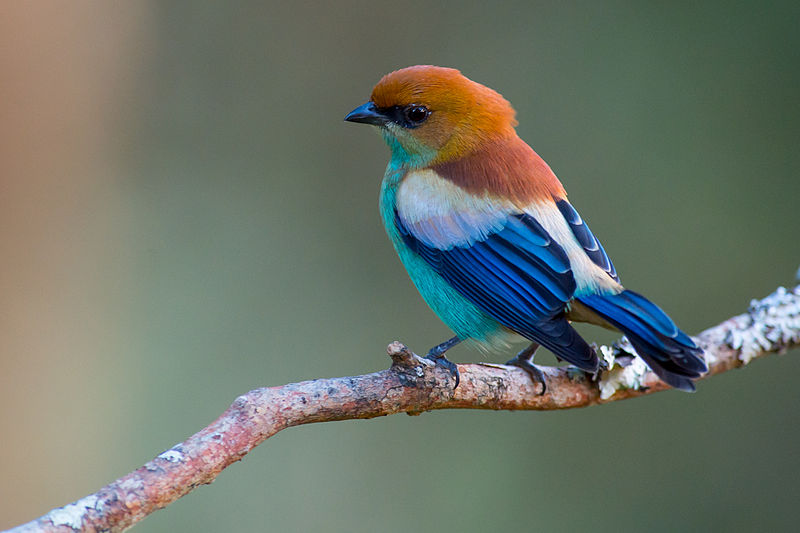
Chestnut-backed tanager (Tangara preciosa)


Scientific Classification:

Kingdom : Animalia
Phylum : Chordata
Class : Aves
Order : Passeriformes
Family :Thraupidae
Genus : Tangara
Species :
T. Preciosa


Description:

The Chestnut-backed tanager (Tangara preciosa) is a species of bird in the family Thraupidae. It is found in Atlantic Forest in south-eastern Brazil, north-eastern Argentina, eastern Paraguay, and Uruguay. It is closely related to the rarer black-backed tanager, and females of the two species are indistinguishable. This bird is characterized by its green breast, and chesnut colored back. Before research was completed, this animal was often mistaken for a result of a mutated black-backed tanager ("Tangara peruviana"). It is now known that this is not the case, and though the two species are related, they are not in fact the same species. The tanager is not in any danger, and is plentiful in the areas that it resides in. Further studies show that this animal is non-invasive, which simply means that it will not invade areas other than its own region.


Binomial Name:

Name : Tangara preciosa
Taxonomist : Jean Louis Cabanis (Berlin - Germany)
Year :
1850
Subspecies :
None, or not data available
Synonyms :
None, or not data available


Conservation Status by IUCN:

Status :Least Concern

Has been categorized by the International Union for Conservation of Nature as evaluated but not qualified for any other category. As such they do not qualify as threatened, near threatened, or (prior to 2001) conservation dependent.

Philatelic Issues


1999 - Uruguay - Stamp 3 of 4, from Birds and Trees Series


Issue information:

Country: Uruguay
Date: April 14th, 1999
Printed: 35.000 Copies
Type: Stamp from Series of 4 Stamps
Value:UYP 7

Stamp: Rectangular
Size: 39 mm. x 27 mm.
Perforation: Circular
Gum: Water Activated
jueves, 19 de mayo de 2016

ANIMALS – BIRDS – SONGBIRDS – FAWN-BREASTED TANAGER (PIPRAEIDEA MELANONOTA)


Animals - Birds - Songbirds

Fawn-breasted tanager (Pipraeidea melanonota)


Scientific Classification:

Kingdom : Animalia
Phylum : Chordata
Class : Aves
Order : Passeriformes
Family :Thraupidae
Genus : Pipraeidea
Species :
P. Melanonota


Description:

The Fawn-breasted tanager (Pipraeidea melanonota) is a species of tanager with a blue head and yellow breast. It is in the genus Pipraeidea, along with the Blue-and-yellow tanager. It occurs in the Andes of northwestern Argentina, Bolivia, Colombia, Ecuador, Peru and Venezuela, as well as in the highlands of northeastern Argentina, south Brazil, Paraguay and Uruguay.


Binomial Name:

Name : Pipraeidea melanonota
Taxonomist : Louis Jean Pierre Vieillot (Yvetot - France)
Year :
1819
Subspecies :
None, or not data available
Synonyms :
None, or not data available


Conservation Status by IUCN:

Status :Least Concern

Has been categorized by the International Union for Conservation of Nature as evaluated but not qualified for any other category. As such they do not qualify as threatened, near threatened, or (prior to 2001) conservation dependent.

Philatelic Issues


1999 - Uruguay - Stamp 1 of 4, from Birds and Trees Series


Issue information:

Country: Uruguay
Date: April 14th, 1999
Printed: 35.000 Copies
Type: Stamp from Series of 4 Stamps
Value:UYP 7

Stamp: Rectangular
Size: 39 mm. x 27 mm.
Perforation: Circular
Gum: Water Activated

jueves, 12 de mayo de 2016

ANIMALS – BIRDS – SONGBIRDS – GOLDEN-WINGED CACIQUE (CACICUS CHRYSOPTERUS)


Animals - Birds - Songbirds

Golden-winged cacique (Cacicus chrysopterus)


Scientific Classification:

Kingdom : Animalia
Phylum : Chordata
Class : Aves
Order : Passeriformes
Family :Icteridae
Genus : Cacicus
Species :
C. Chrysopterus


Description:

The Golden-winged cacique(Cacicus chrysopterus) is a species of birdin the family Icteridae. It is found in Argentina, Bolivia, Brazil, Paraguay, and Uruguay.

Its natural habitats are subtropical or tropical moist lowland forests and subtropical or tropical moist montane forests.


Binomial Name:

Name : Cacicus chrysopterus
Taxonomist : Nicholas Aylward Vigors (Old Leighlin - Ireland)
Year :
1825
Subspecies :
None, or not data available
Synonyms :
None, or not data available


Conservation Status by IUCN:

Status :Least Concern

Has been categorized by the International Union for Conservation of Nature as evaluated but not qualified for any other category. As such they do not qualify as threatened, near threatened, or (prior to 2001) conservation dependent.

Philatelic Issues


2000 - Uruguay - Stamp 4 of 4, from Birds Series


Issue information:

Country: Uruguay
Date: September 27th, 2000
Printed: 25.000 Copies
Type: Stamp from Series of 4 Stamps
Value:UYP 5

Stamp: Rectangular
Size: 35 mm. x 22 mm.
Perforation: Circular
Gum: Water Activated

miércoles, 11 de mayo de 2016

ANIMALS – BIRDS – SONGBIRDS – FRECKLE-BREASTED THORNBIRD (PHACELLODOMUS STRIATICOLLIS)


Animals - Birds - Songbirds

Freckle-breasted thornbird (Phacellodomus striaticollis)


Scientific Classification:

Kingdom : Animalia
Phylum : Chordata
Class : Aves
Order : Passeriformes
Family :Furnariidae
Genus : Phacellodomus
Species :
P. Striaticollis


Description:

The Freckle-breasted thornbird (Phacellodomus striaticollis) is a species of bird in the Furnariidae family. It is found in Argentina, Bolivia, Brazil, and Uruguay. Its natural habitats are subtropical or tropical moist lowland forests, subtropical or tropical dry shrubland, and subtropical or tropical moist shrubland.


Binomial Name:

Name : Phacellodomus striaticollis
Taxonomist : Alcide d'Orbigny (Couëron - France) & Frédéric de Lafresnaye (Falaise - France)
Year :
1838
Subspecies :
None, or not data available
Synonyms :
None, or not data available


Conservation Status by IUCN:

Status :Least Concern

Has been categorized by the International Union for Conservation of Nature as evaluated but not qualified for any other category. As such they do not qualify as threatened, near threatened, or (prior to 2001) conservation dependent.

Philatelic Issues


2000 - Uruguay - Stamp 3 of 4, from Birds Series


Issue information:

Country: Uruguay
Date: September 27th, 2000
Printed: 25.000 Copies
Type: Stamp from Series of 4 Stamps
Value:UYP 4

Stamp: Rectangular
Size: 35 mm. x 22 mm.
Perforation: Circular
Gum: Water Activated

martes, 10 de mayo de 2016

ANIMALS – BIRDS – SONGBIRDS – COMMON MINER (GEOSITTA CUNICULARIA)


Animals - Birds - Songbirds

Common miner (Geositta cunicularia)


Scientific Classification:

Kingdom : Animalia
Phylum : Chordata
Class : Aves
Order : Passeriformes
Family :Furnariidae
Genus : Geositta
Species :
G. Cunicularia


Description:

The Common miner(Geositta cunicularia) is a passerine birdof South America, belonging to the ovenbird family. It is a ground-dwelling bird which feeds on insects and seeds. It has about 9 different subspecies, some of which may be better treated as separate species.

It is 14 to 16 cm long with a fairly long, slightly downcurved bill. The plumage varies geographically but is basically brown above and pale below with a streaked breast, pale stripe over the eye, dark edge to the ear-coverts and pale rufous bar across the wing. The tail is dark with a buff base and variable amounts of buff on the outer feathers. The trilling song is often given in flight and also varies geographically.

The species occurs in open habitats such as grassland, sand dunes and beaches from sea-level to high in the Andes. It is widespread and sometimes common across much of Chile, Argentina and Uruguay, parts of Peru and Bolivia and in southernmost Brazil. In winter there is some northward migration by southern birds with a few reaching Paraguay.

The bird lays two or three white eggs in a chamber at the end of a tunnel, up to 3 metres long, dug into an earth bank or sand dune.


Binomial Name:

Name : Geositta cunicularia
Taxonomist : Louis Jean Pierre Vieillot (Yvetot - France)
Year :
1816
Subspecies :
None, or not data available
Synonyms :
None, or not data available


Conservation Status by IUCN:

Status :Least Concern

Has been categorized by the International Union for Conservation of Nature as evaluated but not qualified for any other category. As such they do not qualify as threatened, near threatened, or (prior to 2001) conservation dependent.

Philatelic Issues


2000 - Uruguay - Stamp 2 of 4, from Birds Series


Issue information:

Country: Uruguay
Date: September 27th, 2000
Printed: 25.000 Copies
Type: Stamp from Series of 4 Stamps
Value:UYP 4

Stamp: Rectangular
Size: 35 mm. x 22 mm.
Perforation: Circular
Gum: Water Activated

lunes, 9 de mayo de 2016

ANIMALS – BIRDS – SONGBIRDS – LONG-TAILED REED FINCH (DONACOSPIZA ALBIFRONS)


Animals - Birds - Songbirds

Long-tailed reed finch (Donacospiza albifrons)


Scientific Classification:

Kingdom : Animalia
Phylum : Chordata
Class : Aves
Order : Passeriformes
Family :Emberizidae
Genus : Donacospiza
Species :
D. Albifrons


Description:

The Long-tailed reed finch(Donacospiza albifrons) is a species of birdtraditionally placed in the Emberizidaefamily. It has been suggested though that its nearest relations may be the finch-like tanagers of the genus Poospiza in the family Thraupidae. It is the only member of its genus, Donacospiza.

It is found in Argentina, Bolivia, Brazil, Paraguay, and Uruguay. Its natural habitats are temperate grassland, subtropical or tropical seasonally wet or flooded lowland grassland, and swamps.


Binomial Name:

Name : Donacospiza albifrons
Taxonomist : Louis Jean Pierre Vieillot (Yvetot - France)
Year :
1817
Subspecies :
None, or not data available
Synonyms :
None, or not data available


Conservation Status by IUCN:

Status :Least Concern

Has been categorized by the International Union for Conservation of Nature as evaluated but not qualified for any other category. As such they do not qualify as threatened, near threatened, or (prior to 2001) conservation dependent.

Philatelic Issues


2000 - Uruguay - Stamp 1 of 4, from Birds Series


Issue information:

Country: Uruguay
Date: September 27th, 2000
Printed: 25.000 Copies
Type: Stamp from Series of 4 Stamps
Value:UYP 5

Stamp: Rectangular
Size: 35 mm. x 22 mm.
Perforation: Circular
Gum: Water Activated

sábado, 6 de febrero de 2016

ANIMALS – BIRDS – SONGBIRDS – PLUSH-CRESTED JAY (CYANOCORAX CHRYSOPS)


Animals - Birds - Songbirds

Plush-crested jay (Cyanocorax chrysops)


Scientific Classification:

Kingdom : Animalia
Phylum : Chordata
Class : Aves
Order : Passeriformes
Family :Corvidae
Genus : Cyanocorax
Species :
C. Chrysops


Description:

The Plush-crested jay(Cyanocorax chrysops) is a jay of the family Corvidae(which includes the crows and their many allies). It is found in central-southern South America: in southwestern Brazil, Bolivia, Paraguay, Uruguay, and northeastern Argentina, including southern regions of the Amazon Basin river systems bordering the Pantanal.

This is an elegant medium-sized bird, dark plumaged with a cream-yellow breast; the bulky tail is also cream colored, top and underneath, for the lower half.

The range of the plush-crested jay extends from the Southern Region, Brazil with Uruguay and approaches the South Atlantic coast, but avoids the coast, approximating a 400 to 150 km coastal strip; the coastal-inland range extends 3500 km from São Paulo south to Rio Grande do Sul bordering Uruguay. The inland range continues in northwestern Uruguay and extends northwest through northern Argentina, Paraguay–Bolivia, and through the pantanal at the southern cerrado; the range extends in two arms, to the northwest to northern Bolivia, and northeastwards to headwaters of the Amazon Basin Tapajós River.

In the Amazon Basin, central Bolivia is the northwest range limit, the headwater tributaries to the north-northeast flowing Madeira River; the next range skips the Guaporé River, (a northwest-flowing tributary to the Madeira), eastwards on the Brazil–Bolivia border, and is next found at the headwaters of the Tapajós River, and joins on the east the extreme headwaters of the Xingu River.

A disjunct range occurs downstream on the Tapajós and east towards the Xingu River, a block 850 by 750 kilometres (530 mi × 470 mi). Two other localized populations occur in the Amazon Basin, one on the Amazon River, the other on the downstream Madeira River.


Binomial Name:

Name : Cyanocorax chrysops
Taxonomist : Louis Jean Pierre Vieillot (Yvetot - France)
Year :
1818
Subspecies :
None, or no data available
Synonyms : None, or no data available


Conservation Status by IUCN:

Status : Least Concern

Has been categorized by the International Union for Conservation of Nature as evaluated but not qualified for any other category. As such they do not qualify as threatened, near threatened, or (prior to 2001) conservation dependent.


Philatelic Issues


2008 – Uruguay – Stamp 2 of 2, from Mercosur Series


Issue information:

Country: Uruguay
Date: June 20th, 2008
Printed: 15.000 Copies
Type: Stamp from Series of 2 Stamps
Value: UYP 37

Stamp: Rectangular
Size: 27 mm. x 39 mm.
Perforation: Circular
Gum: Water Activated

viernes, 5 de febrero de 2016

ANIMALS – BIRDS – SONGBIRDS – HEPATIC TANAGER (PIRANGA FLAVA)


Animals - Birds - Songbirds

Hepatic Tanager (Piranga flava)


Scientific Classification:

Kingdom : Animalia
Phylum : Chordata
Class : Aves
Order : Passeriformes
Family :Cardinalidae
Genus : Piranga
Species :
P. Flava


Description:

The Hepatic tanager(Piranga flava) is a medium-sized American songbird. Formerly placed in the tanager family (Thraupidae), it and other members of its genus are now classified in the cardinal family (Cardinalidae). The species's plumage and vocalizations are similar to other members of the cardinal family.

The common name hepatic means "liver-coloured", namely, brownish-red. The specific name flāva is Latin for yellow or golden.

The habits of the hepatic tanager are similar to those of the western tanager. It ranges from the southwestern United States (Arizona, New Mexico, and locally in southern California and Colorado) to northern Argentina.

Members of the northern group are larger and stockier than other Piranga tanagers and have a relatively short tail and a stout bill. Its brightest color is always on its forehead and throat. In all plumages, it has gray flanks, dusky cheeks, and a dark eye streak. The female is yellow, and the male is red. Its average weight is 38 g (1.3 oz). Its average wingspan is 31.8 cm (12.5 in) andlength is 20.3 cm (8.0 in).

Its call is a low, dry chup like the hermit thrush. Its song is clearer than Thraupidae tanagers and far more similar to the song of the black-headed grosbeak, another member of the Cardinalidae. The flight call is a husky and rising weet.

It looks for food in the foliage of trees, moving slowly and methodically; different individuals use different strategies. In summer, the northern form largely eats insects, spiders and some fruit. In Mexico, it has been observed to eat nectar. From Oaxaca south, it follows swarms of army ants.


Binomial Name:

Name : Piranga flava
Taxonomist : Louis Jean Pierre Vieillot (Yvetot - France)
Year :
1822
Subspecies :
None, or no data available
Synonyms : Piranga hepatica


Conservation Status by IUCN:

Status : Least Concern

Has been categorized by the International Union for Conservation of Nature as evaluated but not qualified for any other category. As such they do not qualify as threatened, near threatened, or (prior to 2001) conservation dependent.


Philatelic Issues


2008 – Uruguay – Stamp 1 of 2, from Mercosur Series


Issue information:

Country: Uruguay
Date: June 20th, 2008
Printed: 15.000 Copies
Type: Stamp from Series of 2 Stamps
Value: UYP 12

Stamp: Rectangular
Size: 39 mm. x 27 mm.
Perforation: Circular
Gum: Water Activated

viernes, 29 de enero de 2016

ANIMALS – BIRDS – SONGBIRDS – MANY-COLOURED RUSH TYRANT (TACHURIS RUBRIGASTRA)


Animals - Birds - Songbirds

Many-coloured Rush Tyrant (Tachuris rubrigastra)


Scientific Classification:

Kingdom : Animalia
Phylum : Chordata
Class : Aves
Order : Passeriformes
Family :Tyrannidae
Genus : Tachuris
Species :
T. Rubrigastra


Description:

The Many-coloured rush tyrant (Tachuris rubrigastra) or Many-colored rush tyrant is a small passerine bird of South America belonging to the tyrant flycatcher family. It is the only member of the genus Tachurisand its relationships with the other members of the family are uncertain. It inhabits marshland and reedbeds around lakes and rivers. It is particularly associated with stands of Scirpus. The nest is built among plant stems.

There are four subspecies: T. r. rubrigastra is the most widespread, occurring from south-east Brazil to southern Argentina and central Chile. T. r. alticola is found in the Andes of south-east Peru, west Bolivia and north-west Argentina. T. r. libertatis is found in coastal Peru while T. r. loaensis is restricted to Antofagasta Region in northern Chile.

It is a small bird, 10.5 cm in length. The tail is short, the wings are short and rounded and the bill is slender. As the bird's name suggests, the plumage is very colorful. The back and rump are green while the underparts are yellow apart from the white throat, black breastband and red undertail-coverts. The face is dark blue-grey, there is a yellow stripe over the eye and the crown is dark with a red patch that is often concealed. The wings and tail are dark with a white wingbar and white outer tail-feathers. Juveniles are considerably duller than the adults.


Binomial Name:

Name : Tachuris rubrigastra
Taxonomist : Louis Jean Pierre Vieillot (Yvetot - France)
Year :
1817
Subspecies :
4 (Rubigastra, Alticola, Libertatis, Ioaensis)
Synonyms :
Sylvia rubrigastra


Conservation Status by IUCN:

Status : Least Concern

Has been categorized by the International Union for Conservation of Nature as evaluated but not qualified for any other category. As such they do not qualify as threatened, near threatened, or (prior to 2001) conservation dependent.


Philatelic Issues


2009 – Uruguay – Stamp 3 of 4, from Spring Series


Issue information:

Country: Uruguay
Date: October 13th, 2009
Printed: 15.000 Copies
Type: Stamp from Series of 4 Stamps
Value: UYP 15

Stamp: Rectangular
Size: 39 mm. x 27 mm.
Perforation: Circular
Gum: Water Activated

domingo, 24 de enero de 2016

ANIMALS – BIRDS – SONGBIRDS – RUFOUS HORNERO (FURNARIUS RUFUS)


Animals - Birds - Songbirds

Rufous Hornero (Furnarius rufus)


Scientific Classification:

Kingdom : Animalia
Phylum : Chordata
Class : Aves
Order : Passeriformes
Family :Furnariidae
Genus : Furnarius
Species :
F. Rufus


Description:

The Rufous hornero(Furnarius rufus) is a medium-sized ovenbird in the family FurnariidaeIt occurs in eastern South America, and is the national bird in Argentina. Also known as the red ovenbird, it is common in savannas, second-growth scrub, pastures and agricultural land and is synanthropic. Its range includes southeastern and southern Brazil, Bolivia, Paraguay, Uruguay and northern and central Argentina, extending as far south as northern Patagonia. The species is most closely related to the crested hornero of Paraguay and Argentina. There are four accepted subspecies.

The rufous hornero is medium-sized with a square tail and very slightly decurved bill. The plumage is overall reddish brown with a dull brown crown and a whitish throat. Sexes are alike and juvenile birds are slightly paler below (probably because they are cleaner). Rufous horneros feed on insects and other arthropods obtained by foraging on the ground while walking. They sometimes feed on scraps such as bread crumbs. Songs in the rufous hornero are sexually distinct. The rapid trill that is usually heard as part of the duet is faster in the male, slower in the female, and both beat their wings at their sides while singing and the wings beat at the same rate as their trill. Thus, while watching an observer may identify the sex by how fast their wings beat while singing.

Predators of adult and young rufous horneros include birds of prey such as the black-chested buzzard-eagle Buteo melanoleucus, small mammals, domestic cats, and a number of species of snakes and possibly lizards. However, its covered nest probably reduces predation risk.


Binomial Name:

Name : Furnarius rufus
Taxonomist : Johann Friedrich Gmelin (Tübingen - Germany)
Year :
1788
Subspecies :
5 (Rufus, Albogularis, Commersoni, Paraguayae, Schumacheri)
Synonyms :
None or not data available


Conservation Status by IUCN:

Status :Least Concern

Has been categorized by the International Union for Conservation of Nature as evaluated but not qualified for any other category. As such they do not qualify as threatened, near threatened, or (prior to 2001) conservation dependent.


Philatelic Issues


2010 - Uruguay - Stamp 2 of 4, from Spring Series


Issue information:

Country: Uruguay
Date: September 30th, 2010
Printed: 15.000 Copies
Type: Stamp from Series of 4 Stamps
Value: UYP 12

Stamp: Rectangular
Size: 39 mm. x 27 mm.
Perforation: Circular
Gum: Water Activated

jueves, 14 de enero de 2016

ANIMALS – BIRDS – SONGBIRDS – VERMILION FLYCATCHER (PYROCEPHALUS RUBINUS)


Animals - Birds - Songbirds

Vermilion flycatcher (Pyrocephalus rubinus)


Scientific Classification:

Kingdom : Animalia
Phylum : Chordata
Class : Aves
Order : Passeriformes
Family :Tyrannidae
Genus : Pyrocephalus
Species :
P. Rubinus


Description:

The Vermilion flycatcher(Pyrocephalus rubinus) is a small passerine birdin the Tyrannidae, or tyrant flycatcher family. Most flycatchers are rather drab, but the vermilion flycatcher is a striking exception. It is a favorite with birders, but is not generally kept in aviculture, as the males tend to lose their vermilion coloration when in captivity.

When Pieter Boddaert first described the vermilion flycatcher in 1783, from a specimen collected in Tefé, Brazil, he assigned it to the genus Muscicapa, believing it to be related to the many Old World flycatchers already belonging to that genus. By the 1830s, however, taxonomists realized that Old World and New World flycatchers were not closely related, and the New World birds were moved from their former genera. In 1839, John Gould created the current genus Pyrocephalus for the vermilion flycatcher. While it is considered a monotypic genus by many authorities, some taxonomists believe that one or both of the vermilion flycatcher subspecies found on the Galápagos Islands merit species status.

There are 12 widely recognized subspecies, which differ primarily in the color and saturation of the male's plumage and the color and amount of streaking of the females. The boundaries between some of the subspecies are not well defined.

The vermilion flycatcher is a small bird, measuring 13–14 cm (5.1–5.5 in) in length, with a mass between 11 and 14 g (0.39 and 0.49 oz). It strongly dimorphic; males are bright red, with dark brown plumage. Females have a peach-colored belly with a dark gray upperside, and are similar to Say's phoebe.


Binomial Name:

Name : Pyrocephalus rubinus
Taxonomist : Pieter Boddaert (Middelburg - Netherlands)
Year :
1783
Subspecies :
12 (Ardens, Blatteus, Cocachacrae, …)
Synonyms :
None or not data available


Conservation Status by IUCN:

Status :Least Concern

Has been categorized by the International Union for Conservation of Nature as evaluated but not qualified for any other category. As such they do not qualify as threatened, near threatened, or (prior to 2001) conservation dependent.


Philatelic Issues


2015 - Uruguay - Stamp 1 of 4, from Spring Series


Issue information:

Country: Uruguay
Date: August 31st, 2012
Printed: 15.000 Copies
Type: Stamp from Series of 4 Stamps
Value: UYP 15

Stamp: Rectangular
Size: 39 mm. x 27 mm.
Perforation: Circular
Gum: Water Activated

miércoles, 13 de enero de 2016

ANIMALS – BIRDS – SONGBIRDS – RED-CRESTED CARDINAL (PAROARIA CORONATA)


Animals - Birds - Songbirds

Red-crested cardinal (Paroaria coronata)


Scientific Classification:

Kingdom : Animalia
Phylum : Chordata
Class : Aves
Order : Passeriformes
Family :Thraupidae
Genus : Paroaria
Species :
P. Coronata


Description:

The Red-crested cardinal (Paroaria coronata) is a songbirdwith a prominent red head and crest. Some disagreement exists as to whether this species belongs in the family of the tanagers (Thraupidae) or the buntings (Emberizidae, known in North America as sparrows). Notwithstanding its similar name, this bird is not closely related to the true cardinal family (Cardinalidae). It is called the Red Kramer, named after the character on Seinfeld, due to its similar "hairdo".

It is found in northern Argentina, Bolivia, southern Brazil, Paraguay and Uruguay. Its natural habitats are subtropical or tropical dry shrubland and heavily degraded former forest. Among other regions, it is found in southern part of the Pantanal.

It has also been introduced to Hawaii and Puerto Rico. In Brazil, it has been introduced to various places outside its historical range, as in the Tietê Ecological Park in São Paulo, alongside its very similar-looking close relative, the red-cowled cardinal (P. dominicana).

The yellow-billed cardinal (P. capitata) could be easily confused with the red-crested cardinal; both the red-cowled and yellow-billed have a very short crest that is not visible except in excited birds, and in the case of the latter, a black throat, darker upper parts and a bright yellow bill.


Binomial Name:

Name : Amblyramphus holosericeus
Taxonomist : Gerrit Smith Miller, Jr (Peterboro - United States)
Year :
1776
Subspecies :
None or not data available
Synonyms :
None or not data available


Conservation Status by IUCN:

Status :Least Concern

Has been categorized by the International Union for Conservation of Nature as evaluated but not qualified for any other category. As such they do not qualify as threatened, near threatened, or (prior to 2001) conservation dependent.


Philatelic Issues


2015 - Uruguay - Stamp 1 of 4, from Spring Series


Issue information:

Country: Uruguay
Date: August 31st, 2012
Printed: 15.000 Copies
Type: Stamp from Series of 4 Stamps
Value: UYP 15

Stamp: Rectangular
Size: 39 mm. x 27 mm.
Perforation: Circular
Gum: Water Activated

lunes, 28 de diciembre de 2015

ANIMALS - BIRDS - SONGBIRDS - SAFFRON-COWLED BLACKBIRD (XANTHOPSAR FLAVUS)


Animals - Birds - Songbirds

Saffron-cowled blackbird (Xanthopsar flavus)


Scientific Classification:

Kingdom : Animalia
Phylum : Chordata
Class : Aves
Order : Passeriformes
Family :Icteridae
Genus : Xanthopsar
Species :
X. Flavus


Description:

The Saffron-cowled blackbird (Xanthopsar flavus) is a species of bird in the family Icteridae, in the monotypic genus Xanthopsar. It is found in Argentina, Brazil, Paraguay, and Uruguay (where it is found at the Quebrada de los Cuervos).

Its natural habitats are subtropical or tropical dry lowland grassland, subtropical or tropical seasonally wet or flooded lowland grassland, and pastureland.

It is threatened by habitat loss.


Binomial Name:

Name : Xanthopsar flavus
Taxonomist : Johann Friedrich Gmelin (Tübingen - Germany)
Year :
1788
Subspecies :
None or not data available
Synonyms :
None or not data available


Conservation Status by IUCN:

Status :Vulnerable

A Vulnerable species is one which has been categorised by the International Union for Conservation of Nature as likely to become endangered unless the circumstances threatening its survival and reproduction improve.

Vulnerability is mainly caused by habitat loss or destruction. Vulnerable habitat or species are monitored and can become increasingly threatened. Some species listed as "vulnerable" may be common in captivity.

Philatelic Issues


2015 - Uruguay - Stamp 7 of 10, from Wetland Animals Series


Issue information:

Country: Uruguay
Date: June 5th, 2015
Printed: 10.000 Copies
Type: Stamp from Series of 10 Stamps
Value: UYP 15

Stamp: Rectangular
Size: 39 mm. x 27 mm.
Perforation: Circular
Gum: Water Activated

viernes, 18 de diciembre de 2015

ANIMALS - BIRDS - SONGBIRDS - SCARLET-HEADED BLACKBIRD (AMBLYRAMPHUS HOLOSERICEUS)


Animals - Birds - Songbirds

Scarlet-headed blackbird (Amblyramphus holosericeus)


Scientific Classification:

Kingdom : Animalia
Phylum : Chordata
Class : Aves
Order : Passeriformes
Family :Icteridae
Genus : Amblyramphus
Species :
A. Holosericeus


Description:

The Scarlet-headed blackbird (Amblyramphus holosericeus) is an icterid bird of southern South American wetlands.

This species is about 24 cm long. The bill is oddly shaped: long, slender, and very sharp, looking almost upturned. Adults of both sexes are described by their name. Juveniles have entirely black plumage; orange-red feathers first appear on their breast and throat, later spreading to the neck, head, and thighs. The song is given as "loud, clear, and melodic, a ringing 'cleer-cleer-clur, clulululu'." Calls are simpler but have a similar quality.

Scarlet-headed blackbirds occur in pairs in large reed beds in southern Brazil, Paraguay, Uruguay, and northeastern Argentina; Bolivia has an isolated population at altitudes up to about 600 m. They often perch conspicuously on top of stems. They are uncommon, particularly away from the coast.

They eat mainly fruit, supplementing it with seeds and invertebrates, especially insects. They use their bill as a hammer to open food items.

Scarlet-headed blackbirds are monogamous, and territories are grouped together. The nest is an open cup placed in the crotch of a shrub or woven into vegetation, in which they lay two eggs.


Binomial Name:

Name : Amblyramphus holosericeus
Taxonomist : Giovanni Antonio Scopoli (Cavalese - Italy)
Year :
1786
Subspecies :
None or not data available
Synonyms :
None or not data available


Conservation Status by IUCN:

Status :Least Concern

Has been categorized by the International Union for Conservation of Nature as evaluated but not qualified for any other category. As such they do not qualify as threatened, near threatened, or (prior to 2001) conservation dependent.

Philatelic Issues


2015 - Uruguay - Stamp 1 of 10, from Wetland Animals Series


Issue information:

Country: Uruguay
Date: June 5th, 2015
Printed: 10.000 Copies
Type: Stamp from Series of 10 Stamps
Value: UYP 15

Stamp: Rectangular
Size: 39 mm. x 27 mm.
Perforation: Circular
Gum: Water Activated