Mostrando entradas con la etiqueta Musical Instrument. Mostrar todas las entradas

viernes, 24 de julio de 2015

URU - 2015 - #023 - BRIEF DESCRIPTION - 125 YEARS OF ESO ERIS MUMMY IN URUGUAY


Uruguay - 2015 - 125 Years of the ESO ERIS Mummy in Uruguay PreviousNext)


Options:

SERIES --- 4,50 EUR
STAMP 1 --- 2,00 EUR
STAMP 2 --- 4,00 EUR
SE-TENANT --- 5,00 EUR
BLOCK --- 5,50 EUR
FDC of BLOCK --- 6,50 EUR

If you are interested in any of this items, or any other items from Uruguay, just make a donation including your e-mail in the description.

I will contact you as soon I receive your donation, we agree on which items do you need, and I will discount the donation done to the amount of your purchase.


Issue information:

Country: Uruguay
Date: July 23rd, 2015
Printed: 10.000 copies

Stamp Shape and Size: Both Rectangular [27 mm. x 39 mm.]
Perforation: Circular
Gum: Water Activated

Block Configuration: 1 Series, 2 Stamps [1 x 2]
Block Shape and Size: Rectangular [120 mm. x 60 mm.]

FDC Type: Official Cover from Post Office
FDC Shape and Size: Rectangular [165 mm. x 105 mm.]


Catalogue information:

Michel: No Data Available
Ivert: No Data Available
Scott: No Data Available
Stanley & Gibbons: No Data Available

Topics:

Brief Description:

A brief description of the Most Popular Topics of this Release are: Although it was issued to Celebrate a new year of uninterrupted Diplomatic Relationship between Egypt and Uruguay since 1932, whose natural Topic is International Diplomacy, or Diplomatic Relationships, both Contentand Designof the Releasemade us conclude that Egyptologyand Music, were clearly the Topicsin which this Issuehas his Focuson.

The Contentof this Release is clearly directed to Ancient Egyptian History, perhaps more specificaly in it Religionand Culture, as it commemorates the 125th Anniversary of the presence of the ESO ERIS Mummy in Uruguay. This Mummy was donated, by the Uruguayan Engineer Luis Viglione, to the National Museum of Natural Arts, in 1890. Studies indicate that the Mummified Body dates from between 664 and 525 BC. ESO-ERIS was a Priestess of the Temple of God Min, in the city of Akhmim, where during Religious Ceremonies ran a Musical Instrumentcalled Sistrum, and in this Roleof ESO-ERISit is implied the relationship with MusicTopic, which will be clearly reinforced also by the Design.

Then, looking more at the desing of the Issue, besides that all Elements in the Release are connected with Egyptology, the foucus is put in the Topic Music, honouring the Roleof ESO-ERIS, and other Priestessesof the Temple of God Min, which this connection between Musicand Religion, put them in the Highest Status in Ancient Egyptian Culture.

The connection with Musicin the Designare two, both Related in particular with Musical Instruments. One is made by the First Stamp, that shows a Sistrum, a Musical Instrumentof the Percussion Family, chiefly associated with Ancient Iraq and Egypt, that consists of a Handleand a U-shaped Metal Frame, made of Brassor Bronzeand between 30 and 76 cm in width, that, when shaken, the small rings or loops of thin metal on its movable crossbars produce a sound that can be from a Soft Clank to a Loud Jangling. Its name in the Ancient Egyptian languagewas Sekhem (sḫm)and Sesheshet (sššt). Sekhem is the simpler, Hoop-like Sistrum, while Sesheshet(an onomatopoeic word) is the Naos-shapedone.

The second connection to Music, is done outside the Stamps, in the Blockdecoration, as the Main Scene represented in the Block is a group of three Priestessesof the Temple of God Minrunning different Musical Instruments during a Religious Ceremony. The Musical Instruments shown in this Scene seems to be some similar, when reading the Design from left to right, to the actual ones: Flute, Guitar, and Harp, however, the precise name of these Musical Instruments it is not said in the Design.

Also from this Scene other Topicsarises, the most related one could be Ancient Egyptian Clothes, as the Block shows how the Priestessesof the Temple of God Minusually were dressed in. As in these Ceremonies, Priestesses used to wear Semi-Transparent Clothes or being barely NakedNudes or Female Nudes, could be included as Topicsof this Issue too, and finally, Earrings, Jewlery, Dresses, and Wigs, are Topics that also are related to this Releasethrough this Scene.

Then, the Backgroundof the Blockincludes in a clever way the Textureof the Linen, a Textilemade from the Fibersof the Flaxplant, Linum usitatissimum. Linenis laborious to manufacture, but the fiber is very absorbent, and garments made of linen are valued for their exceptional coolness and freshness in hot weather, that it is why Linen was the most common textile in Ancient Egyptian Culture, and also the only one not forbidden in Temples and Sanctuaries.

The last Topicsincluded by the Block, are a minor and possible Arabic Characters, and another way more Popular as it is Flags, as the Block Designincludes in it Right-Top Corner both, the Flag of Egypt, and the Flag of Uruguay. The Flag of Egypt is a tricolour consisting of the three equal horizontal red, white, and black bands of the Arab Liberation Flag dating back to the Egyptian Revolution of 1952, and the flag bears Egypt's National Emblem, the Eagle of Saladin centered in the white band. So, besides much of Arab Historyis include in the Flag, also Birds, and Eaglesor Birds of PreyTopics are included too by the Egyptian Flag. Then the Flag of Uruguayincludes the presence of the Sun, and with this the Topics Astronomy and Space are linked by this issue, and in particular this Sun, the Sun of May refers to the May Revolution, a week-long series of events that took place from May 18 to 25, 1810, in Buenos Aires, capital of the Viceroyalty of the Río de la Plata. This Spanish colony included roughly the territories of present-day Argentina, Bolivia, Paraguay and Uruguay. The result was the removal of Viceroy Baltasar Hidalgo de Cisnerosand the establishment of a local government, the Primera Junta (First Junta), on May 25. It is also claimed that the Sun of May is a representation of the Inca Sun god Inti, and also another view is that is influenced by the emblem of the French Revolution, and that emblem was taken from the Freemasonic representations of the All-seeing eye.

Now, returning to Stamps, more precisely to Stamp Two, which design was not analyzed yet, it clearly includes MaskTopic, and more specifically Funerary Mask or Mortuary Mask. It also, because of the Materials in which it was made, Metalsand in particular Goldget related to this Release by the Mask. Then, also Egyptian Hieroglyphs, as some of them are seen in the Mask decoration, so Language, and Ancient Egyptian Art, is included too.

Finally, just a few words about the First Day Cancellation, that it is a nice piece of Art, showing one Architectural Capital specific for the Ancient Egyptian Civilization, that relates this issue to Architecture and also to ColumnsTopics.


If you consider that there are another topics in this stamp, that were not spot in this review, you are encouraged to telling me about them, so please do not hesitate to post a comment. I would appreciate your help very much.

lunes, 16 de febrero de 2015

URU - 2015 - #005 - BRIEF DESCRIPTION - CARNIVAL


Uruguay - 2015 - CarnivalPreviousNext)


Options:

SERIES --- 1,00 EUR
 SERIES [2x2] --- 4,00 EUR
BLOCK --- 9,00 EUR
 FDC not Sent --- 2,00 EUR
FDC Sent on First Day --- 9,00 EUR

If you are interested in any of this items, or any other items from Uruguay, just make a donation including your e-mail in the description.

I will contact you as soon I receive your donation, we agree on which items do you need, and I will discount the donation done to the amount of your purchase.


Issue information:

Country: Uruguay
Date: February 11th, 2015
Printed: 15.003 copies

Stamp Shape and Size: Rectangular [39 mm. x 27 mm.]
Perforation: Circular
Gum: Water Activated

Block Configuration: 9 stamps [3 x 3]
Block Shape and Size: Rectangular [141 mm. x 119 mm.]

FDC Type: Official Cover from Post Office
FDC not sent Shape and Size: Rectangular [165 mm. x 105 mm.]
FDC sent on issue day Shape and Size: Rectangular [165 mm. x 105 mm.]

Cover Shape and Size: Not available

Catalogue information:

Michel: No Data Available
Ivert: No Data Available
Scott: No Data Available
Stanley & Gibbons: No Data Available

Topics:

Brief Description:

A brief description of the Most Popular Topics of this Release are: Clearly Carnival as the Main Topic, and then going to wider Topics, many could be named, like: Celebrations, Popular Celebrationsor even Religion related Celebrations, in this case, Christian Celebrationsof a wider Christianity. Then going to more specific Topics, clearly Uruguayan Carnival, is the particular Carnivalbeing honoured in this Issue.

Finally, surrounding Uruguayan Carnival many Topics arises. The following are some of them: Music, Theatre, Humor, Parody, Burlesque, Candombe, Murga, Singing, Acting, Costumes, and Make up.

Then, looking at the desing of the Issue, the stamp scene shows a fragment of the Sketchof a Carnival Float, made by the Italian Artist Alejandro Pietromarchi, ceded by the "Museo del Carnaval", in english Museum of Carnival, institution that on this year is hounouring this great Artist of the Uruguayan Carnival. With the nationality of the Artist, Italy Topic, could be included too, and also Italian Personalities, or the wider PersonalitiesTopics. Also MuseumsTopic is one of the Topics of this Release

From the Carnival Floatshown in the stamp many Topics emerges: Dogs, Ducks, Pigeons, and Birds, with the wider Animalsor Fauna. Then also Shipsor Boats, with Transportsor Water Transports, and even Fencingwith it wider Sports, as both Characters of the Scene are kind of practicing this
activity, with rather funny Swords, so in some way WeaponsTopic is represented too. A last Topic that it is included in the Stamp Design it is the MasksTopic, as one  appears almost invisible as background of the stamp Scene.

Another Topics included in the Release are Drums, as this item appears as ink colour icons in the Block, and Cymbals, as the person shown in the First day Cancelation is playing. So Musical Instrumentsand MusiciansTopic are included in this Release too.

Finally, a last sentence to put the attention on that, this Release is the Third since 2013 about Uruguayan Carnival. The Firstwas Issued on February 28th of 2013, and the Secondwas on February 25th of 2014. In the three releases the Block Format of the Issue was the same, 9 stamps [3x3], however in the previous ones the focus was put on Costumes, and on this last one on the Carnival Float.


If you consider that there are another topics in this stamp, that were not spot in this review, you are encouraged to telling me about them, so please do not hesitate to post a comment. I would appreciate your help very much.

viernes, 11 de julio de 2014

URU - 2014 - #013 - DESCRIPTION - SECTIONAL 20 OF COMMUNIST PARTY, NATIONAL HISTORY LANDMARK


Uruguay - 2014 - Sectional 20 of Communist Party, National History Landmark PreviousNext)


Options:

SERIE--- 1,00 EUR
SERIE [2X2] --- 4,00 EUR
FDC not Sent --- 2,00 EUR
FDC Sent on First Day --- 7,00 EUR
COVER Sent on First Day --- 5,00 EUR

If you are interested in any of this items, or any other items from Uruguay, just make a donation including your e-mail in the description.

I will contact you as soon I receive your donation, we agree on which items do you need, and I will discount the donation done to the amount of your purchase.


Issue information:

Country: Uruguay
Date: April 23rd, 2014
Printed: 15.000 copies

Stamp Shape and Size: Rectangular [39 mm. x 27 mm.]
Perforation: Circular
Gum: Water Activated

Block Configuration: 25 stamps [5 x 5]
Block Shape and Size: Rectangular [Unknown]

FDC Type: Official Cover from Post Office
FDC not sent Shape and Size: Rectangular [165 mm. x 105 mm.]
FDC sent on issue day Shape and Size: Rectangular [165 mm. x 105 mm.]

Cover Shape and Size: Rectangular [240 mm. x 160 mm.]

Catalogue information:

Michel: No Data Available
Ivert: No Data Available
Scott: No Data Available
Stanley & Gibbons: No Data Available

Topics:

Issue:

As Main Topic: Politics could be the more comprehensive one, and in the path of going to more specific ones, one could spot first Left Wing Political Parties, and then Communist Party, later reducing geographically, Uruguayan Communist Party, and finally the Sectional 20 of the Uruguayan Comunist Party, that is the one commemorated in this release, after being declared National Historic Landmark, to Preserve the Memory that this Sectional, 42 years ago, on April 17th of 1972, was Taken by Assaultby more than 500 members of Militar, Police, and Paramilitary Forces, and eight Communist workers were cowardly Assassinated.

The eight Martyrsthat were Executedin the Assaultwere: Luis Mendiola, José Abreu, José Sena, Elman Fernández, Héctor Cervelli, Ruben López, Ricardo González and Raúl Gancio.

Then, surrounding the main topic, could be found the followings: The first is Human Rights, and the Fight for Human Rights. Then, could be Criminality, in particular Government Criminality, and also Fascism and Government Terrorism.

Also, History, and more precisely Uruguayan History, or Recent Uruguayan History is a clearly a Topic of this release too.

Now, regarding the desing of the stamp:A complete different topic is included by it, that is Art, in particular Painting, and more precisely Mural Painting.

The Muralshown is the Stamp is the actual Facadeof the Sectional 20 of Uruguayan Communist Party, and it was painted in 2013 by the Plastic ArtistAlvaro Ortiz, born in the Department of San José of Uruguay.

The Muralof Alvaro Ortizis plenty of Objectsand Symbolism, that makes this release useful in many Topic Collections.

You can easily see a white Pigeonsymbolizing Peace, and useful for Birdsand AnimalsTopics.

Also a background of Ears of Wheatthat infer Abundancyand Worktoo, and also it is useful for the Topics of Vegetables, Flora, Agriculture, and even Food.

Vegetablesand Floraare reinforced by the Flowershown at the left-bottom corner, that could be placed to bring the Epoch of the Sixties, and the HippieIdeology or Way of Life.

Then, Musicand Music InstrumentTopics are included in the Mural with the presence of a Guitar.

At the horizon of the Scene shown in the Mural, there are eight Hands in the Gesture of a Fight Fist, one Fist for each MartyrAssessinatedin the Sectional 20. Also, the location of the Fistsat the horizon resembles Chimneysof Factories, that gives an additional connection with Work and Industry.

Finally, the scene has his focus on two women, one making a Sickle with a Hammer over an Anvil, being these Hammer and Sickle a clear rererence to theCommunist Party, and the other women carrying a Lantern, probably symbolizing the Search for Justice, Human Rights, and Equality, and also making the release useful for a Collection about Fire.

The scene also has Paintbrushsto establish the importance of Artin the Welfareof a CommunityBooks to add a Link to the need of Educationto build a Society, and Wrenches, Spanners and Nuts surely to Symbolize Work.

Finally, in a more symbolic way:besides all the symbolism already mentioned, I think the big message in this release, is Recognition, is Progress of a Nation in Equality, is Progress in Human Rights, is Honour the Fight for Freedom, Honour the Fight for a better Society, is Preserve the Memory of those who died for our Welfare, to Thank them, to Inspire in us the same Fightthat they do.


Block:

The block: as it only shows an iconic design of Handsin the Gestureof a Fight Fistin the proof of colour on the right-top corner of the Block, reinforces the Hands or FistsTopics, or even a wider Human Body Parts Collection, and also could be useful for a peculiar Collection of Gestures, or one about Fightor Symbols.


FDC:

The desing of the First Day Cancelation:It is a rather poetic one, as it nicely represent the eight Workers that were Assessinated by Eight Nuts. This Symbolic Creationwas not made by the post office graphic designer, it is part of the Facade of the Sectional 20 of the Comunist Party, and it is placed at the left of the part of the portion of it that is shown in the Stamp. This Nutshonouring the Martyrs were not created by Alvaro Ortiz, the Artist that mades the actual Mural that is shown in the Stamp, as they already exist before 2013, the moment in which this Muralwas painted.


If you consider that there are another topics in this stamp, that were not spot in this review, you are encouraged to telling me about them, so please do not hesitate to post a comment. I would appreciate your help very much.

URU - 2014 - #013 - SERIE - SECTIONAL 20 OF COMMUNIST PARTY, NATIONAL HISTORY LANDMARK


Uruguay - 2014 - Sectional 20 of Communist Party, National History Landmark


If you are interested in any of this items, or any other items from Uruguay, just make a donation including your e-mail in the description.

I will contact you as soon I receive your donation, we agree on which items do you need, and I will discount the donation done to the amount of your purchase.


URU - 2014 - #013 - SERIE [2x2] - SECTIONAL 20 OF COMMUNIST PARTY, NATIONAL HISTORY LANDMARK


Uruguay - 2014 - Sectional 20 of Communist Party, National History Landmark


If you are interested in any of this items, or any other items from Uruguay, just make a donation including your e-mail in the description.

I will contact you as soon I receive your donation, we agree on which items do you need, and I will discount the donation done to the amount of your purchase.


URU - 2014 - #013 - FDC not Sent - SECTIONAL 20 OF COMMUNIST PARTY, NATIONAL HISTORY LANDMARK


Uruguay - 2014 - Sectional 20 of Communist Party, National History Landmark


If you are interested in any of this items, or any other items from Uruguay, just make a donation including your e-mail in the description.

I will contact you as soon I receive your donation, we agree on which items do you need, and I will discount the donation done to the amount of your purchase.


URU - 2014 - #013 - FDC Sent on First Day - SECTIONAL 20 OF COMMUNIST PARTY, NATIONAL HISTORY LANDMARK


Uruguay - 2014 - Sectional 20 of Communist Party, National History Landmark


If you are interested in any of this items, or any other items from Uruguay, just make a donation including your e-mail in the description.

I will contact you as soon I receive your donation, we agree on which items do you need, and I will discount the donation done to the amount of your purchase.


URU - 2014 - #013 - COVER Sent on First Day - SECTIONAL 20 OF COMMUNIST PARTY, NATIONAL HISTORY LANDMARK


Uruguay - 2014 - Sectional 20 of Communist Party, National History Landmark


If you are interested in any of this items, or any other items from Uruguay, just make a donation including your e-mail in the description.

I will contact you as soon I receive your donation, we agree on which items do you need, and I will discount the donation done to the amount of your purchase.


URU - 2014 - #013 - DESCRIPTION - SECTIONAL 20 OF COMMUNIST PARTY, NATIONAL HISTORY LANDMARK


Uruguay - 2014 - Sectional 20 of Communist Party, National History Landmark PreviousNext)


Options:

SERIE--- 1,00 EUR
SERIE [2X2] --- 4,00 EUR
FDC not Sent --- 2,00 EUR
FDC Sent on First Day --- 7,00 EUR
COVER Sent on First Day --- 5,00 EUR

If you are interested in any of this items, or any other items from Uruguay, just make a donation including your e-mail in the description.

I will contact you as soon I receive your donation, we agree on which items do you need, and I will discount the donation done to the amount of your purchase.


Issue information:

Country: Uruguay
Date: April 23rd, 2014
Printed: 15.000 copies

Stamp Shape and Size: Rectangular [39 mm. x 27 mm.]
Perforation: Circular
Gum: Water Activated

Block Configuration: 25 stamps [5 x 5]
Block Shape and Size: Rectangular [Unknown]

FDC Type: Official Cover from Post Office
FDC not sent Shape and Size: Rectangular [165 mm. x 105 mm.]
FDC sent on issue day Shape and Size: Rectangular [165 mm. x 105 mm.]

Cover Shape and Size: Rectangular [240 mm. x 160 mm.]

Catalogue information:

Michel: No Data Available
Ivert: No Data Available
Scott: No Data Available
Stanley & Gibbons: No Data Available

Topics:

Issue:

As Main Topic: Politics could be the more comprehensive one, and in the path of going to more specific ones, one could spot first Left Wing Political Parties, and then Communist Party, later reducing geographically, Uruguayan Communist Party, and finally the Sectional 20 of the Uruguayan Comunist Party, that is the one commemorated in this release, after being declared National Historic Landmark, to Preserve the Memory that this Sectional, 42 years ago, on April 17th of 1972, was Taken by Assaultby more than 500 members of Militar, Police, and Paramilitary Forces, and eight Communist workers were cowardly Assassinated.

The eight Martyrsthat were Executedin the Assaultwere: Luis Mendiola, José Abreu, José Sena, Elman Fernández, Héctor Cervelli, Ruben López, Ricardo González and Raúl Gancio.

Then, surrounding the main topic, could be found the followings: The first is Human Rights, and the Fight for Human Rights. Then, could be Criminality, in particular Government Criminality, and also Fascism and Government Terrorism.

Also, History, and more precisely Uruguayan History, or Recent Uruguayan History is a clearly a Topic of this release too.

Now, regarding the desing of the stamp:A complete different topic is included by it, that is Art, in particular Painting, and more precisely Mural Painting.

The Muralshown is the Stamp is the actual Facadeof the Sectional 20 of Uruguayan Communist Party, and it was painted in 2013 by the Plastic ArtistAlvaro Ortiz, born in the Department of San José of Uruguay.

The Muralof Alvaro Ortizis plenty of Objectsand Symbolism, that makes this release useful in many Topic Collections.

You can easily see a white Pigeonsymbolizing Peace, and useful for Birdsand AnimalsTopics.

Also a background of Ears of Wheatthat infer Abundancyand Worktoo, and also it is useful for the Topics of Vegetables, Flora, Agriculture, and even Food.

Vegetablesand Floraare reinforced by the Flowershown at the left-bottom corner, that could be placed to bring the Epoch of the Sixties, and the HippieIdeology or Way of Life.

Then, Musicand Music InstrumentTopics are included in the Mural with the presence of a Guitar.

At the horizon of the Scene shown in the Mural, there are eight Hands in the Gesture of a Fight Fist, one Fist for each MartyrAssessinatedin the Sectional 20. Also, the location of the Fistsat the horizon resembles Chimneysof Factories, that gives an additional connection with Work and Industry.

Finally, the scene has his focus on two women, one making a Sickle with a Hammer over an Anvil, being these Hammer and Sickle a clear rererence to theCommunist Party, and the other women carrying a Lantern, probably symbolizing the Search for Justice, Human Rights, and Equality, and also making the release useful for a Collection about Fire.

The scene also has Paintbrushsto establish the importance of Artin the Welfareof a CommunityBooks to add a Link to the need of Educationto build a Society, and Wrenches, Spanners and Nuts surely to Symbolize Work.

Finally, in a more symbolic way:besides all the symbolism already mentioned, I think the big message in this release, is Recognition, is Progress of a Nation in Equality, is Progress in Human Rights, is Honour the Fight for Freedom, Honour the Fight for a better Society, is Preserve the Memory of those who died for our Welfare, to Thank them, to Inspire in us the same Fightthat they do.


Block:

The block: as it only shows an iconic design of Handsin the Gestureof a Fight Fistin the proof of colour on the right-top corner of the Block, reinforces the Hands or FistsTopics, or even a wider Human Body Parts Collection, and also could be useful for a peculiar Collection of Gestures, or one about Fightor Symbols.


FDC:

The desing of the First Day Cancelation:It is a rather poetic one, as it nicely represent the eight Workers that were Assessinated by Eight Nuts. This Symbolic Creationwas not made by the post office graphic designer, it is part of the Facade of the Sectional 20 of the Comunist Party, and it is placed at the left of the part of the portion of it that is shown in the Stamp. This Nutshonouring the Martyrs were not created by Alvaro Ortiz, the Artist that mades the actual Mural that is shown in the Stamp, as they already exist before 2013, the moment in which this Muralwas painted.


If you consider that there are another topics in this stamp, that were not spot in this review, you are encouraged to telling me about them, so please do not hesitate to post a comment. I would appreciate your help very much.

jueves, 15 de agosto de 2013

URU - 2013 - #010 - SERIE - PROMINENT PERSONALITIES OF URUGUAY, NIBYA MARIÑO


Uruguay - 2013 - Prominent personalities of Uruguay, Nibya Mariño


Options:

SERIE --- 1,40 EUR
SERIE [1X2] with LABEL --- 3,20 EUR
SERIE [2X2] with LABEL --- 5,60 EUR
BLOCK --- 10,00 EUR
FDC not Sent --- 2,80 EUR
FDC Sent on First Day --- 9,00 EUR
COVER Sent on First Day --- 6,00 EUR

If you are interested in any of this items, or any other items from Uruguay, just make a donation including your e-mail in the description.

I will contact you as soon I receive your donation, we agree on which items do you need, and I will discount the donation done to the amount of your purchase.


Issue information:

Country: Uruguay
Date: March 22nd, 2013
Printed: 15.000 copies

Stamp Shape and Size: Rectangular [39 mm. x 27 mm.]
Perforation: Circular
Gum: Water Activated

Block Configuration: 8 stamps [3 x 3] and one Label at position 2,2
[ [STAMP, STAMP, STAMP]
[STAMP, LABEL, STAMP]
[STAMP, STAMP, STAMP] ]
Block Shape and Size: Rectangular [150 mm. x 133 mm.]

FDC Type: Special for this issue
FDC Shape and Size: Rectangular [169 mm. x 89 mm.]
Cover Shape and Size: Rectangular [241 mm. x 159 mm.]

Catalogue information:

Michel: No Data Available
Ivert: No Data Available
Scott: No Data Available
Stanley & Gibbons: No Data Available

Topics:

Issue:

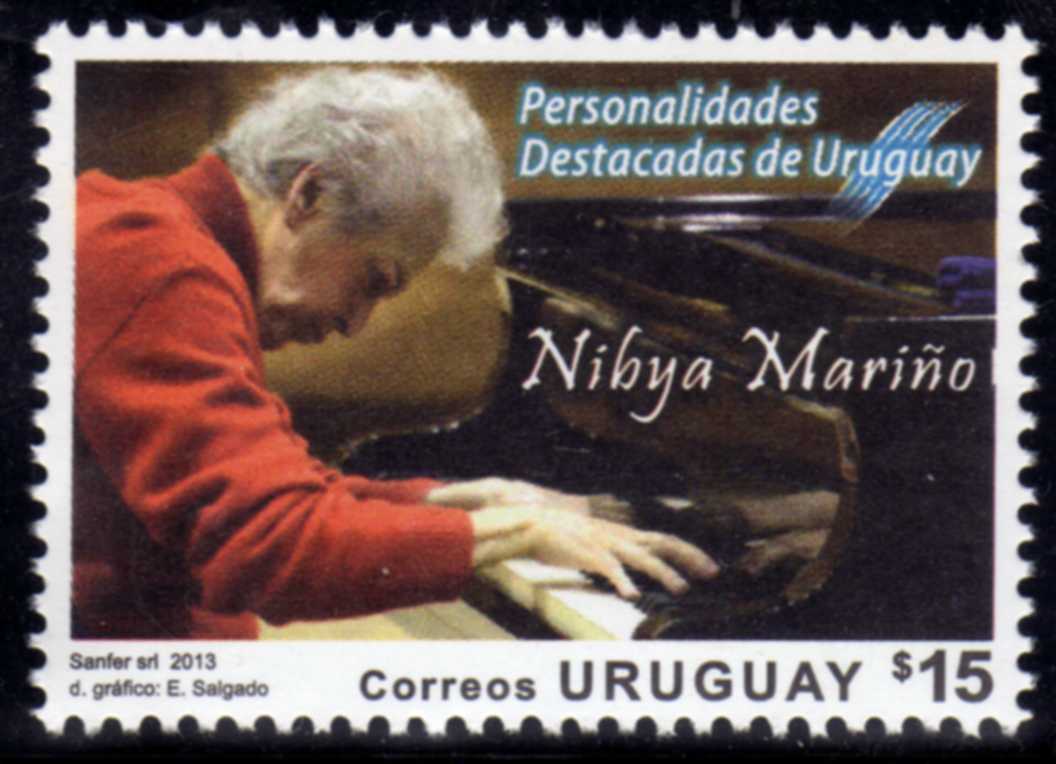
This stamp is a new release of an annually that is being issued since last year about prominent personalities of Uruguay. This year, the honour of being chosen for this serie, it is for Nibya Mariño, a contemporary classical pianist from Uruguay.

The stamp, which was released just one day before the 94th birthday of Nibya, shows a picture of her, deeply concentrated and with fierce attitude, with his hands over a black grand piano, in one of his recent concertos.

The design is completed with the logo of the serie with the legend "Personalidades destacadas del Uruguay", that in english means "Prominent personalities of Uruguay", crossed with a white and sky-blue national ribbon, and bellow of this legend, the name of the pianist honoured.

This release repeats the block configuration introduced in the eight issue of this year about soccer team "Defensor", and adds an unique label in the center position of the block, making it a valuable collector item, as it exist only one for each eight stamps that composes the block. Both Label and block design will be described later, each one in their respective sections.

In relation to the annually serie, this second release shows that there is from a wide domain that the personalities are selected, as the other personality selected was from a completely different activity, as it was Enrique Iglesias, an also contemporanean, however an economist man, that received global recognition after being elected president of the Inter-American Development Bank in 1988.

Finally, another topics that could be considered to be present in this stamp are: women, music, musical instruments, wood, and gray hair.

Nybia Marino Bellini was born on March 23th of 1919 in Montevideo, and is a worldwide known Uruguayan classical pianist.

He began his musical training being very small with Master William Kolischer. He debuted at the age of six years, and only a few years later, still being a little girl, she gives a concert at the theater "Colón" in Buenos Aires, playing the Concerto in LA minor Op 54 by Robert Schumann, under the direction of Ernest Ansermet.

He traveled to Paris to improve her technique, where she took part in several competitions, standing out his performance in Brussels, in the Isaye contest, where she was the best and get very good returns. From there, Mariño began a series of concerts throughout Europe, Latin America and the United States.

He continued her studies in the United States with Claudio Arrau, considered the greatest pianist in the world. In this country recorded three CDs, two works by Schumann and the other with the Concerto for Two Pianos of Poulenc with the also Uruguayan Enrique Graf and an orchestra, under the direction of David Stohl.

She had played in the most important theaters of the world, both in the U.S. and Europe. He formed a remembered duo with Hugo Balzo. In 1994 she received an award from the Organization of American States (OAS) for her contribution to the artistic community of the Americas.

In late March 2009 he was honored for his 90 years of life. The concert, organized by SODRE Symphony Orchestra under the direction of maestro Piero Gamba, included the Piano Concerto No. 4 Op 58 by Ludwig van Beethoven.

She is married to Walter Pintos Surmani (son of well known uruguayan architect Walter Pintos Risso), and is the mother of Sergio Pintos Marino.

The piano is a musical instrument played by means of a keyboard. Widely used in classical and jazz music for solo performances, ensemble use, chamber music and accompaniment, the piano is also popular as a tool for composing and rehearsal. Although not portable and often expensive, the piano's versatility and ubiquity have made it one of the world's most familiar musical instruments.

Pressing a key on the piano's keyboard causes a padded (often with felt) hammer to strike steel strings. The hammers rebound, and the strings continue to vibrate at their resonant frequency. These vibrations are transmitted through a bridge to a sounding board that more efficiently couples the acoustic energy to the air. The sound would otherwise be no louder than that directly produced by the strings. When the key is released, a damper stops the string's vibration and the sound. See the article on Piano key frequencies for a picture of the piano keyboard and the location of middle-C. In the Hornbostel-Sachs system of instrument classification, pianos are considered chordophones.

The word piano is a shortened form of pianoforte (PF), the Italian word for the instrument (which in turn derives from the previous terms gravicembalo col piano e forte and fortepiano). The Italian musical terms piano and forte indicate "soft" and "strong" respectively, in this context referring to the variations in sound volume the instrument produces in response to a pianist's touch on the keys: the greater the velocity of a key press, the greater the force of the hammer hitting the strings, and the louder the sound of the note produced.

The piano was founded on earlier technological innovations. The first string instruments with struck strings were the hammered dulcimers.[3] During the Middle Ages, there were several attempts at creating stringed keyboard instruments with struck strings. By the 17th century, the mechanisms of keyboard instruments such as the clavichord and the harpsichord were well known. In a clavichord the strings are struck by tangents, while in a harpsichord they are plucked by quills. Centuries of work on the mechanism of the harpsichord in particular had shown the most effective ways to construct the case, soundboard, bridge, and keyboard for a mechanism intended to hammer strings.

The invention of the modern piano is credited to Bartolomeo Cristofori (1655–1731) of Padua, Italy, who was employed by Ferdinando de' Medici, Grand Prince of Tuscany, as the Keeper of the Instruments. He was an expert harpsichord maker, and was well acquainted with the body of knowledge on stringed keyboard instruments. It is not known exactly when Cristofori first built a piano. An inventory made by his employers, the Medici family, indicates the existence of a piano by the year 1700; another document of doubtful authenticity indicates a date of 1698. The three Cristofori pianos that survive today date from the 1720s.

While the clavichord allowed expressive control of volume and sustain, it was too quiet for large performances. The harpsichord produced a sufficiently loud sound, but had little expressive control over each note. The piano was likely formed as an attempt to combine loudness with control, avoiding the trade-offs of available instruments.

Cristofori's great success was solving, with no prior example, the fundamental mechanical problem of piano design: the hammer must strike the string, but not remain in contact with it (as a tangent remains in contact with a clavichord string) because this would dampen the sound. Moreover, the hammer must return to its rest position without bouncing violently, and it must be possible to repeat a note rapidly. Cristofori's piano action was a model for the many different approaches to piano actions that followed. Cristofori's early instruments were made with thin strings, and were much quieter than the modern piano—but compared to the clavichord (the only previous keyboard instrument capable of dynamic nuance via the keyboard) they were much louder and had more sustain.

Cristofori's new instrument remained relatively unknown until an Italian writer, Scipione Maffei, wrote an enthusiastic article about it in 1711, including a diagram of the mechanism. This article was widely distributed, and most of the next generation of piano builders started their work due to reading it. One of these builders was Gottfried Silbermann, better known as an organ builder. Silbermann's pianos were virtually direct copies of Cristofori's, with one important addition: Silbermann invented the forerunner of the modern damper pedal, which lifts all the dampers from the strings simultaneously.

Piano-making flourished during the late 18th century in the Viennese school, which included Johann Andreas Stein (who worked in Augsburg, Germany) and the Viennese makers Nannette Streicher (daughter of Stein) and Anton Walter. Viennese-style pianos were built with wood frames, two strings per note, and had leather-covered hammers. Some of these Viennese pianos had the opposite coloring of modern-day pianos; the natural keys were black and the accidental keys white. It was for such instruments that Wolfgang Amadeus Mozart composed his concertos and sonatas, and replicas of them are built today for use in authentic-instrument performance of his music. The pianos of Mozart's day had a softer, more ethereal tone than today's pianos or English pianos, with less sustaining power. The term fortepiano is now used to distinguish the 18th-century instrument from later pianos.

In the period lasting from about 1790 to 1860, the Mozart-era piano underwent tremendous changes that led to the modern form of the instrument. This revolution was in response to a preference by composers and pianists for a more powerful, sustained piano sound, and made possible by the ongoing Industrial Revolution with resources such as high-quality piano wire for strings, and precision casting for the production of iron frames. Over time, the tonal range of the piano was also increased from the five octaves of Mozart's day to the 7⅓ or more octaves found on modern pianos.


Label:

The label design is divided in two frames. The right one shows a beautiful picture with a close-up of Nibya Marino in her youth, with it sight pointing a bit upwards, and her hands together below her chin. Then, left one also present a picture, however this time of a poster that promotes an early concert of this pianist.

The concert was held, as it is said in the poster, on a Saturday June 24th, of a year that we do not know, in the auditoriom of the "Orquesta Sinfónica del Servicio Oficial de Difusión Radio Eléctrica (OSSODDRE), that is the national symphonic orchestra of Uruguay. The concert, as also expressed in the poster, has two functions, one at 18:00 and the other at 21:00, and was directed by Lamberto Baldi, one of the most known directors of the OSSSODRE.

The poster besides the information about the concert, shows another nice picture of Nibya, wearing a dress, and looking very young, surely younger even than in the right picture.

Finally, also from the poster, it could be seen that the coat of arms is included in it, so this label could be useful, for very deep searchers collectors of topics coat of arms, and also for collectors of animals, specially horses and cows, measurement instruments, specially scales, and Lighthouses, as a horse, a cow, a scale, and the Hill of Montevideo with his lighthouse are included in the Coat of Arms of Uruguay

The "Servicio Oficial de Difusión, Radiotelevisión y Espectáculos (SODRE)", that in english means "Official Service of Broadcasting, Radio, Television, and Shows", is an institute under the Ministry of Education and Culture of Uruguay, for the dissemination and generation of information, art and culture in general. It was created by Law No. 8,557 on December 19th of 1929.

Created as "Servicio Oficial de Difusión Radio Eléctrica", that could be translated in english to "Official Service of Radio Electric Broadcasting", its initial function was to broadcast cultural and information programs, that is transmit shows or performances of an artistic, scientific, illustrative or entertaining purposes for the spiritual improvement of the country's inhabitants. The law also mandated creation, among other things, of schools and conservatories, and to acquire and lease phonographic material, theatrical, cinematic, or printed music that relates to their activities, also to edit catalogs, programs or other publications, among other things. By the same law established a symphony orchestra, a chamber, a choir, a ballet, theaters, an audio library and other departments.

The SODRE now has four stable divisions: Symphony Orchestra, Chamber Music, Choir, and Corps de Ballet, and it also had the "Escuela Nacional de Danza", in english "National Dance School", also three medium wave radio stations, two in shortwave and five in modulated frequency. Besides it has a Museum of the Word, that treasures intellectuals recordings of speechs done by personalities from art, culture, society, politics, and a National Archive Image that, in addition to preserving a valuable historical heritage , it also produces and exhibits films and videos.

The "Orquestra Sinfónica del SODRE (OSSODRE)", the SODRE Symphony Orchestra, began operations on June 20th of 1931, directed by Vicente Pablo. With 103 musicians, began the path of longest-lived body in Uruguay in the official plan. In the history of the orchestra it is remarkable the contribution of Erich Kleiber. During World War II, Uruguay get benefited from the arrival of teachers who settled in America.

Then, directed by Kleiber, Albert Wolf and Fritz Busch, OSSODRE received the distinguished visitors as Jascha Horeinstein, Paul Paray, Clement Krauss, Hermann Scherchen, Victor de Sabata, Malcolm Sargent, Arthur Rodzinsky, Nikolai Malko, Paul Klechi, Witold Rowicki, Leopold Ludwig, Wilhelm Van Otterloo, Kiril Kondrashin, Jean Martinon, Enrique Jorda, Antal Dorati and Howard Mitchell, among others.

After that there came a crisis with the removal of most of the musicians and was called Lamberto Baldi to reorganize the orchestra. Following an international call, the OSSODRE reached its highest level, however, with the departure of Baldi, programs began to lose interest, and the Studio Theater fire in 1971 was a blow to the orchestra. Thereafter, he had no fixed place, so it has to rehearse and act in Teatro Solis and other rooms. This led to impairments in the technical and the beginning of a period of ups and downs.

The stable direction of Juan José Castro enriched the repertoire of the twentieth century, with fundamental contributions of De Falla, Hindemith, Stravinsky, Dmitri Shostakovich, Bela Bartok. From 1985 came back world renowned directors such as Simon Blech, Jorghe Rotter, Shunji Aretani, and new names like the Mexican Eduardo Diazmuñoz, Nicolas Rauss, Nicolas Pasquet or Brazilian David Machado.

At a later stage, was appointed artistic director Roberto Montenegro, who was inclined to more sober and traditional repertoire than its predecessor. Then headed Piero Gamba and stable David Machado as director from 1966. His unexpected death left a void that Piero Gamba was able to fill in the emergency.

Lamberto Baldi was born on 1895 in Orvieto, Italy, and passed away on 1979 in Montevideo, he was an Italian conductor and composer.

Baldi received his musical training in Orvieto, and then studied with Ildebrando Pizzetti in Florence. After working in various European countries, in 1926, he emigrated to South America. Until 1931 he was Director of the "Sociedad de Conciertos Sinfónicos" of San Pablo, and then he worked until 1942 (and again in 1951-1953) as director of the OSSODRE.

Then he conducted at the Colón Theater in Buenos Aires, Argentina, and wwas director of the Municipal Symphony Orchestra of that city from 1947 to 1949. Finally, from 1962 to 1963 he organized the Chamber Orchestra of the Gulbenkian Foundation in Lisbon Caloustre.

Baldi led mainly on the works of contemporary composers such as Claude Debussy, Paul Hindemith, Arthur Honegger, Igor Stravinsky, Eduardo Fabini and Héctor Tosar. He also orchestrated the opera Euridice by Jacopo Peri, who had worldwide success after its premiere on 1949 in Montevideo.


Block:

The block design is nice and reinforces the content of stamps and label. The major highlight of it is the inclusion of another picture, surely from the same concert as the one of the stamp photograph, in which Nibya's hands receive the main attention, as they are placed above the stamps and between the two legends of the block, that repeats the ones of the stamp, that are "Prominent personalities of Uruguay, and the name of the pianist.

The picture mentioned it is blurred and faded as one goes from up to down, and the design is completed with a set of four stylized icons of grand pianos to show the inks used to print the block.


FDC:

The cancelation is quite simple, besides the legends present in both stamp and block, that express the name of this anual serie, and the name of the personality chosen this year, i also includes a section of the keyboard of a piano.

Then, about the cover of the FDC, it is a special one, specially built for this release. However, the design of the cover it is intentionally not fully original, as is it is follows the same pattern of the one made for the release of this serie of prominent personalities of Uruguay of past year. The only difference is that now "Sra. Nibya Mariño" replaces "Cr. Enrique V. Iglesias" of the previous cover, however maintaining the same stylized font.


If you consider that there are another topics in this stamp, that were not spot in this review, you are encouraged to telling me about them, so please do not hesitate to post a comment. I would appreciate your help very much.

URU - 2013 - #010 - FDC Sent on First Day - PROMINENT PERSONALITIES OF URUGUAY, NIBYA MARIÑO


Uruguay - 2013 - Prominent personalities of Uruguay, Nibya Mariño


If you are interested in any of this items, or any other items from Uruguay, just make a donation including your e-mail in the description.

I will contact you as soon I receive your donation, we agree on which items do you need, and I will discount the donation done to the amount of your purchase.


URU - 2013 - #010 - COVER Sent on First Day - PROMINENT PERSONALITIES OF URUGUAY, NIBYA MARIÑO


Uruguay - 2013 - Prominent personalities of Uruguay, Nibya Mariño


If you are interested in any of this items, or any other items from Uruguay, just make a donation including your e-mail in the description.

I will contact you as soon I receive your donation, we agree on which items do you need, and I will discount the donation done to the amount of your purchase.


URU - 2013 - #010 - SERIE [1x2] with LABEL - PROMINENT PERSONALITIES OF URUGUAY, NIBYA MARIÑO


Uruguay - 2013 - Prominent personalities of Uruguay, Nibya Mariño


If you are interested in any of this items, or any other items from Uruguay, just make a donation including your e-mail in the description.

I will contact you as soon I receive your donation, we agree on which items do you need, and I will discount the donation done to the amount of your purchase.


URU - 2013 - #010 - SERIE [2x2] with LABEL - PROMINENT PERSONALITIES OF URUGUAY, NIBYA MARIÑO


Uruguay - 2013 - Prominent personalities of Uruguay, Nibya Mariño


If you are interested in any of this items, or any other items from Uruguay, just make a donation including your e-mail in the description.

I will contact you as soon I receive your donation, we agree on which items do you need, and I will discount the donation done to the amount of your purchase.