viernes, 29 de abril de 2016

PERSONALITIES - WRITERS - WILLIAM SHAKESPEARE


Personalities - Writers

William Shakespeare


Characteristics :

Birth Date : Unknown (Baptised: April 26th 1564)
Birth Place : Stratford-upon-Avon – England

Decease Date : April 23rd, 1616
Decease Place : Stratford-upon-Avon – England

Occupation : Playwright, Poet, Actor
Period :
English Renaissance, Elizabethan Era

Spouse :
Anne Hathaway (married from 1582 to 1616)
Children :
Susanna Hall, Hamnet Shakespeare, Judith Quiney


Description:

William Shakespeare(26 April 1564 (baptised) – 23 April 1616) was an English poet, playwright, and actor, widely regarded as the greatest writer in the English language and the world's pre-eminent dramatist. He is often called England's national poet, and the "Bard of Avon". His extant works, including collaborations, consist of approximately 38 plays, 154 sonnets, two long narrative poems, and a few other verses, some of uncertain authorship. His plays have been translated into every major living language and are performed more often than those of any other playwright.


Biography :

Shakespeare was born and brought up in Stratford-upon-Avon, Warwickshire. At the age of 18, he married Anne Hathaway, with whom he had three children: Susanna, and twins Hamnet and Judith. Sometime between 1585 and 1592, he began a successful career in London as an actor, writer, and part-owner of a playing company called the Lord Chamberlain's Men, later known as the King's Men. He appears to have retired to Stratford around 1613, at age 49, where he died three years later. Few records of Shakespeare's private life survive, which has stimulated considerable speculation about such matters as his physical appearance, sexuality, and religious beliefs, and whether the works attributed to him were written by others.

Shakespeare produced most of his known work between 1589 and 1613. His early plays were primarily comedies and histories, and these are regarded as some of the best work ever produced in these genres. He then wrote mainly tragedies until about 1608, including Hamlet, Othello, King Lear, and Macbeth, considered some of the finest works in the English language. In his last phase, he wrote tragicomedies, also known as romances, and collaborated with other playwrights.

Many of his plays were published in editions of varying quality and accuracy during his lifetime. In 1623, however, John Heminges and Henry Condell, two friends and fellow actors of Shakespeare, published a more definitive text known as the First Folio, a posthumous collected edition of his dramatic works that included all but two of the plays now recognized as Shakespeare's. It was prefaced with a poem by Ben Jonson, in which Shakespeare is hailed, presciently, as "not of an age, but for all time".

In the 20th and 21st centuries, his works have been repeatedly adapted and rediscovered by new movements in scholarship and performance. His plays remain highly popular, and are constantly studied, performed, and reinterpreted in diverse cultural and political contexts throughout the world.


Philatelic Issues


2016 – Uruguay – Unique Miniature Sheet, from William Shakespeare Series


Issue information:

Country: Uruguay
Date: April 28th, 2016
Printed: 10.000 Copies
Type: Stamps Series
Value:UYP 60

Stamp: Rectangular
Size: 101 mm. x 62 mm.
Perforation: Circular
Gum: Water Activated

jueves, 28 de abril de 2016

INTERNATIONAL ORGANIZATIONS - MERCOSUR


International Organizations

Mercosur


Characteristics :

Type : Intergovermental

Establishment :
Treaty of Asunción (March 26th 1991) and
Protocol of Ouro Preto (December 16th 1994)
Headquarters :
Montevideo, San Pablo, Buenos Aires, Rio de Janeiro, Caracas
Official Languages :
Spanish, Portuguese, Guarani

Full Members : 5 (Argentina, Brazil, Paraguay, Uruguay, Venezuela)
Associated Members : 5 (Chile, Bolivia, Colombia, Ecuador, Perú)
Observer Members : 2 (México, New Zealand)

Area : 19.326.961 km2 (Full members only)
Population :
288.996.820 (2012)
Density : 15 / km2


Description:

Mercosur or Mercosul (Spanish: Mercado Común del Sur, Portuguese: Mercado Comum do Sul, Guarani: Ñemby Ñemuha, in English: “Southern Common Market”) is a sub-regional bloc.

Its full members are Argentina, Brazil, Paraguay, Uruguay and Venezuela. Its associate countries are Bolivia, Chile, Peru, Colombia, Ecuador and Suriname. And, Observer countries are New Zealand and Mexico.

Its purpose is to promote free trade and the fluid movement of goods, people, and currency. The official languages are Spanish, Portuguese and Guarani. It has been updated, amended, and changed many times since. It is now a full customs union and a trading bloc. Mercosur and the Andean Community of Nations are customs unions that are components of a continuing process of South American integration connected to the Union of South American Nations.


Geography :

The territory of Mercosur consists of the combined territories of five of the 12 countries of South America and their population. Including the overseas territories of member states, Mercosur experiences most types of climate from Antarctic to tropical, rendering meteorological averages for Mercosur as a whole meaningless. The majority of the population lives in areas with a subtropical climate (Uruguay, Southern Paraguay, Northeastern Argentina and Southern and Southeastern Brazil), or a tropical climate (Venezuela and Northeastern Brazil).


Merchandise Trade :

Intra-Mercosur merchandise trade (excluding Venezuela) grew from US$10 billion at the inception of the trade bloc in 1991, to US$88 billion in 2010; Brazil and Argentina each accounted for 43% of this total. The trade balance within the bloc has historically been tilted toward Brazil, which recorded an intra-Mercosur balance of over US$5 billion in 2010. Trade within Mercosur amounted to only 16% of the four countries' total merchandise trade in 2010, however; trade with the European Union (20%), China (14%), and the United States (11%) was of comparable importance. Exports from the bloc are highly diversified, and include a variety of agricultural, industrial, and energy goods. Merchandise trade with the rest of the world in 2010 resulted in a surplus for Mercosur of nearly US$7 billion; trade in services, however, was in deficit by over US$28 billion. The EU and China maintained a nearly balanced merchandise trade with Mercosur in 2010, while the United States reaped a surplus of over US$14 billion; Mercosur, in turn, earned significant surpluses (over US$4 billion each in 2010) in its trade with Chile and Venezuela. The latter became a full member in 2012.


Philatelic Issues


2016 – Uruguay – Unique Stamp, from Mercosur Series


Issue information:

Country: Uruguay
Date: April 25th, 2016
Printed: 15.000 Copies
Type: Unique Stamp from Series
Value:UYP 60

Stamp: Rectangular
Size: 39 mm. x 27 mm.
Perforation: Circular
Gum: Water Activated

martes, 26 de abril de 2016

HEALTH - DISEASES - VISUAL IMPAIRMENT


Health - Diseases

Visual Impairment


Characteristics:

Speciality : Ophthalmology

ICD - 10 : H54.0 , H54.1 , H54.4
ICD - 9 - CM : 369
Diseases DB : 28256
MedilinePlus :
003040
MeSH : D001766


Description :

Visual impairment, also known as vision impairment or vision loss, is a decreased ability to see to a degree that causes problems not fixable by usual means, such as glasses. Some also include those who have a decreased ability to see because they do not have access to glasses or contact lenses. Visual impairment is often defined as a best corrected visual acuity of worse than either 20/40 or 20/60. The term blindnessis used for complete or nearly complete vision loss. Visual impairment may cause people difficulties with normal daily activities such as driving, reading, socializing, and walking.

The most common causes of visual impairment globally are uncorrected refractive errors (43%), cataracts (33%), and glaucoma (2%).] Refractive errors include near sighted, far sighted, presbyopia, and astigmatism. Cataracts are the most common cause of blindness. Other disorders that may cause visual problems include age related macular degeneration, diabetic retinopathy, corneal clouding, childhood blindness, and a number of infections. Visual impairment can also be caused by problems in the brain due to stroke, prematurity, or trauma among others. These cases are known as cortical visual impairment. Screening for vision problems in children may improve future vision and educational achievement. Screening adults may also be beneficial. Diagnosis is by an eye exam.

The World Health Organization (WHO) estimates that 80% of visual impairment is either preventable or curable with treatment. This includes cataracts, the infections river blindness and trachoma, glaucoma, diabetic retinopathy, uncorrected refractive errors, and some cases of childhood blindness. Many people with significant visual impairment benefit from vision rehabilitation, changes in their environmental, and assistive devices.

As of 2012 there were 285 million people who were visually impaired of which 246 million had low vision and 39 million were blind. The majorities of people with poor vision is in the developing world and are over the age of 50 years. Rates of visual impairment have decreased since the 1990s. Visual impairments have considerable economic costs both directly due to the cost of treatment and indirectly due to decreased ability to work.


Diagnosis :

It is critical that all people be examined by someone specializing in low vision care prior to other rehabilitation training to rule out potential medical or surgical correction for the problem and to establish a careful baseline refraction and prescription of both normal and low vision glasses and optical aids. Only a doctor is qualified to evaluate visual functioning of a compromised visual system effectively.

The American Medical Association provide an approach to evaluating visual loss as it affects an individual's ability to perform activities of daily living.


Philatelic Issues


2016 – Uruguay – Unique Miniature Sheet, from Blind Congress Series


Issue information:

Country: Uruguay
Date: April 20th, 2016
Printed: 10.000 Copies
Type: Unique Miniature Sheet from Series
Value:UYP 20

Stamp: Rectangular
Size: 120 mm. x 70 mm.
Perforation: Circular
Gum: Water Activated

martes, 19 de abril de 2016

ANIMALS – REPTILES – SNAKES – CROSSED PIT VIPER (BOTHROPS ALTERNATUS)


Animals - Reptiles - Snakes

Crossed Pit Viper (Bothrops alternatus)


Scientific Classification:

Kingdom : Animalia
Phylum : Chordata
Subphylum : Vertebrata
Class : Reptilia
Order : Squamata
Suborder : Serpentes
Family : Viperidae
Subfamily :Crotalinae
Genus : Bothrops
Species :
B. Alternatus


Description:

The Crossed Pit Viper(Bothrops alternatus) is a venomous pit viperspecies found in Brazil, Paraguay, Uruguay and Argentina. Within its range, it is an important cause of snakebite. The specific name, alternatus, which is Latin for "alternating", is apparently a reference to the staggered markings along the body. No subspecies are currently recognized.

Large and stout, this terrestrial species reportedly exceeds 2 m (6.6 ft) in total length, although the verified maximum is 169 cm (67 in). Most specimens are 80–120 cm (31–47 in) in total length, with females being significantly longer and heavier than males.

Occurs in tropical and semitropical forests, as well as temperate deciduous forests. According to Gallardo (1977), it prefers marshes, low-lying swamps, riparian zones and other humid habitats. It is also said to be common in sugarcane plantations. It is found in a variety of habitats depending on the latitude, including open fields and rocky areas in the Sierra de Achiras in Córdoba and the Sierra de la Ventana in Buenos Aires in Argentina, fluvial areas, grasslands and cerrado. However, it is usually absent in dry environments.

An important cause of snakebite within its range, bites are rarely fatal but frequently cause severe local tissue damage. Although Spix and Martius (1824) found that it had a reputation for being one of the most venomous snakes in Brazil, its bite "said to occasion almost certain death", the statistics tell a different story. In his survey of 6,601 snakebite cases in Central and South America, Fonseca (1949) found that 384 were attributed to this species and that, of that number, only eight were fatal (2%).


Binomial Name:

Name : Bothrops alternatus
Taxonomist : André Marie Constant Duméril (Amiens - France), Gabriel Bibron (Paris - France), Auguste Henri André Duméril (Paris - France)
Year :
1854
Subspecies :
None, or not data available
Synonyms :
Many


Conservation Status by IUCN:

Status : Not Evaluated, or not data available


Philatelic Issues


2001 - Uruguay - Stamp 2 of 2, from Snakes Series


Issue information:

Country: Uruguay
Date: May 28th, 2001
Printed: 15.000 Copies
Type: Stamp from Series of 2 Stamps
Value: UYP 11

Stamp: Rectangular
Size: 39 mm. x 27 mm.
Perforation: Circular
Gum: Water Activated

lunes, 18 de abril de 2016

ANIMALS - REPTILES - SNAKES - SOUTH AMERICAN GREEN RACER (PHILODRYAS AESTIVA)


Animals - Reptiles - Snakes

South American Green Racer (Philodryas olfersii)


Scientific Classification:

Kingdom : Animalia
Phylum : Chordata
Subphylum : Vertebrata
Class : Reptilia
Order : Squamata
Suborder : Serpentes
Family : Colubridae
Subfamily :Xenodontinae
Genus : Philodryas
Species :
P. Olfersii


Description:

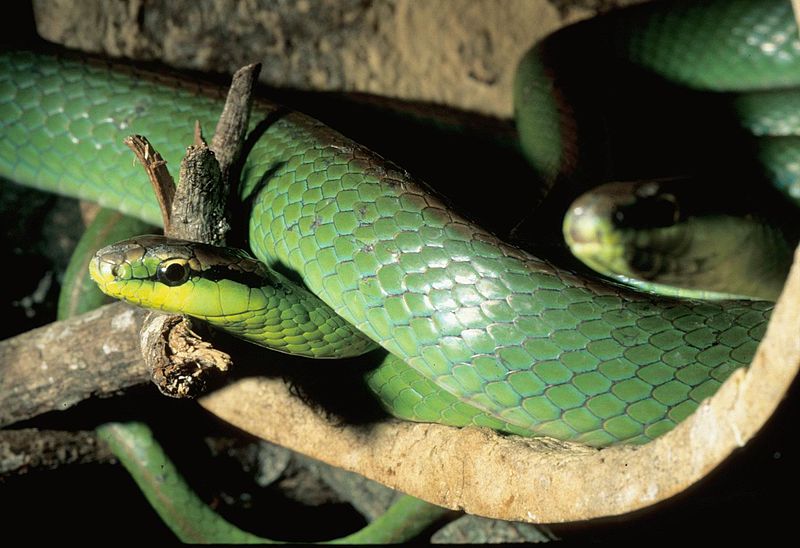
South American Green Racer(Philodryas olfersii) is a species of colubrid snake, endemic to South America, known also by the common names Lichtenstein's green racer, and eastern green whiptail, and in Brazil, cobra-cipó, cobra de São João, cobra-facão, cobra-verde, and mboi-obi.

The specific name, olfersii, is in honor of German naturalist Ignaz von Olfers.

It is native to much of South America, including Brazil, Peru, Bolivia, Paraguay, Uruguay, Argentina, Colombia, French Guiana, and Venezuela.

P. olfersii reaches 1 to 1.5 meters (about 40 to 60 inches) in maximum total length.

Dorsally, it is green in color; ventrally, it is yellowish.

The dorsal scales are smooth, without apical pits, and are arranged in 19 rows at midbody.

It can be found in many habitat types, including the Cerrado, Caatinga, forests, forest transition, and restinga.

This species is often arboreal, but it also forages on the ground. It is diurnal, though it has been observed mating late in the evening.

Prey items include rodents, lizards, amphibians, and birds, especially nestlings. They will also eat other snakes, including ones almost as large as themselves.

The egg of the snake measures about 5 centimeters (about 2 inches). The clutch size is 4 to 11 eggs, with larger females producing more eggs than smaller ones.


Binomial Name:

Name : Philodryas olfersii
Taxonomist : Martin Hinrich Carl Lichtenstein (Hamburg - Germany)
Year :
1823
Subspecies :
3 (Herbeus, Iatirostris, Olfersii)
Synonyms :
Coluber olfersii, Herpetodryas olfersii, Dryophylax olfersii, Philodryas olfersii


Conservation Status by IUCN:

Status : Not Evaluated, or not data available


Philatelic Issues


2001 - Uruguay - Stamp 1 of 2, from Snakes Series


Issue information:

Country: Uruguay
Date: May 28th, 2001
Printed: 15.000 Copies
Type: Stamp from Series of 2 Stamps
Value: UYP 11

Stamp: Rectangular
Size: 39 mm. x 27 mm.
Perforation: Circular
Gum: Water Activated

domingo, 17 de abril de 2016

ANIMALS – INSECTS – BEES – WESTERN HONEY BEE (APIS MELLIFERA)


Animals - Insects - Bees

Western Honey Bee (Apis mellifera)


Scientific Classification:

Kingdom : Animalia
Phylum : Arthropoda
Class : Insecta
Order : Hymenoptera
Family :Apdae
Genus : Apis
Species :
A. Mellifera


Description:

The Western honey beeor European honey bee(Apis mellifera) is a species of honey bee. The genus name Apis is Latin for "bee", and mellifera means "honey-bearing". It has a defined social caste system and complex communication behaviors, such as intricate dance routines to indicate food availability. It is frequently maintained by beekeepers for its honey product. This species is widely distributed and an important pollinator for agriculture, though it is currently threatened by colony collapse disorder. It is also an important organism for scientific studies on social insects, especially as it now has a fully sequenced genome.

The western honey bee isnative to Europe, Asia and Africa. During the early 1600s it was introduced to North America, with other European subspecies introduced two centuries later. Since then, it has spread throughout the Americas.

Western honey bees evolved into geographic races as they spread from Africa into Eurasia, and 28 subspecies based on these geographic variations are recognized. All races are cross-fertile, although reproductive adaptations may make interbreeding unlikely. The subspecies are divided into four major branches, based on work by Ruttner and confirmed by mitochondrial DNA analysis. African subspecies belong to branch A, northwestern European subspecies branch M, southwestern European subspecies branch C and Mideastern subspecies branch O. These subspecies are listed and grouped in the sidebar. Regions with local variations may be identified as subspecies in the future; A. m. pomonella, from the Tian Shan, would be included in the Mideastern subspecies branch.

Geographic isolation led to adaptation as honey bees spread after the last ice age. These adaptations include brood cycles synchronized to the blooming period of local flora, forming a winter cluster in colder climates, migratory swarming in Africa and enhanced foraging behavior in desert areas.


Binomial Name:

Name : Apis mellifera
Taxonomist : Carl Linnaeus (Småland - Sweden)
Year :
1758
Subspecies :
Many
Synonyms :
Apis Mellifica


Conservation Status by IUCN:

Status : Not Evaluated, or not data available


Philatelic Issues


2001 – Uruguay – Bees Series


Issue information:

Country: Uruguay
Date: Septermber 12th, 2001
Printed: 15.000 Copies
Type: Complete 2 Stamp Series
Value:
2 * UYP 12 = UYP 24

Stamp: Rectangular
Size: All 35 mm. x 25 mm.
Perforation: Circular
Gum: Water Activated

martes, 5 de abril de 2016

ARCHITECTURE - TEMPLES - ERECHTHEION


Architecture - Temples

Erechtheion


Characteristics :

Architectural Style : Ionic

Location : Athens - Greece
Owner : Greek Government

Construction Started : 421 BC
Construction Completed : 406 BC

Architect : (may have been)Mnesikles
Sculptor and Mason :
Phidias
Ordained by : Pericles

Dedicated to : Athena and Poseidon


Description:

The Erechtheionor Erechtheum, is an ancient Greek temple on the north side of the Acropolis of Athens in Greece which was dedicated to both Athenaand Poseidon.


Etymology :

The temple as seen today was built between 421 and 406 BCE. Its architect may have been Mnesicles, and it derived its name from a shrine dedicated to the legendary Greek hero Erichthonius. The sculptor and mason of the structure was Phidias, who was employed by Periclesto build both the Erechtheum and the Parthenon. Some have suggested that it may have been built in honor of the legendary king Erechtheus, who is said to have been buried nearby. Erechtheus was mentioned in Homer's Iliad as a great king and ruler of Athens during the Archaic Period, and Erechtheus and the hero Erichthonius were often syncretized. It is believed to have been a replacement for the Peisistratid temple of Athena Polias destroyed by the Persians in 480 BC.

The need to preserve multiple adjacent sacred precincts likely explains the complex design. The main structure consists of up to four compartments, the largest being the east cella, with an Ionic portico on its east end. Other current thinking would have the entire interior at the lower level and the East porch used for access to the great altar of Athena Polias via a balcony and stair and also as a public viewing platform.

The entire temple is on a slope, so the west and north sides are about 3 m (9 ft) lower than the south and east sides. It was built entirely of marble from Mount Pentelikon, with friezes of black limestone from Eleusis which bore sculptures executed in relief in white marble. It had elaborately carved doorways and windows, and its columns were ornately decorated (far more so than is visible today); they were painted, gilded and highlighted with gilt bronze and multi-colored inset glass beads. The building is known for early examples of egg-and-dart, and guilloche ornamental moldings. The Theory of Mouldings, p22, J.H. Janson 1926, has detailed drawings of some of the decorations.

On the north side, there is another large porch with six Ionic columns, and on the south, the famous "Porch of the Maidens", with six draped female figures (caryatids) as supporting columns. The porch was built to conceal the giant 15-ft beam needed to support the southwest corner over the Kekropion, after the building was drastically reduced in size and budget following the onset of the Peloponnesian war.


Philatelic Issues


2016 – Uruguay – Unique Stamp, from Hellenic Community Series


Issue information:

Country: Uruguay
Date: March 16th, 2016
Printed: 15.000 Copies
Type: Unique Stamp from Series
Value:UYP 20

Stamp: Rectangular
Size: 39 mm. x 27 mm.
Perforation: Circular
Gum: Water Activated