Mostrando entradas con la etiqueta Work. Mostrar todas las entradas

martes, 18 de agosto de 2015

URU - 2015 - #024 - BRIEF DESCRIPTION - 25 YEARS OF MASONIC LODGE "GRAN ORIENTE DE URUGUAY"


Uruguay - 2015 - 25 Years of the Masonic Lodge "Gran Oriente de Uruguay" PreviousNext)


Options:

SERIES --- 1,00 EUR
 SERIES [2x2] --- 4,00 EUR
 SERIES [3x3] --- 8,00 EUR
 BLOCK --- 20,00 EUR
 FDC --- 2,00 EUR

If you are interested in any of this items, or any other items from Uruguay, just make a donation including your e-mail in the description.

I will contact you as soon I receive your donation, we agree on which items do you need, and I will discount the donation done to the amount of your purchase.


Issue information:

Country: Uruguay
Date: August 17th, 2015
Printed: 15.000 copies

Stamp Shape and Size: Rectangular [389 mm. x 27 mm.]
Perforation: Circular
Gum: Water Activated

Block Configuration: 25 stamps [5 x 5]
Block Shape and Size: Rectangular [231 mm. x 176 mm.]

FDC Type: Official Cover Issued by Post Office
FDC Shape and Size: Rectangular [165 mm. x 105 mm.]


Catalogue information:

Michel: No Data Available
Ivert: No Data Available
Scott: No Data Available
Stanley & Gibbons: No Data Available

Topics:

Brief Description:

A brief description of the Most Popular Topics of this Release are: Clearly Masonry or Freemasonry,and in particular Freemasonryin Uruguay, and even more precisely the Masonic Lodge "Gran Oriente de Uruguay", whose 25th Anniversary is honoured with this issue.

Freemasonryis a Fraternal Organisation that traces its origins to the local fraternities of Stonemasons, which from the end of the XIV Century regulated the qualifications of Stonemasons and their interaction with authorities and clients. Masons are members of the organization. The degrees of Freemasonry, its gradal system, retain the three grades of medieval craft guilds, those of Apprentice, journeyman or fellow (now called Fellowcraft), and Master Mason. These are the degrees offered by craft, or blue lodge Freemasonry. There are additional degrees, which vary with locality and jurisdiction, and are now administered by different bodies than the craft degrees.

The basic, local organisational unit of Freemasonry is the Lodge. The Lodgesare usually supervised and governed at the regional level (usually coterminous with either a state, province, or national border) by a Grand Lodge or Grand Orient. There is no international, world-wide Grand Lodge that supervises all of Freemasonry. Each Grand Lodge is independent, and they do not necessarily recognise each other.

Then, the desing of the Issue is divided in three clearly defined components, two of them sharing the foreground, that are the kind of Coin that is shown at right, and the Sculptureat Left, over a background of a Chessboard like Floor Tileswith three different Columnsover it, and a full of Stars Sky behind them.

The Coinbrings obviously NumismaticTopic to the Release, also Metalsand Minerals, in particular Gold, as the most probable Materialin which the Coinis made. Then, from the elements in the Coin, clearly the Square and Compass, main Symbols of the Freemasonry, and also Toolsof Measurementand Construction. Also the inscription of "Libertad, Igualdad, Fraternidad" included in the Coin, refers to the French Phrase "Liberté, Egalité, Fraternité" from the French Revolution, so there is here a link to the France as a Country, and to Democracy, Republicanism, and Liberalism Ideologies.

Then, the Sculpture, besides bringing Artto the Topics of the Issue, it also brings Work, as it is the Topic of the Scuplture, and also Marble, because of the Materialin which it was made, and even the Sculptor Angel Ferrari Rocca as the Artist who made the Sculpture that is shown in the Stamp.

Finally, the background of the Stamp links the Release to Architecture by the Columns, to Astronomy or Space, through the Stars and Sky, and Chess because of the Chessboardlike Tiles.


If you consider that there are another topics in this stamp, that were not spot in this review, you are encouraged to telling me about them, so please do not hesitate to post a comment. I would appreciate your help very much.

sábado, 28 de septiembre de 2013

URU - 2013 - #015 - SERIE - RURAL WORKER RIGHTS, FISHERWOMAN


Uruguay - 2013 - Permanent Serie of Rural Worker Rights, Fisherwoman


Options:

SERIE --- 4,20 EUR
SERIE [2X2] --- 15,00 EUR
FDC not Sent --- 5,60 EUR
FDC Sent on First Day --- 9,00 EUR
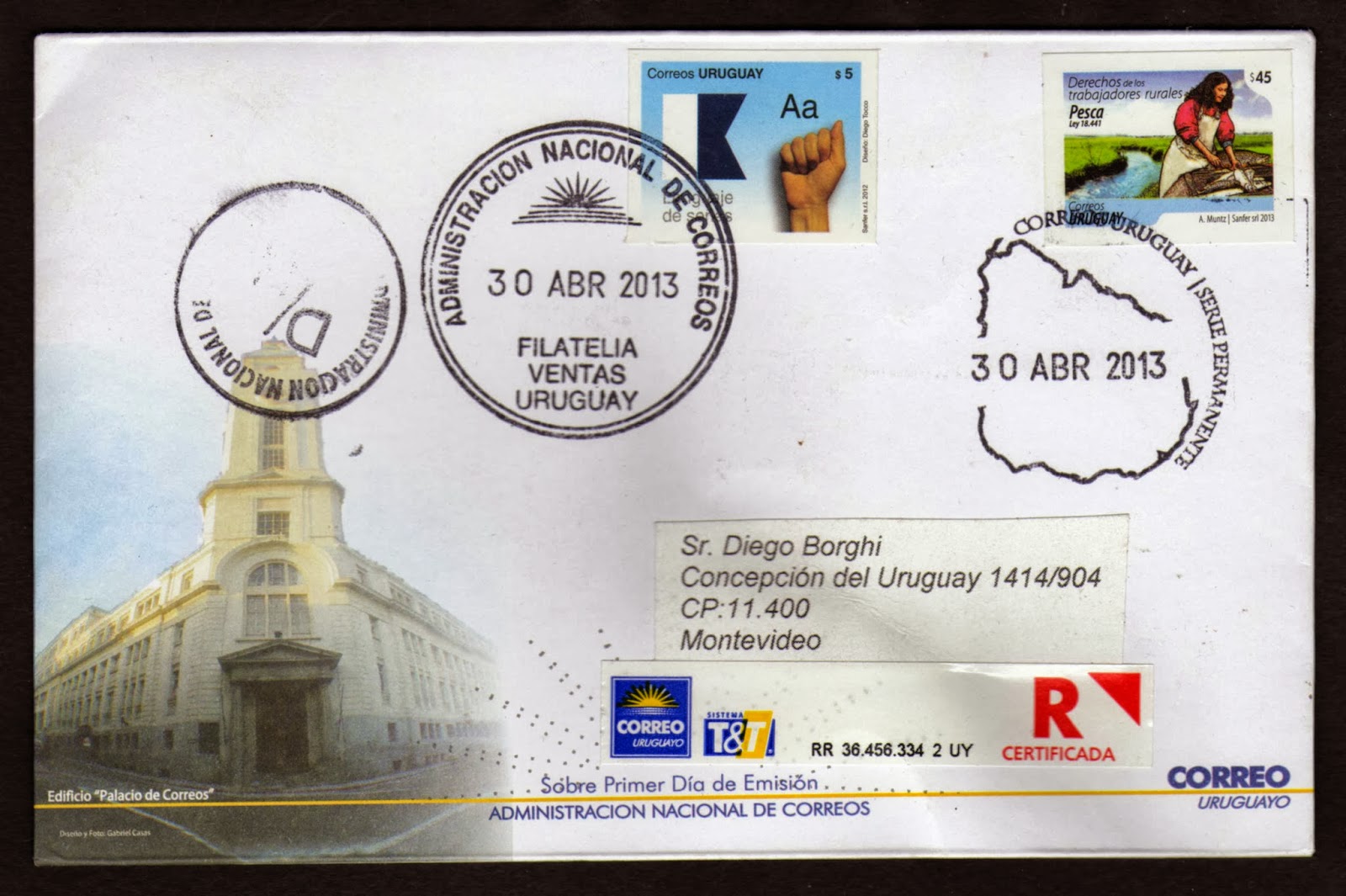
COVER Sent on First Day --- 6,00 EUR

If you are interested in any of this items, or any other items from Uruguay, just make a donation including your e-mail in the description.

I will contact you as soon I receive your donation, we agree on which items do you need, and I will discount the donation done to the amount of your purchase.


Issue information:

Country: Uruguay
Date: April 30th, 2013
Printed: 100.000 copies

Stamp Shape and Size: Rectangular [27 mm. x 20 mm.]
Perforation: Lines
Gum: Self Adhesive

Block Configuration: 25 stamps [5 x 5]
Block Shape and Size: Rectangular [219 mm. x 195 mm.]

FDC Type: Normal
FDC Shape and Size: Rectangular [165 mm. x 105 mm.]
Cover Shape and Size: Rectangular [241 mm. x 159 mm.]

Catalogue information:

Michel: No Data Available
Ivert: No Data Available
Scott: No Data Available
Stanley & Gibbons: No Data Available

Topics:

Issue:

This stamp is the sixth release of the permanent serie already mentioned, thought to spread awareness about the right of rural works enshrined in law 18.441, added in Uruguay law system on December 24th, 2008.

This permanent serie will be compounded by many stamps, nine already were issued at the moment was written this article. In each of them a different rural activity, and in particular, the rural worker involved in it, will be focus of the issue.

In this particular issue, the fisherwoman is the activity choosen, and the design for depicting this task was to show a women wearing an apron, cutting the fish and removing their viscera, over a table, near a tiny rivulet. The selection of a woman in duty in this stamp as in the previous two ones of this permanent serie, adds the topic of gender equality at job, that around the globe it is a problem still unsolved.

The design of the stamps also shows an idyllic field of bright green grass under a lightly clouded sky.

The right of rural works enshrined in law 18.441 were: Limitation of labour to 8 hours a day; Payment of overtime for time which exceeds the legal time; Intermediate rest for continuous-time workers; Free day between 12 hours labour days; Weekly free day.

Other rural worker rights that are not included in law 18.441, however very important for them are: Freedom of union association; Collective bargaining; Participation in the Councils of wage.

Fishing is the activity of trying to catch fish. Fish are normally caught in the wild. Techniques for catching fish include hand gathering, spearing, netting, angling and trapping.

The term fishing may be applied to catching other aquatic animals such as molluscs, cephalopods, crustaceans, and echinoderms. The term is not normally applied to catching farmed fish, or to aquatic mammals, such as whales, where the term whaling is more appropriate.

According to FAO statistics, the total number of commercial fishermen and fish farmers is estimated to be 38 million. Fisheries and aquaculture provide direct and indirect employment to over 500 million people. In 2005, the worldwide per capita consumption of fish captured from wild fisheries was 14.4 kilograms, with an additional 7.4 kilograms harvested from fish farms. In addition to providing food, modern fishing is also a recreational pastime.

Fishing is an ancient practice that dates back to at least the beginning of the Paleolithic period about 40,000 years ago. Isotopic analysis of the skeletal remains of Tianyuan man, a 40,000-year old modern human from eastern Asia, has shown that he regularly consumed freshwater fish. Archaeology features such as shell middens, discarded fish bones and cave paintings show that sea foods were important for survival and consumed in significant quantities. During this period, most people lived a hunter-gatherer lifestyle and were, of necessity, constantly on the move. However, where there are early examples of permanent settlements (though not necessarily permanently occupied) such as those at Lepenski Vir, they are almost always associated with fishing as a major source of food.

The ancient river Nile was full of fish; fresh and dried fish were a staple food for much of the population. The Egyptians had implements and methods for fishing and these are illustrated in tomb scenes, drawings, and papyrus documents. Some representations hint at fishing being pursued as a pastime. In India, the Pandyas, a classical Dravidian Tamil kingdom, were known for the pearl fishery as early as the 1st century BC. Their seaport Tuticorin was known for deep sea pearl fishing. The Paravas, a Tamil caste centred in Tuticorin, developed a rich community because of their pearl trade, navigation knowledge and fisheries. Seafood played a central role in the food culture of ancient Greeks, though fishing scenes are rarely represented in their art, a reflection of the low social status of fishing. Oppian of Corycus, a Greek author wrote a major treatise on sea fishing; the Halieulica or Halieutika, composed between 177 and 180. This is the earliest such work to have survived to the modern day. Pictorial evidence of Roman fishing comes from mosaics. The Roman god of the sea Neptune is depicted as wielding a fishing trident. The Moche people of ancient Peru depicted fishermen in their ceramics.

One of the world’s longest trading histories is the trade of dry cod from the Lofoten area of Norway to the southern parts of Europe, Italy, Spain and Portugal. The trade in cod started during the Viking period or before, has been going on for more than 1,000 years and is still important.

There are many fishing techniques and tactics for catching fish. The term can also be applied to methods for catching other aquatic animals such as molluscs (shellfish, squid, octopus) and edible marine invertebrates.

Fishing techniques include hand gathering, spearfishing, netting, angling and trapping. Recreational, commercial and artisanal fishers use different techniques, and also, sometimes, the same techniques. Recreational fishers fish for pleasure or sport, while commercial fishers fish for profit. Artisanal fishers use traditional, low-tech methods, for survival in third-world countries, and as a cultural heritage in other countries. Mostly, recreational fishers use angling methods and commercial fishers use netting methods.

There is an intricate link between various fishing techniques and knowledge about the fish and their behaviour including migration, foraging and habitat. The effective use of fishing techniques often depends on this additional knowledge. Some fishermen follow fishing folklores which claim that fish feeding patterns are influenced by the position of the sun and the moon.

Fishing tackle is a general term that refers to the equipment used by fishermen when fishing.

Almost any equipment or gear used for fishing can be called fishing tackle. Some examples are hooks, lines, sinkers, floats, rods, reels, baits, lures, spears, nets, gaffs, traps, waders and tackle boxes.

Tackle that is attached to the end of a fishing line is called terminal tackle. This includes hooks, sinkers, floats, leaders, swivels, split rings and wire, snaps, beads, spoons, blades, spinners and clevises to attach spinner blades to fishing lures.

Fishing tackle can be contrasted with fishing techniques. Fishing tackle refers to the physical equipment that is used when fishing, whereas fishing techniques refers to the ways the tackle is used when fishing.

A fishing vessel is a boat or ship used to catch fish in the sea, or on a lake or river. Many different kinds of vessels are used in commercial, artisanal and recreational fishing.

According to the FAO, in 2004 there were four million commercial fishing vessels. About 1.3 million of these are decked vessels with enclosed areas. Nearly all of these decked vessels are mechanised, and 40,000 of them are over 100 tons. At the other extreme, two-thirds (1.8 million) of the undecked boats are traditional craft of various types, powered only by sail and oars. These boats are used by artisan fishers.

It is difficult to estimate how many recreational fishing boats there are, although the number is high. The term is fluid, since most recreational boats are also used for fishing from time to time. Unlike most commercial fishing vessels, recreational fishing boats are often not dedicated just to fishing. Just about anything that will stay afloat can be called a recreational fishing boat, so long as a fisher periodically climbs aboard with the intent to catch a fish. Fish are caught for recreational purposes from boats which range from dugout canoes, kayaks, rafts, pontoon boats and small dingies to runabouts, cabin cruisers and cruising yachts to large, hi-tech and luxurious big game rigs. Larger boats, purpose-built with recreational fishing in mind, usually have large, open cockpits at the stern, designed for convenient fishing.

Traditional fishing is any kind of small scale, commercial or subsistence fishing practices using traditional techniques such as rod and tackle, arrows and harpoons, throw nets and drag nets, etc.

Recreational and sport fishing are fishing primarily for pleasure or competition. Recreational fishing has conventions, rules, licensing restrictions and laws that limit the way in which fish may be caught; typically, these prohibit the use of nets and the catching of fish with hooks not in the mouth. The most common form of recreational fishing is done with a rod, reel, line, hooks and any one of a wide range of baits or lures such as artificial flies. The practice of catching or attempting to catch fish with a hook is generally known as angling. In angling, it is sometimes expected or required that fish be returned to the water (catch and release). Recreational or sport fishermen may log their catches or participate in fishing competitions.

Big-game fishing is fishing from boats to catch large open-water species such as tuna, sharks, and marlin. Sport fishing (sometimes game fishing) is recreational fishing where the primary reward is the challenge of finding and catching the fish rather than the culinary or financial value of the fish's flesh. Fish sought after include marlin, tuna, tarpon, sailfish, shark, mackerel, and many others.

The fishing industry includes any industry or activity concerned with taking, culturing, processing, preserving, storing, transporting, marketing or selling fish or fish products. It is defined by the FAO as including recreational, subsistence and commercial fishing, and the harvesting, processing, and marketing sectors. The commercial activity is aimed at the delivery of fish and other seafood products for human consumption or for use as raw material in other industrial processes.

For communities like fishing villages, fisheries provide not only a source of food and work but also a community and cultural identity.

A "fishing expedition" is a situation where an interviewer implies he knows more than he actually does in order to trick his target into divulging more information than he wishes to reveal. Other examples of fishing terms that carry a negative connotation are: "fishing for compliments", "to be fooled hook, line and sinker" (to be fooled beyond merely "taking the bait"), and the internet scam of Phishing in which a third party will duplicate a website where the user would put sensitive information (such as bank codes).

Fishing has had an effect on all major religions, including Islam, Christianity, Buddhism, Jainism, Zoroastrianism, Hinduism, and the various new age religions. Jesus was known to participate in fishing excursions. According to the Roman Catholic faith the first Pope was a fisherman, the Apostle Peter, a number of the miracles, and many parables and stories reported in the Bible involve it. The Pope's traditional vestments include a fish-shaped hat.

A fisherman or fisher is someone who captures fish and other animals from a body of water, or gathers shellfish.

Worldwide, there are about 38 million commercial and subsistence fishermen and fish farmers. The term can also be applied to recreational fishermen and may be used to describe both men and women. Fishing has existed as a means of obtaining food since the Mesolithic period.

Fishing has existed as a means of obtaining food since the Mesolithic period. By the time of the Ancient Egyptians, fishermen provided the majority of food for Egyptians. Fishing had become a major means of survival as well as a business venture.

Fishing and the fisherman had also influenced Ancient Egyptian religion; mullets were worshiped as a sign of the arriving flood season. Bastet was often manifested in the form of a catfish. In ancient Egyptian literature, the method that Amun used to create the world is associated with the tilapia's method of mouth-brooding.

According to the FAO, there were 38 million commercial and subsistence fishermen and fish farmers in 2002, more than triple the number in 1970. Of this total, 74% worked in capture fisheries and 26% in aquaculture. The total fishery production of 133 million tonnes equated to an average productivity of 3.5 tonnes per person.

Most of this growth took place in Asian countries, where four-fifths of world fishers and fish farmers dwell.

Most fishermen are men involved in offshore and deep-sea fisheries. Women fish in some regions inshore from small boats or collect shellfish and seaweed. In many artisanal fishing communities, women are responsible for making and repairing nets, post-harvest processing and marketing.

The fishing industry is hazardous for fishermen. Between 1992 and 1999, US commercial fishing vessels averaged 78 deaths per year. The main contributors to fatalities are: Inadequate preparation for emergencies. Poor vessel maintenance and inadequate safety equipment. Lack of awareness of or ignoring stability issues.

Many fishermen, while accepting that fishing is dangerous, staunchly defend their independence. Many proposed laws and additional regulation to increase safety have been defeated because fishermen oppose them.

Alaska's commercial fishermen work in one of the world's harshest environments. They endure isolated fishing grounds, high winds, seasonal darkness, very cold water, icing, and short fishing seasons, where very long work days are the norm. Fatigue, physical stress, and financial pressures face most Alaska fishermen through their careers. The hazardous work conditions faced by fishermen have a strong impact on their safety. Out of 948 work-related deaths that took place in Alaska during 1990-2006, one-third (311) occurred to fishermen. This is equivalent to an estimated annual fatality rate of 128/100,000 workers/year. This fatality rate is 26 times that of the overall U.S. work-related fatality rate of approximately 5/100,000 workers/year for the same time period.

While the work-related fatality rate for commercial fishermen in Alaska is still very high, it does appear to be decreasing: since 1990, there has been a 51 percent decline in the annual fatality rate. The successes in commercial fishing are due in part to the U.S. Coast Guard implementing new safety requirements in the early 1990s. These safety requirements contributed to 96 percent of the commercial fishermen surviving vessel sinkings/capsizings in 2004, whereas in 1991, only 73 percent survived. While the number of occupational deaths in commercial fishermen in Alaska has been reduced, there is a continuing pattern of losing 20 to 40 vessels every year. There are still about 100 fishermen who must be rescued each year from cold Alaska waters. Successful rescue is still dependent on the expertly trained personnel of the US Coast Guard Search and Rescue operations, and such efforts can be hindered by the harshness of seas and the weather. Furthermore, the people involved in Search and Rescue operations are themselves at considerable risk for injury or death during these rescue attempts.

A fish is any member of a paraphyletic group of organisms that consist of all gill-bearing aquatic craniate animals that lack limbs with digits. Included in this definition are the living hagfish, lampreys, and cartilaginous and bony fish, as well as various extinct related groups. Most fish are ectothermic ("cold-blooded"), allowing their body temperatures to vary as ambient temperatures change, though some of the large active swimmers like white shark and tuna can hold a higher core temperature. Fish are abundant in most bodies of water. They can be found in nearly all aquatic environments, from high mountain streams (e.g., char and gudgeon) to the abyssal and even hadal depths of the deepest oceans (e.g., gulpers and anglerfish). At 32,000 species, fish exhibit greater species diversity than any other group of vertebrates.

Fish are an important resource for humans worldwide, especially as food. Commercial and subsistence fishers hunt fish in wild fisheries (see fishing) or farm them in ponds or in cages in the ocean (see aquaculture). They are also caught by recreational fishers, kept as pets, raised by fishkeepers, and exhibited in public aquaria. Fish have had a role in culture through the ages, serving as deities, religious symbols, and as the subjects of art, books and movies.

Because the term "fish" is defined negatively, and excludes the tetrapods (i.e., the amphibians, reptiles, birds and mammals) which descend from within the same ancestry, it is paraphyletic, and is not considered a proper grouping in systematic biology. The traditional term pisces (also ichthyes) is considered a typological, but not a phylogenetic classification.

The earliest organisms that can be classified as fish were soft-bodied chordates that first appeared during the Cambrian period. Although they lacked a true spine, they possessed notochords which allowed them to be more agile than their invertebrate counterparts. Fish would continue to evolve through the Paleozoic era, diversifying into a wide variety of forms. Many fish of the Paleozoic developed external armor that protected them from predators. The first fish with jaws appeared in the Silurian period, after which many (such as sharks) became formidable marine predators rather than just the prey of arthropods.

Fish do not represent a monophyletic group, and therefore the "evolution of fish" is not studied as a single event.

Early fish from the fossil record are represented by a group of small, jawless, armored fish known as Ostracoderms. Jawless fish lineages are mostly extinct. An extant clade, the Lampreys may approximate ancient pre-jawed fish. The first jaws are found in Placodermi fossils. The diversity of jawed vertebrates may indicate the evolutionary advantage of a jawed mouth. It is unclear if the advantage of a hinged jaw is greater biting force, improved respiration, or a combination of factors.

Fish may have evolved from a creature similar to a coral-like Sea squirt, whose larvae resemble primitive fish in important ways. The first ancestors of fish may have kept the larval form into adulthood (as some sea squirts do today), although perhaps the reverse is the case.

In the Book of Jonah a "great fish" swallowed Jonah the Prophet. Legends of half-human, half-fish mermaids have featured in stories like those of Hans Christian Andersen and movies like Splash.

Among the deities said to take the form of a fish are Ika-Roa of the Polynesians, Dagon of various ancient Semitic peoples, the shark-gods of Hawaiʻi and Matsya of the Hindus. The astrological symbol Pisces is based on a constellation of the same name, but there is also a second fish constellation in the night sky, Piscis Austrinus.

Fish have been used figuratively in many different ways, for example the ichthys used by early Christians to identify themselves, through to the fish as a symbol of fertility among Bengalis.

In the semiotic of Ashtamangala (buddhist symbolism) the golden fish (Sanskrit: Matsya), represents the state of fearless suspension in samsara, perceived as the harmless ocean, referred to as 'buddha-eyes' or 'rigpa-sight'. The fish symbolizes the auspiciousness of all living beings in a state of fearlessness without danger of drowning in the Samsaric Ocean of Suffering, and migrating from teaching to teaching freely and spontaneously just as fish swim.

They have religious significance in Hindu, Jain and Buddhist traditions but also in Christianity who is first signified by the sign of the fish, and especially referring to feeding the multitude in the desert. In the dhamma of Buddha the fish symbolize happiness as they have complete freedom of movement in the water. They represent fertility and abundance. Often drawn in the form of carp which are regarded in the Orient as sacred on account of their elegant beauty, size and life-span.


Block:

The block, although it did not add any more topics, it has the peculiarity that all of the last autoadhesive blocks issued by Uruguay is presenting. This singularity is that, in autoadhesive issues, the perforation that generally exist between the stamps in the border of the block and the limit of the block itself, in this issues did not exist, creating many variations of the stamps in the block.

The variations generated are many. The most common, and the one that we could consider as the most representative stamp of the block, is the variation of the stamps that are not in the borders of the block, the block of 3x3 that is located in the center of the stamp.

Then, the other variations, in order of frequency in the block, are the three center stamps of the first column, having larger left margins, the three center in the fifth column having larger right margins, also the three center stamps of the fifth row, that present arger bottom margins.

There is also, as you already had imagined, the three center stamps of the first row, with the top margin extended, however, although the the ones of row two and three are equal, the other is a particular one, as it has the block number in it.

Finally, the four stamps of the corners, are each one a different variation of the stamp. Stamp at row-col position one-one has left and top margin extended, the one at position one-five has right and left margins augmented and also it includes the four squares to show the ink colours used to print the block. After that the remaining variation are the ones at position five-one, and five-five, with left and bottom, and right and bottom, margin increased respectively.


FDC:

The desing of the First Day Cancelation for all the permanent series is the same for a period of time. It is a fixed design that has a configurable date, that is set to the date of issue of each permanent serie stamp released.

The actual design chosen, is the one used since year 2012, and it shows a frontiers only map of Uruguay.


If you consider that there are another topics in this stamp, that were not spot in this review, you are encouraged to telling me about them, so please do not hesitate to post a comment. I would appreciate your help very much.

URU - 2013 - #015 - SERIE [2x2] - RURAL WORKER RIGHTS, FISHERWOMAN


Uruguay - 2013 - Permanent Serie of Rural Worker Rights, Fisherwoman


If you are interested in any of this items, or any other items from Uruguay, just make a donation including your e-mail in the description.

I will contact you as soon I receive your donation, we agree on which items do you need, and I will discount the donation done to the amount of your purchase.


URU - 2013 - #015 - FDC not Sent - RURAL WORKER RIGHTS, FISHERWOMAN


Uruguay - 2013 - Permanent Serie of Rural Worker Rights, Fisherwoman


If you are interested in any of this items, or any other items from Uruguay, just make a donation including your e-mail in the description.

I will contact you as soon I receive your donation, we agree on which items do you need, and I will discount the donation done to the amount of your purchase.


URU - 2013 - #015 - FDC Sent on First Day - RURAL WORKER RIGHTS, FISHERWOMAN


Uruguay - 2013 - Permanent Serie of Rural Worker Rights, Fisherwoman


If you are interested in any of this items, or any other items from Uruguay, just make a donation including your e-mail in the description.

I will contact you as soon I receive your donation, we agree on which items do you need, and I will discount the donation done to the amount of your purchase.


URU - 2013 - #015 - COVER Sent on First Day - RURAL WORKER RIGHTS, FISHERWOMAN


Uruguay - 2013 - Permanent Serie of Rural Worker Rights, Fisherwoman


If you are interested in any of this items, or any other items from Uruguay, just make a donation including your e-mail in the description.

I will contact you as soon I receive your donation, we agree on which items do you need, and I will discount the donation done to the amount of your purchase.


URU - 2013 - #015 - SERIE - RURAL WORKER RIGHTS, FISHERWOMAN


Uruguay - 2013 - Permanent Serie of Rural Worker Rights, Fisherwoman


Options:

SERIE --- 4,20 EUR
SERIE [2X2] --- 15,00 EUR
FDC not Sent --- 5,60 EUR
FDC Sent on First Day --- 9,00 EUR
COVER Sent on First Day --- 6,00 EUR

If you are interested in any of this items, or any other items from Uruguay, just make a donation including your e-mail in the description.

I will contact you as soon I receive your donation, we agree on which items do you need, and I will discount the donation done to the amount of your purchase.


Issue information:

Country: Uruguay
Date: April 30th, 2013
Printed: 100.000 copies

Stamp Shape and Size: Rectangular [27 mm. x 20 mm.]
Perforation: Lines
Gum: Self Adhesive

Block Configuration: 25 stamps [5 x 5]
Block Shape and Size: Rectangular [219 mm. x 195 mm.]

FDC Type: Normal
FDC Shape and Size: Rectangular [165 mm. x 105 mm.]
Cover Shape and Size: Rectangular [241 mm. x 159 mm.]

Catalogue information:

Michel: No Data Available
Ivert: No Data Available
Scott: No Data Available
Stanley & Gibbons: No Data Available

Topics:

Issue:

This stamp is the sixth release of the permanent serie already mentioned, thought to spread awareness about the right of rural works enshrined in law 18.441, added in Uruguay law system on December 24th, 2008.

This permanent serie will be compounded by many stamps, nine already were issued at the moment was written this article. In each of them a different rural activity, and in particular, the rural worker involved in it, will be focus of the issue.

In this particular issue, the fisherwoman is the activity choosen, and the design for depicting this task was to show a women wearing an apron, cutting the fish and removing their viscera, over a table, near a tiny rivulet. The selection of a woman in duty in this stamp as in the previous two ones of this permanent serie, adds the topic of gender equality at job, that around the globe it is a problem still unsolved.

The design of the stamps also shows an idyllic field of bright green grass under a lightly clouded sky.

The right of rural works enshrined in law 18.441 were: Limitation of labour to 8 hours a day; Payment of overtime for time which exceeds the legal time; Intermediate rest for continuous-time workers; Free day between 12 hours labour days; Weekly free day.

Other rural worker rights that are not included in law 18.441, however very important for them are: Freedom of union association; Collective bargaining; Participation in the Councils of wage.

Fishing is the activity of trying to catch fish. Fish are normally caught in the wild. Techniques for catching fish include hand gathering, spearing, netting, angling and trapping.

The term fishing may be applied to catching other aquatic animals such as molluscs, cephalopods, crustaceans, and echinoderms. The term is not normally applied to catching farmed fish, or to aquatic mammals, such as whales, where the term whaling is more appropriate.

According to FAO statistics, the total number of commercial fishermen and fish farmers is estimated to be 38 million. Fisheries and aquaculture provide direct and indirect employment to over 500 million people. In 2005, the worldwide per capita consumption of fish captured from wild fisheries was 14.4 kilograms, with an additional 7.4 kilograms harvested from fish farms. In addition to providing food, modern fishing is also a recreational pastime.

Fishing is an ancient practice that dates back to at least the beginning of the Paleolithic period about 40,000 years ago. Isotopic analysis of the skeletal remains of Tianyuan man, a 40,000-year old modern human from eastern Asia, has shown that he regularly consumed freshwater fish. Archaeology features such as shell middens, discarded fish bones and cave paintings show that sea foods were important for survival and consumed in significant quantities. During this period, most people lived a hunter-gatherer lifestyle and were, of necessity, constantly on the move. However, where there are early examples of permanent settlements (though not necessarily permanently occupied) such as those at Lepenski Vir, they are almost always associated with fishing as a major source of food.

The ancient river Nile was full of fish; fresh and dried fish were a staple food for much of the population. The Egyptians had implements and methods for fishing and these are illustrated in tomb scenes, drawings, and papyrus documents. Some representations hint at fishing being pursued as a pastime. In India, the Pandyas, a classical Dravidian Tamil kingdom, were known for the pearl fishery as early as the 1st century BC. Their seaport Tuticorin was known for deep sea pearl fishing. The Paravas, a Tamil caste centred in Tuticorin, developed a rich community because of their pearl trade, navigation knowledge and fisheries. Seafood played a central role in the food culture of ancient Greeks, though fishing scenes are rarely represented in their art, a reflection of the low social status of fishing. Oppian of Corycus, a Greek author wrote a major treatise on sea fishing; the Halieulica or Halieutika, composed between 177 and 180. This is the earliest such work to have survived to the modern day. Pictorial evidence of Roman fishing comes from mosaics. The Roman god of the sea Neptune is depicted as wielding a fishing trident. The Moche people of ancient Peru depicted fishermen in their ceramics.

One of the world’s longest trading histories is the trade of dry cod from the Lofoten area of Norway to the southern parts of Europe, Italy, Spain and Portugal. The trade in cod started during the Viking period or before, has been going on for more than 1,000 years and is still important.

There are many fishing techniques and tactics for catching fish. The term can also be applied to methods for catching other aquatic animals such as molluscs (shellfish, squid, octopus) and edible marine invertebrates.

Fishing techniques include hand gathering, spearfishing, netting, angling and trapping. Recreational, commercial and artisanal fishers use different techniques, and also, sometimes, the same techniques. Recreational fishers fish for pleasure or sport, while commercial fishers fish for profit. Artisanal fishers use traditional, low-tech methods, for survival in third-world countries, and as a cultural heritage in other countries. Mostly, recreational fishers use angling methods and commercial fishers use netting methods.

There is an intricate link between various fishing techniques and knowledge about the fish and their behaviour including migration, foraging and habitat. The effective use of fishing techniques often depends on this additional knowledge. Some fishermen follow fishing folklores which claim that fish feeding patterns are influenced by the position of the sun and the moon.

Fishing tackle is a general term that refers to the equipment used by fishermen when fishing.

Almost any equipment or gear used for fishing can be called fishing tackle. Some examples are hooks, lines, sinkers, floats, rods, reels, baits, lures, spears, nets, gaffs, traps, waders and tackle boxes.

Tackle that is attached to the end of a fishing line is called terminal tackle. This includes hooks, sinkers, floats, leaders, swivels, split rings and wire, snaps, beads, spoons, blades, spinners and clevises to attach spinner blades to fishing lures.

Fishing tackle can be contrasted with fishing techniques. Fishing tackle refers to the physical equipment that is used when fishing, whereas fishing techniques refers to the ways the tackle is used when fishing.

A fishing vessel is a boat or ship used to catch fish in the sea, or on a lake or river. Many different kinds of vessels are used in commercial, artisanal and recreational fishing.

According to the FAO, in 2004 there were four million commercial fishing vessels. About 1.3 million of these are decked vessels with enclosed areas. Nearly all of these decked vessels are mechanised, and 40,000 of them are over 100 tons. At the other extreme, two-thirds (1.8 million) of the undecked boats are traditional craft of various types, powered only by sail and oars. These boats are used by artisan fishers.

It is difficult to estimate how many recreational fishing boats there are, although the number is high. The term is fluid, since most recreational boats are also used for fishing from time to time. Unlike most commercial fishing vessels, recreational fishing boats are often not dedicated just to fishing. Just about anything that will stay afloat can be called a recreational fishing boat, so long as a fisher periodically climbs aboard with the intent to catch a fish. Fish are caught for recreational purposes from boats which range from dugout canoes, kayaks, rafts, pontoon boats and small dingies to runabouts, cabin cruisers and cruising yachts to large, hi-tech and luxurious big game rigs. Larger boats, purpose-built with recreational fishing in mind, usually have large, open cockpits at the stern, designed for convenient fishing.

Traditional fishing is any kind of small scale, commercial or subsistence fishing practices using traditional techniques such as rod and tackle, arrows and harpoons, throw nets and drag nets, etc.

Recreational and sport fishing are fishing primarily for pleasure or competition. Recreational fishing has conventions, rules, licensing restrictions and laws that limit the way in which fish may be caught; typically, these prohibit the use of nets and the catching of fish with hooks not in the mouth. The most common form of recreational fishing is done with a rod, reel, line, hooks and any one of a wide range of baits or lures such as artificial flies. The practice of catching or attempting to catch fish with a hook is generally known as angling. In angling, it is sometimes expected or required that fish be returned to the water (catch and release). Recreational or sport fishermen may log their catches or participate in fishing competitions.

Big-game fishing is fishing from boats to catch large open-water species such as tuna, sharks, and marlin. Sport fishing (sometimes game fishing) is recreational fishing where the primary reward is the challenge of finding and catching the fish rather than the culinary or financial value of the fish's flesh. Fish sought after include marlin, tuna, tarpon, sailfish, shark, mackerel, and many others.

The fishing industry includes any industry or activity concerned with taking, culturing, processing, preserving, storing, transporting, marketing or selling fish or fish products. It is defined by the FAO as including recreational, subsistence and commercial fishing, and the harvesting, processing, and marketing sectors. The commercial activity is aimed at the delivery of fish and other seafood products for human consumption or for use as raw material in other industrial processes.

For communities like fishing villages, fisheries provide not only a source of food and work but also a community and cultural identity.

A "fishing expedition" is a situation where an interviewer implies he knows more than he actually does in order to trick his target into divulging more information than he wishes to reveal. Other examples of fishing terms that carry a negative connotation are: "fishing for compliments", "to be fooled hook, line and sinker" (to be fooled beyond merely "taking the bait"), and the internet scam of Phishing in which a third party will duplicate a website where the user would put sensitive information (such as bank codes).

Fishing has had an effect on all major religions, including Islam, Christianity, Buddhism, Jainism, Zoroastrianism, Hinduism, and the various new age religions. Jesus was known to participate in fishing excursions. According to the Roman Catholic faith the first Pope was a fisherman, the Apostle Peter, a number of the miracles, and many parables and stories reported in the Bible involve it. The Pope's traditional vestments include a fish-shaped hat.

A fisherman or fisher is someone who captures fish and other animals from a body of water, or gathers shellfish.

Worldwide, there are about 38 million commercial and subsistence fishermen and fish farmers. The term can also be applied to recreational fishermen and may be used to describe both men and women. Fishing has existed as a means of obtaining food since the Mesolithic period.

Fishing has existed as a means of obtaining food since the Mesolithic period. By the time of the Ancient Egyptians, fishermen provided the majority of food for Egyptians. Fishing had become a major means of survival as well as a business venture.

Fishing and the fisherman had also influenced Ancient Egyptian religion; mullets were worshiped as a sign of the arriving flood season. Bastet was often manifested in the form of a catfish. In ancient Egyptian literature, the method that Amun used to create the world is associated with the tilapia's method of mouth-brooding.

According to the FAO, there were 38 million commercial and subsistence fishermen and fish farmers in 2002, more than triple the number in 1970. Of this total, 74% worked in capture fisheries and 26% in aquaculture. The total fishery production of 133 million tonnes equated to an average productivity of 3.5 tonnes per person.

Most of this growth took place in Asian countries, where four-fifths of world fishers and fish farmers dwell.

Most fishermen are men involved in offshore and deep-sea fisheries. Women fish in some regions inshore from small boats or collect shellfish and seaweed. In many artisanal fishing communities, women are responsible for making and repairing nets, post-harvest processing and marketing.

The fishing industry is hazardous for fishermen. Between 1992 and 1999, US commercial fishing vessels averaged 78 deaths per year. The main contributors to fatalities are: Inadequate preparation for emergencies. Poor vessel maintenance and inadequate safety equipment. Lack of awareness of or ignoring stability issues.

Many fishermen, while accepting that fishing is dangerous, staunchly defend their independence. Many proposed laws and additional regulation to increase safety have been defeated because fishermen oppose them.

Alaska's commercial fishermen work in one of the world's harshest environments. They endure isolated fishing grounds, high winds, seasonal darkness, very cold water, icing, and short fishing seasons, where very long work days are the norm. Fatigue, physical stress, and financial pressures face most Alaska fishermen through their careers. The hazardous work conditions faced by fishermen have a strong impact on their safety. Out of 948 work-related deaths that took place in Alaska during 1990-2006, one-third (311) occurred to fishermen. This is equivalent to an estimated annual fatality rate of 128/100,000 workers/year. This fatality rate is 26 times that of the overall U.S. work-related fatality rate of approximately 5/100,000 workers/year for the same time period.

While the work-related fatality rate for commercial fishermen in Alaska is still very high, it does appear to be decreasing: since 1990, there has been a 51 percent decline in the annual fatality rate. The successes in commercial fishing are due in part to the U.S. Coast Guard implementing new safety requirements in the early 1990s. These safety requirements contributed to 96 percent of the commercial fishermen surviving vessel sinkings/capsizings in 2004, whereas in 1991, only 73 percent survived. While the number of occupational deaths in commercial fishermen in Alaska has been reduced, there is a continuing pattern of losing 20 to 40 vessels every year. There are still about 100 fishermen who must be rescued each year from cold Alaska waters. Successful rescue is still dependent on the expertly trained personnel of the US Coast Guard Search and Rescue operations, and such efforts can be hindered by the harshness of seas and the weather. Furthermore, the people involved in Search and Rescue operations are themselves at considerable risk for injury or death during these rescue attempts.

A fish is any member of a paraphyletic group of organisms that consist of all gill-bearing aquatic craniate animals that lack limbs with digits. Included in this definition are the living hagfish, lampreys, and cartilaginous and bony fish, as well as various extinct related groups. Most fish are ectothermic ("cold-blooded"), allowing their body temperatures to vary as ambient temperatures change, though some of the large active swimmers like white shark and tuna can hold a higher core temperature. Fish are abundant in most bodies of water. They can be found in nearly all aquatic environments, from high mountain streams (e.g., char and gudgeon) to the abyssal and even hadal depths of the deepest oceans (e.g., gulpers and anglerfish). At 32,000 species, fish exhibit greater species diversity than any other group of vertebrates.

Fish are an important resource for humans worldwide, especially as food. Commercial and subsistence fishers hunt fish in wild fisheries (see fishing) or farm them in ponds or in cages in the ocean (see aquaculture). They are also caught by recreational fishers, kept as pets, raised by fishkeepers, and exhibited in public aquaria. Fish have had a role in culture through the ages, serving as deities, religious symbols, and as the subjects of art, books and movies.

Because the term "fish" is defined negatively, and excludes the tetrapods (i.e., the amphibians, reptiles, birds and mammals) which descend from within the same ancestry, it is paraphyletic, and is not considered a proper grouping in systematic biology. The traditional term pisces (also ichthyes) is considered a typological, but not a phylogenetic classification.

The earliest organisms that can be classified as fish were soft-bodied chordates that first appeared during the Cambrian period. Although they lacked a true spine, they possessed notochords which allowed them to be more agile than their invertebrate counterparts. Fish would continue to evolve through the Paleozoic era, diversifying into a wide variety of forms. Many fish of the Paleozoic developed external armor that protected them from predators. The first fish with jaws appeared in the Silurian period, after which many (such as sharks) became formidable marine predators rather than just the prey of arthropods.

Fish do not represent a monophyletic group, and therefore the "evolution of fish" is not studied as a single event.

Early fish from the fossil record are represented by a group of small, jawless, armored fish known as Ostracoderms. Jawless fish lineages are mostly extinct. An extant clade, the Lampreys may approximate ancient pre-jawed fish. The first jaws are found in Placodermi fossils. The diversity of jawed vertebrates may indicate the evolutionary advantage of a jawed mouth. It is unclear if the advantage of a hinged jaw is greater biting force, improved respiration, or a combination of factors.

Fish may have evolved from a creature similar to a coral-like Sea squirt, whose larvae resemble primitive fish in important ways. The first ancestors of fish may have kept the larval form into adulthood (as some sea squirts do today), although perhaps the reverse is the case.

In the Book of Jonah a "great fish" swallowed Jonah the Prophet. Legends of half-human, half-fish mermaids have featured in stories like those of Hans Christian Andersen and movies like Splash.

Among the deities said to take the form of a fish are Ika-Roa of the Polynesians, Dagon of various ancient Semitic peoples, the shark-gods of Hawaiʻi and Matsya of the Hindus. The astrological symbol Pisces is based on a constellation of the same name, but there is also a second fish constellation in the night sky, Piscis Austrinus.

Fish have been used figuratively in many different ways, for example the ichthys used by early Christians to identify themselves, through to the fish as a symbol of fertility among Bengalis.

In the semiotic of Ashtamangala (buddhist symbolism) the golden fish (Sanskrit: Matsya), represents the state of fearless suspension in samsara, perceived as the harmless ocean, referred to as 'buddha-eyes' or 'rigpa-sight'. The fish symbolizes the auspiciousness of all living beings in a state of fearlessness without danger of drowning in the Samsaric Ocean of Suffering, and migrating from teaching to teaching freely and spontaneously just as fish swim.

They have religious significance in Hindu, Jain and Buddhist traditions but also in Christianity who is first signified by the sign of the fish, and especially referring to feeding the multitude in the desert. In the dhamma of Buddha the fish symbolize happiness as they have complete freedom of movement in the water. They represent fertility and abundance. Often drawn in the form of carp which are regarded in the Orient as sacred on account of their elegant beauty, size and life-span.


Block:

The block, although it did not add any more topics, it has the peculiarity that all of the last autoadhesive blocks issued by Uruguay is presenting. This singularity is that, in autoadhesive issues, the perforation that generally exist between the stamps in the border of the block and the limit of the block itself, in this issues did not exist, creating many variations of the stamps in the block.

The variations generated are many. The most common, and the one that we could consider as the most representative stamp of the block, is the variation of the stamps that are not in the borders of the block, the block of 3x3 that is located in the center of the stamp.

Then, the other variations, in order of frequency in the block, are the three center stamps of the first column, having larger left margins, the three center in the fifth column having larger right margins, also the three center stamps of the fifth row, that present arger bottom margins.

There is also, as you already had imagined, the three center stamps of the first row, with the top margin extended, however, although the the ones of row two and three are equal, the other is a particular one, as it has the block number in it.

Finally, the four stamps of the corners, are each one a different variation of the stamp. Stamp at row-col position one-one has left and top margin extended, the one at position one-five has right and left margins augmented and also it includes the four squares to show the ink colours used to print the block. After that the remaining variation are the ones at position five-one, and five-five, with left and bottom, and right and bottom, margin increased respectively.


FDC:

The desing of the First Day Cancelation for all the permanent series is the same for a period of time. It is a fixed design that has a configurable date, that is set to the date of issue of each permanent serie stamp released.

The actual design chosen, is the one used since year 2012, and it shows a frontiers only map of Uruguay.


If you consider that there are another topics in this stamp, that were not spot in this review, you are encouraged to telling me about them, so please do not hesitate to post a comment. I would appreciate your help very much.

domingo, 15 de septiembre de 2013

URU - 2013 - #013 - SERIE - RURAL WORKER RIGHTS, FRUIT PICKER


Uruguay - 2013 - Permanent Serie of Rural Worker Rights, Fruit picker


Options:

SERIE --- 2,30 EUR
SERIE [2X2] --- 9,00 EUR
FDC not Sent --- 3,70 EUR
FDC Sent on First Day --- 9,00 EUR
COVER Sent on First Day --- 6,00 EUR

If you are interested in any of this items, or any other items from Uruguay, just make a donation including your e-mail in the description.

I will contact you as soon I receive your donation, we agree on which items do you need, and I will discount the donation done to the amount of your purchase.


Issue information:

Country: Uruguay
Date: April 18th, 2013
Printed: 100.000 copies

Stamp Shape and Size: Rectangular [27 mm. x 20 mm.]
Perforation: Lines
Gum: Self Adhesive

Block Configuration: 25 stamps [5 x 5]
Block Shape and Size: Rectangular [219 mm. x 195 mm.]

FDC Type: Normal
FDC Shape and Size: Rectangular [165 mm. x 105 mm.]
Cover Shape and Size: Rectangular [241 mm. x 159 mm.]

Catalogue information:

Michel: No Data Available
Ivert: No Data Available
Scott: No Data Available
Stanley & Gibbons: No Data Available

Topics:

Issue:

This stamp is the fifth release of the permanent serie already mentioned, thought to spread awareness about the right of rural works enshrined in law 18.441, added in Uruguay law system on December 24th, 2008.

This permanent serie will be compounded by many stamps, nine already were issued at the moment was written this article, and in each of them a different rural activity, and in particular, the rural worker involved in it, will be focus of the issue.

In this particular issue, the fruit picker is the activity choosen, and the design for depicting this task was to show a women carrying a bag and wearing a hat in background, and a hand in foreground picking a fruit, surely an apple, from a tree. The selection of a woman in duty in this stamp as in the previous one of this permanent serie, adds the topic of gender equality at job, that around the globe it is a problem still unsolved.

The design of the stamps also shows an idyllic field of bright green grass under a lightly clouded sky, and overprinted over this landscape, a branch of a fruit tree full of red fruits and green leaves.

The right of rural works enshrined in law 18.441 were: Limitation of labour to 8 hours a day; Payment of overtime for time which exceeds the legal time; Intermediate rest for continuous-time workers; Free day between 12 hours labour days; Weekly free day.

Other rural worker rights that are not included in law 18.441, however very important for them are: Freedom of union association; Collective bargaining; Participation in the Councils of wage.

Fruit picking or fruit harvesting is a seasonal activity (paid or recreational) that occurs during harvest time in areas with fruit growing wild or being farmed in orchards.

Apple picking is an activity found at apple farms. Apple orchards may be opened to the public, allowing consumers to pick their own apples or purchase pre-picked apples.

Although this is ultimately a method of purchasing apples, it is often a social activity as well. Apple picking is often a very popular dating ritual in the American Midwest. Apple orchards catering to a family outing will provide additional activities beyond the picking of apples. Many have petting zoos, restaurants and country shops that sell related products such as home-made jams and jellies. This aspect of the activity is especially popular in the Northeastern United States & Southern Ontario and Southern Québec in Canada.

The apples that fall off the trees are often used to make apple cider. Apple cider is a juice made grinding the apples, then pressing out the juice.

Most of the fruit picking is done by migrant workers. Migrant workers are frequently used as they can be paid relatively low wages and usually do the job quite well. In California, Mexican migrants are most frequently doing the work. There has been much controversy about replacing workers with automation. It puts many out of work.

As labor costs are still quite expensive in fruit picking, robots are being designed that can replace humans for this kind of work. The research is still in full progress, especially as the robots need to be carefully designed so that they do not bruise the fruit while picking. One solution is the use of suction grippers, used on automated fruit picking machines manufactured, for example, by ACRO. Citrus fruit robot pickers have thus far been the focus of research and development, but cherry pickers are also being researched. Vision Robotics, in particular, has made several robots that are already capable of taking over the work.

Harvest is the process of gathering mature crops from the fields. Reaping is the cutting of grain or pulse for harvest, typically using a scythe, sickle, or reaper. The harvest marks the end of the growing season, or the growing cycle for a particular crop, and social importance of this event makes it the focus of seasonal celebrations such as a harvest festival, found in many religions. On smaller farms with minimal mechanization, harvesting is the most labor-intensive activity of the growing season. On large, mechanized farms, harvesting utilizes the most expensive and sophisticated farm machinery, like the combine harvester. Harvesting in general usage includes an immediate post-harvest handling, all of the actions taken immediately after removing the crop—cooling, sorting, cleaning, packing—up to the point of further on-farm processing, or shipping to the wholesale or consumer market.

Harvest commonly refers to grain and produce, but also has other uses. In addition to fish and timber, the term harvest is also used in reference to harvesting grapes for wine. Within the context of irrigation, water harvesting refers to the collection and run-off of rainwater for agricultural or domestic uses. Instead of harvest, the term exploit is also used, as in exploiting fisheries or water resources. Energy harvesting is the process by which energy (such as solar power, thermal energy, wind energy, salinity gradients and kinetic energy) is captured and stored. Body harvesting, or cadaver harvesting, is the process of collecting and preparing cadavers for anatomical study. In a similar sense, organ harvesting is the removal of tissues or organs from a donor for purposes of transplanting

In botany, a fruit is a part of a flowering plant that derives from specific tissues of the flower, one or more ovaries, and in some cases accessory tissues. Fruits are the means by which these plants disseminate seeds. Many of them that bear edible fruits, in particular, have propagated with the movements of humans and animals in a symbiotic relationship as a means for seed dispersal and nutrition, respectively; in fact, humans and many animals have become dependent on fruits as a source of food. Fruits account for a substantial fraction of the world's agricultural output, and some (such as the apple and the pomegranate) have acquired extensive cultural and symbolic meanings.

In common language usage, "fruit" normally means the fleshy seed-associated structures of a plant that are sweet or sour and edible in the raw state, such as apples, oranges, grapes, strawberries, bananas, and lemons. On the other hand, the botanical sense of "fruit" includes many structures that are not commonly called "fruits", such as bean pods, corn kernels, wheat grains, and tomatoes.

The section of a fungus that produces spores is also called a fruiting body.

In the culinary sense of these words, a fruit is usually any sweet-tasting plant product, especially those associated with seeds; a vegetable is any savoury or less sweet plant product; and a nut is any hard, oily, and shelled plant product.

These culinary vegetables that are botanically fruit include cucurbits (e.g., squash, pumpkin, and cucumber), tomatoes, peas, beans, corn, eggplant, and sweet pepper. In addition, some spices, such as allspice and chilies, are fruits, botanically speaking. In contrast, rhubarb is often referred to as a fruit, because it is used to make sweet desserts such as pies, though only the petiole (leaf stalk) of the rhubarb plant is edible. Edible gymnosperm seeds are often given fruit names, e.g., pine nuts, ginkgo nuts.

Botanically, a cereal grain, such as corn, wheat or rice, is also a kind of fruit, termed a caryopsis. However, the fruit wall is very thin, and is fused to the seed coat, so almost all of the edible grain is actually a seed.

Many common terms for seeds and fruit do not correspond to the botanical classifications. In botany, seeds are ripened ovules; fruits are the ripened ovaries or carpels that contain the seeds and a nut is a type of fruit and not a seed.

The apple is the pomaceous fruit of the apple tree, species Malus domestica in the rose family (Rosaceae). It is one of the most widely cultivated tree fruits, and the most widely known of the many members of genus Malus that are used by humans. Apples grow on small, deciduous trees. The tree originated in Central Asia, where its wild ancestor, Malus sieversii, is still found today. Apples have been grown for thousands of years in Asia and Europe, and were brought to North America by European colonists. Apples have been present in the mythology and religions of many cultures, including Norse, Greek and Christian traditions. In 2010, the fruit's genome was decoded, leading to new understandings of disease control and selective breeding in apple production.

There are more than 7,500 known cultivars of apples, resulting in a range of desired characteristics. Different cultivars are bred for various tastes and uses, including cooking, fresh eating and cider production. Domestic apples are generally propagated by grafting, although wild apples grow readily from seed. Trees are prone to a number of fungal, bacterial and pest problems, which can be controlled by a number of organic and non-organic means.

About 69 million tonnes of apples were grown worldwide in 2010, and China produced almost half of this total. The United States is the second-leading producer, with more than 6% of world production. Turkey is third, followed by Italy, India and Poland. Apples are often eaten raw, but can also be found in many prepared foods (especially desserts) and drinks. Many beneficial health effects are thought to result from eating apples; however, two forms of allergies are seen to various proteins found in the fruit.

The apple forms a tree that is small and deciduous, generally standing 6 to 15 feet (1.8 to 4.6 m) tall in cultivation and up to 30 feet (9.1 m) in the wild. When cultivated, the size, shape and branch density is determined by rootstock selection and trimming method. The leaves are alternately arranged dark green-colored simple ovals with serrated margins and slightly downy undersides.

Blossoms are produced in spring simultaneously with the budding of the leaves, and are produced on spurs and some long shoots. The 3 to 4 centimetres (1.2 to 1.6 in) flowers are white with a pink tinge that gradually fades, five petaled, with an inflorescence consisting of a cyme with 4-6 flowers. The central flower of the inflorescence is called the "king bloom"; it opens first, and can develop a larger fruit.

The fruit matures in autumn, and growers aim to produce an apple that is 2.75 to 3.25 inches (7.0 to 8.3 cm) in diameter, due to market preference. Some consumers, especially those in Japan, prefer a larger apple, while apples below 2.25 inches (5.7 cm) are generally used for making juice and have little fresh market value. The skins of ripe apples is generally red, yellow, green or pink, although many bi- or tri-colored varieties may be found. The skin is covered in a protective layer of epicuticular wax, The flesh is pale yellowish-white.

The original wild ancestor of Malus domestica was Malus sieversii, found growing wild in the mountains of Central Asia in southern Kazakhstan, Kyrgyzstan, Tajikistan, and Xinjiang, China. Cultivation of the species, most likely beginning on the forested flanks of the Tian Shan mountains, progressed over a long period of time and permitted secondary introgression of genes from other species into the open-pollinated seeds. Significant exchange with Malus sylvestris, the crabapple, resulted in current populations of apples to be more related to crabapples than to the more morphologically similar progenitor Malus sieversii. In strains without recent admixture the contribution of the latter predominates.

In 2010, an Italian-led consortium announced they had decoded the complete genome of the apple in collaboration with horticultural genomicists at Washington State University, using the Golden delicious variety. It had about 57,000 genes, the highest number of any plant genome studied to date and more genes than the human genome (about 30,000). This new understanding of the apple genome will help scientists in identifying genes and gene variants that contribute to resistance to disease and drought, and other desirable characteristics. Understanding the genes behind these characteristics will allow scientists to perform more knowledgeable selective breeding. Decoding the genome also provided proof that Malus sieversii was the wild ancestor of the domestic apple—an issue that had been long-debated in the scientific community.

The center of diversity of the genus Malus is in eastern Turkey. The apple tree was perhaps the earliest tree to be cultivated, and its fruits have been improved through selection over thousands of years. Alexander the Great is credited with finding dwarfed apples in Kazakhstan in Asia in 328 BCE; those he brought back to Macedonia might have been the progenitors of dwarfing root stocks. Winter apples, picked in late autumn and stored just above freezing, have been an important food in Asia and Europe for millennia.

Apples were brought to North America by colonists in the 17th century, and the first apple orchard on the North American continent was planted in Boston by Reverend William Blaxton in 1625. The only apples native to North America are crab apples, which were once called "common apples". Apple varieties brought as seed from Europe were spread along Native American trade routes, as well as being cultivated on Colonial farms. An 1845 United States apples nursery catalogue sold 350 of the "best" varieties, showing the proliferation of new North American varieties by the early 19th century. In the 20th century, irrigation projects in Washington state began and allowed the development of the multibillion dollar fruit industry, of which the apple is the leading product.

Until the 20th century, farmers stored apples in frostproof cellars during the winter for their own use or for sale. Improved transportation of fresh apples by train and road replaced the necessity for storage. In the 21st century, long-term storage again came into popularity, as "controlled atmosphere" facilities were used to keep apples fresh year-round. Controlled atmosphere facilities use high humidity and low oxygen and carbon dioxide levels to maintain fruit freshness.

In Norse mythology, the goddess Iðunn is portrayed in the Prose Edda (written in the 13th century by Snorri Sturluson) as providing apples to the gods that give them eternal youthfulness. English scholar H. R. Ellis Davidson links apples to religious practices in Germanic paganism, from which Norse paganism developed. She points out that buckets of apples were found in the Oseberg ship burial site in Norway, and that fruit and nuts (Iðunn having been described as being transformed into a nut in Skáldskaparmál) have been found in the early graves of the Germanic peoples in England and elsewhere on the continent of Europe, which may have had a symbolic meaning, and that nuts are still a recognized symbol of fertility in southwest England.

Davidson notes a connection between apples and the Vanir, a tribe of gods associated with fertility in Norse mythology, citing an instance of eleven "golden apples" being given to woo the beautiful Gerðr by Skírnir, who was acting as messenger for the major Vanir god Freyr in stanzas 19 and 20 of Skírnismál. Davidson also notes a further connection between fertility and apples in Norse mythology in chapter 2 of the Völsunga saga when the major goddess Frigg sends King Rerir an apple after he prays to Odin for a child, Frigg's messenger (in the guise of a crow) drops the apple in his lap as he sits atop a mound. Rerir's wife's consumption of the apple results in a six-year pregnancy and the Caesarean section birth of their son—the hero Völsung.

Further, Davidson points out the "strange" phrase "Apples of Hel" used in an 11th-century poem by the skald Thorbiorn Brúnarson. She states this may imply that the apple was thought of by Brúnarson as the food of the dead. Further, Davidson notes that the potentially Germanic goddess Nehalennia is sometimes depicted with apples and that parallels exist in early Irish stories. Davidson asserts that while cultivation of the apple in Northern Europe extends back to at least the time of the Roman Empire and came to Europe from the Near East, the native varieties of apple trees growing in Northern Europe are small and bitter. Davidson concludes that in the figure of Iðunn "we must have a dim reflection of an old symbol: that of the guardian goddess of the life-giving fruit of the other world."

Apples appear in many religious traditions, often as a mystical or forbidden fruit. One of the problems identifying apples in religion, mythology and folktales is that the word "apple" was used as a generic term for all (foreign) fruit, other than berries, including nuts, as late as the 17th century. For instance, in Greek mythology, the Greek hero Heracles, as a part of his Twelve Labours, was required to travel to the Garden of the Hesperides and pick the golden apples off the Tree of Life growing at its center.

The Greek goddess of discord, Eris, became disgruntled after she was excluded from the wedding of Peleus and Thetis. In retaliation, she tossed a golden apple inscribed Καλλίστη (Kalliste, sometimes transliterated Kallisti, 'For the most beautiful one'), into the wedding party. Three goddesses claimed the apple: Hera, Athena, and Aphrodite. Paris of Troy was appointed to select the recipient. After being bribed by both Hera and Athena, Aphrodite tempted him with the most beautiful woman in the world, Helen of Sparta. He awarded the apple to Aphrodite, thus indirectly causing the Trojan War.

The apple was thus considered, in ancient Greece, to be sacred to Aphrodite, and to throw an apple at someone was to symbolically declare one's love; and similarly, to catch it was to symbolically show one's acceptance of that love. An epigram claiming authorship by Plato states:

I throw the apple at you, and if you are willing to love me, take it and share your girlhood with me; but if your thoughts are what I pray they are not, even then take it, and consider how short-lived is beauty.
—Plato, Epigram VII


Atalanta, also of Greek mythology, raced all her suitors in an attempt to avoid marriage. She outran all but Hippomenes (also known as Melanion, a name possibly derived from melon the Greek word for both "apple" and fruit in general), who defeated her by cunning, not speed. Hippomenes knew that he could not win in a fair race, so he used three golden apples (gifts of Aphrodite, the goddess of love) to distract Atalanta. It took all three apples and all of his speed, but Hippomenes was finally successful, winning the race and Atalanta's hand.

Though the forbidden fruit of Eden in the Book of Genesis is not identified, popular Christian tradition has held that it was an apple that Eve coaxed Adam to share with her. The origin of the popular identification with a fruit unknown in the Middle East in biblical times is found in confusion between the Latin words mālum (an apple) and mălum (an evil), each of which is normally written malum. The tree of the forbidden fruit is called "the tree of the knowledge of good and evil" in Genesis 2:17, and the Latin for "good and evil" is bonum et malum.

Renaissance painters may also have been influenced by the story of the golden apples in the Garden of Hesperides. As a result, in the story of Adam and Eve, the apple became a symbol for knowledge, immortality, temptation, the fall of man into sin, and sin itself. The larynx in the human throat has been called Adam's apple because of a notion that it was caused by the forbidden fruit remaining in the throat of Adam. The apple as symbol of sexual seduction has been used to imply sexuality between men, possibly in an ironic vein.


Block:

The block, although it did not add any more topics, it has the peculiarity that all of the last autoadhesive blocks issued by Uruguay is presenting. This singularity is that, in autoadhesive issues, the perforation that generally exist between the stamps in the border of the block and the limit of the block itself, in this issues did not exist, creating many variations of the stamps in the block.

The variations generated are many. The most common, and the one that we could consider as the most representative stamp of the block, is the variation of the stamps that are not in the borders of the block, the block of 3x3 that is located in the center of the stamp.

Then, the other variations, in order of frequency in the block, are the three center stamps of the first column, having larger left margins, the three center in the fifth column having larger right margins, also the three center stamps of the fifth row, that present arger bottom margins.

There is also, as you already had imagined, the three center stamps of the first row, with the top margin extended, however, although the the ones of row two and three are equal, the other is a particular one, as it has the block number in it.

Finally, the four stamps of the corners, are each one a different variation of the stamp. Stamp at row-col position one-one has left and top margin extended, the one at position one-five has right and left margins augmented and also it includes the four squares to show the ink colours used to print the block. After that the remaining variation are the ones at position five-one, and five-five, with left and bottom, and right and bottom, margin increased respectively.


FDC:

The desing of the First Day Cancelation for all the permanent series is the same for a period of time. It is a fixed design that has a configurable date, that is set to the date of issue of each permanent serie stamp released.

The actual design chosen, is the one used since year 2012, and it shows a frontiers only map of Uruguay.


If you consider that there are another topics in this stamp, that were not spot in this review, you are encouraged to telling me about them, so please do not hesitate to post a comment. I would appreciate your help very much.