Mostrando entradas con la etiqueta Christianism. Mostrar todas las entradas

lunes, 22 de febrero de 2016

CELEBRATIONS – CARNIVAL – URUGUAYAN CARNIVAL


Celebrations - Carnival

Uruguayan Carnival


Characteristics:

Cultural Origins : African, European
Typical Instruments :
Candombe Drums

Subgenres :
Candombe Beat, Murga, Comparsa, Revista, Candombe


Description:

Uruguayan Carnivalis a popular festival that takes place every year in Uruguay from mid January to late February.

It is related to candombe, Murga and tablados. It has evolved into a dance parade in which different comparsas play the drums and dance to the music at "Desfile Innaugural del Carnaval" and Llamadas parade.

The biggest carnival celebrations are in the capital Montevideo and can last up to 40 days and it involves a series of cultural events such as dance parades in the streets, street stages called "tablados" and an artistic contest in the "Teatro de Verano" (Summer Theatre) in Montevideo.


Origins:

The background to the Uruguayan Carnival come in Europe, where in different contexts, the celebration of the harvest or a religious festival, served as a space for meeting people, creating a space for individual and collective freedom.

Already on Uruguayan soil, in colonial times, the days of Carnival and Christmas and New Year, Montevideans black slaves were covered with bright robes and gaudy and went outside to go to the city walls, whose feet were allowed to sing their songs and perform dances. Some common practices carnival in Europe, bran and flour shed, shed water syringes, throw eggs, oranges, or other objects were imported into Uruguay. The importance of some of these practices by the first inhabitants of the city of Montevideo led to the carnival celebrations.

According to Juan Carlos pattern, it is possible that in 1860, when two sources called "Wells of the King", the "van guerrillas" were disseminated and conform the first carnival practices were built.


Philatelic Issues


2016 – Uruguay – Unique Stamp, from Carnival Series


Issue information:

Country: Uruguay
Date: February 19th, 2016
Printed: 15.000 Copies
Type: Unique Stamp from Series
Value:UYP 20

Stamp: Rectangular
Size: 32 mm. x 71 mm.
Perforation: Circular
Gum: Water Activated

martes, 21 de abril de 2015

URU - 2015 - #013 - BRIEF DESCRIPTION - CARDINAL DANIEL STURLA


Uruguay - 2015 - Cardinal Daniel Sturla
PreviousNext)


Options:

SERIES --- 3,50 EUR
BLOCK 1 --- 4,00 EUR
BLOCK 2 --- 17,00 EUR
 FDC not Sent --- 4,50 EUR
 FDC of BLOCK not Sent --- 5,00 EUR
 FDC of BLOCK not Sent AUTOGRAPHED --- 90,00 EUR
FDC Sent on First Day --- 9,00 EUR

If you are interested in any of this items, or any other items from Uruguay, just make a donation including your e-mail in the description.

I will contact you as soon I receive your donation, we agree on which items do you need, and I will discount the donation done to the amount of your purchase.


Issue information:

Country: Uruguay
Date: April 21st, 2015
Printed: 20.000 copies (5.000 of Block 1, 3000 of Block 2 with 5 Stamps)

Stamp Shape and Size: Rectangular [27 mm. x 39 mm.]
Perforation: Circular
Gum: Water Activated

Block Configuration:
Block 1: 1 stamp
Block 2: 5 Stamps [1 x 5]
Block Shape and Size:
Block 1: Rectangular [79 mm. x 54 mm.]
Block 2: Rectangular [170 mm. x 119 mm.]

FDC Type: Decorated Cover from Post Office
FDC not sent Shape and Size: Rectangular [182 mm. x 140 mm.]
FDC sent on issue day Shape and Size: Rectangular [182 mm. x 140 mm.]

Cover Shape and Size: Not available

Catalogue information:

Michel: No Data Available
Ivert: No Data Available
Scott: No Data Available
Stanley & Gibbons: No Data Available

Topics:

Brief Description:

A brief description of the Most Popular Topics of this Release are: Christianism and Catholicism or a wider ReligionTopic, focused on the personality of Uruguayan Cardinal Daniel Sturla and also on the one of the Pope Francis, Jorge Maria Bergolio from Argentina, as he was the Popewhich created Daniel Fernando Sturla Berhouet, the Cardinal of Santa Galla, while being the Archbishop of Montevideo, and having been previously Bishop of Phelbes in Egypt. This adding to Popes, Cardinals, Archbishops, and Bishops, or a Wider Catholic TitlesTopics to this release.

Then, these two Personalitiesrelates this issue with other Congregationsand Personalitiesfrom the Catholic Church. Fom the Cardinal Daniel Sturla, the Salesians of Don Bosco, or the Salesian Society, officially named the Society of Saint Francis de Sales, a Roman Catholic Religious Institute founded in the late nineteenth centuryby Saint John Boscoin order to help the young and poor children through charity in the Industrial Revolution, and with this Society the Personalities of Giovanni Melchiorre Bosco, popularly known as Don Bosco, and François de Sales, Bishop of Geneva. Then, from Pope Francis, The Society of Jesus, a male Religious Congregation of the Catholic Church, founded by Ignatius of Loyolain 1540, whose members are called Jesuits, and the personality of Saint Francis of Assisi, or San Francesco d'Assisi, born Giovanni di Pietro di Bernardone, but nicknamed Francesco.

Then, looking more at the desing of the Issue, although the focus of it is clearly in the Personalitiesof Cardinal Daniel Sturla andPope Francis, a lot of other topics arises.

From the Stamp, only the Typical Costumesof both Popesand CardinalsCatholic Titlesappears, with the addition of the minor ones Hats, and Glasses too.

However, it is in both Blocksthat many of very popular Topics are shown. First, in the background it is seen the Projectfrom Gian Lorenzo Bernini, an Italian Artist and a prominent Architect, for the construction of the St. Peter's Square, or Piazza San Pietro, a massive Plazalocated directly in front of St. Peter's Basilica in the Vatican City, the Papal enclave inside Rome. Then, over this Project, besides the stamps, also the Coat of Arms of Cardinal Daniel Sturla is put in both Blocks, and also makes up most of the Postmarkfor the First Day Cancelation.

The Coat of Armsof Cardinal Daniel Sturla, besides adding Coat of Arms Topic, it also includes many other Topics because of the Items of which is composed. This topics are: Lighthouses, and Navigational Aids, as it inculdes the Hill of Montevideo with his traditional Lighthouse on his Fortress. Then, also Birds, in particular the Hornero, a brown bird with rather short tails and fairly long bills, that are known for building mud nests that resemble old wood-fired ovens, and that particulary gives his name, as the Spanish word "hornero" comes from "horno" that means "oven". And finally the Cross in the left side refers to the one erected for the First visit to Uruguayin 1987 of the former Pope Saint John Paul II, born Karol Józef Wojtyła.


If you consider that there are another topics in this stamp, that were not spot in this review, you are encouraged to telling me about them, so please do not hesitate to post a comment. I would appreciate your help very much.

viernes, 6 de febrero de 2015

URU - 2015 - #002 - BRIEF DESCRIPTION - 150 YEARS OF THE SIEGE OF PAYSANDÚ


Uruguay - 2015 - 150 Years of the Siege of Paysandú during Uruguayan WarPreviousNext)


Options:

SERIE --- 4,50 EUR
STAMP 1 --- 4,00 EUR
STAMP 2 --- 2,50 EUR
SE-TENANT NORMAL --- 5,00 EUR
SE-TENANT INVERTED --- 7,50 EUR
SE-TENANT [2x2] --- 17,00 EUR
BLOCK --- 32,00 EUR
FDC not Sent --- 6,00 EUR
FDC Sent on First Day --- 9,00 EUR

If you are interested in any of this items, or any other items from Uruguay, just make a donation including your e-mail in the description.

I will contact you as soon I receive your donation, we agree on which items do you need, and I will discount the donation done to the amount of your purchase.


Issue information:

Country: Uruguay
Date: February 6th, 2015
Printed: 15.000 copies

Stamp Shape and Size: Both Rectangular [27 mm. x 39 mm.]
Perforation: Circular
Gum: Water Activated

Block Configuration: 8 series [4 x 2] , 16 stamps [4 x 4]
[ [ Stamp 1, Stamp 2, Stamp 1, Stamp 2 ]
[ Stamp 1, Stamp 2, Stamp 1, Stamp 2 ]
[ Stamp 1, Stamp 2, Stamp 1, Stamp 2 ]
[ Stamp 1, Stamp 2, Stamp 1, Stamp 2 ] ]
Block Shape and Size: Rectangular [140 mm. x 193 mm.]

FDC Type: Official Cover from Post Office
FDC not sent Shape and Size: Rectangular [165 mm. x 105 mm.]
FDC sent on issue day Shape and Size: Rectangular [165 mm. x 105 mm.]

Cover Shape and Size: Not available

Catalogue information:

Michel: No Data Available
Ivert: No Data Available
Scott: No Data Available
Stanley & Gibbons: No Data Available

Topics:

Brief Description:

A brief description of the Most Popular Topics of this Release are: Wars, in particular the Uruguayan War, and inside this the event that is commemorated in the stamp that is the Siege of Paysandú.  Also undoubtely HistoryTopic is included too, in particularSouth Américan History and Uruguayan History, even Brazilian History, and Argentinian Historycould be related to this issue too. And, by the beligerents involved, the Empire of Brazilcould be included in the topics,  and also the Colorado Party, and Blanco Party from Uruguay too. Even the Personalitiesof Joaquim Marques Lisboa, Marquis of Tamandaré commanding the Empire of Braziltroops, Venancio Flores Barrios leading the Colorado Party ones, and José María Leandro Gómez Calvo as the leader of the Defense of Paysandú

Then, looking more at the desing of the Issue, Ships and in particular War ShipsTopics or Militariaappears in the Steamboat Corvette Parnahyba shown in Stamp 1. Then, also Churchs and Temples and perhaps widers Architecture and Christianism or Religionbecause of the Basilica of Our Lady of the Rosary and St. Benedict of Palermo , Basilica of Paysandú, shown in Stamp 2 in the state in which was left after the Siege of Paysandú. Finally, a few more Topics could be add, as Cannons, Weapons, because of the icons that shows the ink colours used in the printing of the Block, and besides reinforcing the Personalityof Leandro Gomez, Beard could be another Topic to add because a Portraitof Leandro Gomezwith his long Beardis mainly all that it appears in the FDC Cancelation.


If you consider that there are another topics in this stamp, that were not spot in this review, you are encouraged to telling me about them, so please do not hesitate to post a comment. I would appreciate your help very much.

jueves, 10 de abril de 2014

URU - 2014 - #002 - SERIE - CARNIVAL


Uruguay - 2014 - Carnival PreviousNext)


Options:

SERIE--- 1,00 EUR
SERIE [2X2] --- 4,00 EUR
BLOCK--- 9,00 EUR
FDC not Sent --- 2,00 EUR
FDC Sent on First Day --- 7,00 EUR
COVER Sent on First Day --- 5,00 EUR

If you are interested in any of this items, or any other items from Uruguay, just make a donation including your e-mail in the description.

I will contact you as soon I receive your donation, we agree on which items do you need, and I will discount the donation done to the amount of your purchase.


Issue information:

Country: Uruguay
Date: February 25th, 2014
Printed: 15.003 copies

Stamp Shape and Size: Rectangular [27 mm. x 39 mm.]
Perforation: Circular
Gum: Water Activated

Block Configuration: 9 stamps [3 x 3]
Block Shape and Size: Rectangular [110 mm. x 156 mm.]

FDC Type: Official Cover from Post Office
FDC not sent Shape and Size: Rectangular [165 mm. x 105 mm.]
FDC sent on issue day Shape and Size: Rectangular [165 mm. x 105 mm.]

Cover Shape and Size: Rectangular [240 mm. x 160 mm.]

Catalogue information:

Michel: No Data Available
Ivert: No Data Available
Scott: No Data Available
Stanley & Gibbons: No Data Available

Topics:

Issue:

As Main Topic: The Carnival, this almost worldwide celebration that occurs before Lent, and in particular the Uruguayan Carnival, that is a mix of European archetypes (Pierrot, Harlequin and Columbina) merged with African ancestral elements.

Then, surrounding the main topic: Could be found the followings: Although generaly forgotten, in the Celebration itself, Carnival exist because of Religion, in particular Christianism, and specially Catholicism inside it. Then, related to the Carnival, specially to the Uruguayan one, many Topics emerge, clearly Theatre and Opera, also Singing and Music, and the Art of Clothing including Disguises or Costumes, and Makeup. Then Humor is always present in the Uruguayan Carnival mixed with Parody, and Politics criticism. Finally, even that this issue is not focus in that element, African Cultureis a main component in the Uruguayan Carnival.

Now, regarding the desing of the stamp: The main figure of it is a kind of Harlequin, a traditional character from the Italian Commedia dell'arte, with his colorful and funny Clothes, in which one could spot his fantastic Hat, his peculiar Boots, and His Eye Mask. The Design is completed with a Face with full Makeupat left-top corner, and background filled with Streamers or Serpentines.

Finally, in a more symbolic way: The main topic and the stamp design, inspires: Joy, Playfullness, Party, Celebration.


Block:

The block: Although it did not add more topics by it design, it strengthen the Eye Mask one, adding it as the icon selected to show the inks used in printing the Block. And perhaps this could be seen as a strengthen of Clothes, Disguise, Costumes, and Mask Topics.


FDC:

The desing of the First Day Cancelation: Probably it also only help to strengthen some topics, clearly Music and Singing, however, the Hand, as a part of the Human Body could be added too, as it takes a significant part of the design of the cancelation.


If you consider that there are another topics in this stamp, that were not spot in this review, you are encouraged to telling me about them, so please do not hesitate to post a comment. I would appreciate your help very much.

URU - 2014 - #002 - FDC Sent on First Day - CARNIVAL


Uruguay - 2014 - Carnival


If you are interested in any of this items, or any other items from Uruguay, just make a donation including your e-mail in the description.

I will contact you as soon I receive your donation, we agree on which items do you need, and I will discount the donation done to the amount of your purchase.


URU - 2014 - #002 - COVER Sent on First Day - CARNIVAL


Uruguay - 2014 - Carnival


If you are interested in any of this items, or any other items from Uruguay, just make a donation including your e-mail in the description.

I will contact you as soon I receive your donation, we agree on which items do you need, and I will discount the donation done to the amount of your purchase.


URU - 2014 - #002 - SERIE [2x2] - CARNIVAL


Uruguay - 2014 - Carnival


If you are interested in any of this items, or any other items from Uruguay, just make a donation including your e-mail in the description.

I will contact you as soon I receive your donation, we agree on which items do you need, and I will discount the donation done to the amount of your purchase.


URU - 2014 - #002 - BLOCK - CARNIVAL


Uruguay - 2014 - Carnival


If you are interested in any of this items, or any other items from Uruguay, just make a donation including your e-mail in the description.

I will contact you as soon I receive your donation, we agree on which items do you need, and I will discount the donation done to the amount of your purchase.


URU - 2014 - #002 - FDC not Sent - CARNIVAL


Uruguay - 2014 - Carnival


If you are interested in any of this items, or any other items from Uruguay, just make a donation including your e-mail in the description.

I will contact you as soon I receive your donation, we agree on which items do you need, and I will discount the donation done to the amount of your purchase.


URU - 2014 - #002 - SERIE - CARNIVAL


Uruguay - 2014 - Carnival PreviousNext)


Options:

SERIE--- 1,00 EUR
SERIE [2X2] --- 4,00 EUR
BLOCK--- 9,00 EUR
FDC not Sent --- 2,00 EUR
FDC Sent on First Day --- 7,00 EUR
COVER Sent on First Day --- 5,00 EUR

If you are interested in any of this items, or any other items from Uruguay, just make a donation including your e-mail in the description.

I will contact you as soon I receive your donation, we agree on which items do you need, and I will discount the donation done to the amount of your purchase.


Issue information:

Country: Uruguay
Date: February 25th, 2014
Printed: 15.003 copies

Stamp Shape and Size: Rectangular [27 mm. x 39 mm.]
Perforation: Circular
Gum: Water Activated

Block Configuration: 9 stamps [3 x 3]
Block Shape and Size: Rectangular [110 mm. x 156 mm.]

FDC Type: Official Cover from Post Office
FDC not sent Shape and Size: Rectangular [165 mm. x 105 mm.]
FDC sent on issue day Shape and Size: Rectangular [165 mm. x 105 mm.]

Cover Shape and Size: Rectangular [240 mm. x 160 mm.]

Catalogue information:

Michel: No Data Available
Ivert: No Data Available
Scott: No Data Available
Stanley & Gibbons: No Data Available

Topics:

Issue:

As Main Topic: The Carnival, this almost worldwide celebration that occurs before Lent, and in particular the Uruguayan Carnival, that is a mix of European archetypes (Pierrot, Harlequin and Columbina) merged with African ancestral elements.

Then, surrounding the main topic: Could be found the followings: Although generaly forgotten, in the Celebration itself, Carnival exist because of Religion, in particular Christianism, and specially Catholicism inside it. Then, related to the Carnival, specially to the Uruguayan one, many Topics emerge, clearly Theatre and Opera, also Singing and Music, and the Art of Clothing including Disguises or Costumes, and Makeup. Then Humor is always present in the Uruguayan Carnival mixed with Parody, and Politics criticism. Finally, even that this issue is not focus in that element, African Cultureis a main component in the Uruguayan Carnival.

Now, regarding the desing of the stamp: The main figure of it is a kind of Harlequin, a traditional character from the Italian Commedia dell'arte, with his colorful and funny Clothes, in which one could spot his fantastic Hat, his peculiar Boots, and His Eye Mask. The Design is completed with a Face with full Makeupat left-top corner, and background filled with Streamers or Serpentines.

Finally, in a more symbolic way: The main topic and the stamp design, inspires: Joy, Playfullness, Party, Celebration.


Block:

The block: Although it did not add more topics by it design, it strengthen the Eye Mask one, adding it as the icon selected to show the inks used in printing the Block. And perhaps this could be seen as a strengthen of Clothes, Disguise, Costumes, and Mask Topics.


FDC:

The desing of the First Day Cancelation: Probably it also only help to strengthen some topics, clearly Music and Singing, however, the Hand, as a part of the Human Body could be added too, as it takes a significant part of the design of the cancelation.


If you consider that there are another topics in this stamp, that were not spot in this review, you are encouraged to telling me about them, so please do not hesitate to post a comment. I would appreciate your help very much.

viernes, 21 de junio de 2013

URU - 2013 - #003 - SERIE - CARNIVAL


Uruguay - 2013 - Carnival in Uruguay


Options:

SERIE --- 1,40 EUR
SERIE [2X2] --- 5,50 EUR
BLOCK --- 10,00 EUR
FDC not Sent --- 2,80 EUR
FDC Sent on First Day --- 9,00 EUR
COVER Sent on First Day --- 6,00 EUR

If you are interested in any of this items, or any other items from Uruguay, just make a donation including your e-mail in the description.

I will contact you as soon I receive your donation, we agree on which items do you need, and I will discount the donation done to the amount of your purchase.


Issue information:

Country: Uruguay
Date: February 28th, 2013
Printed: 15.000 copies

Stamp Shape and Size: Rectangular [27 mm. x 39 mm.]
Perforation: Circular
Gum: Water Activated

Block Configuration: 8 stamps [2 x 4]
Block Shape and Size: Rectangular [139 mm. x 125 mm.]

FDC Type: Normal
FDC Shape and Size: Rectangular [165 mm. x 105 mm.]
Cover Shape and Size: Rectangular [241 mm. x 159 mm.]

Catalogue information:

Michel: No Data Available
Ivert: No Data Available
Scott: No Data Available
Stanley & Gibbons: No Data Available

Topics:

Issue:

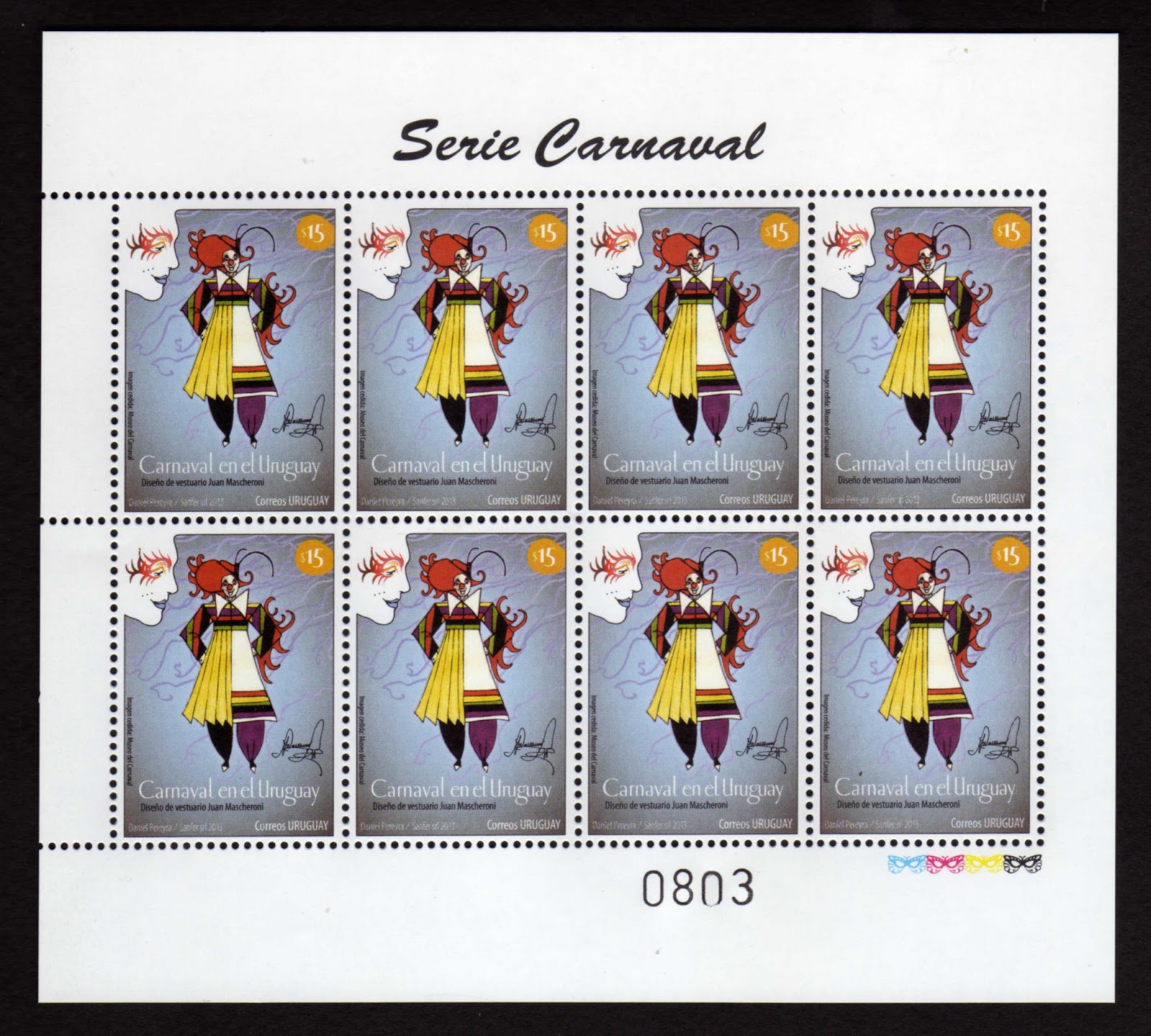
This stamp commemorates the Uruguayan Carnival, the greatest popular celebration of Uruguay, and it does it mainly showing a costume design authored by Juan Mascheroni, surely on for the murga "Saltimbanquis" as for them he has chosen big geometrical shaps for it art.

Also the traditional artistic makeup used in this celebration is introduced in the painted face appearing from the left top corner of the stamp.

And finally, the signature of Juan Mascheroni, a backghound of festive serpentines, and the legend that refers to the Museum of Carnival, completes the design of the stamp.

Some fact that is interesting about this issue, is that is repeating not many years later, a very similar release that was done on year 2009, more precisely on May 28th of this year. That stamp also was about Carnival, however most focused in the Carnival Museum, and also the main component in it desing was a costume painting of Juan Mascheroni.

Uruguayan Carnival is a popular festival that takes place every year in Uruguay from mid January to late February or even March too. It is related to african music candombe, and also an Uruguayan type of Music and show called Murga. It has evolved into a dance parade in which different comparsas play the drums and dance to the music at "Desfile Innaugural del Carnaval" and "Llamadas" parade.

Uruguayan carnival last around 40 days and it involves a series of cultural events such as many dance parades in the streets, shows in street stages called "tablados", and an artistic contest at "Teatro de Verano" in Montevideo.

It is estimated that the Uruguayan carnival, in just six weeks, sells more tickets in this country that all the others both sporting and cultural events together, including football, the national sport and the most popular.

Then, about John Mascheroni, he was born in Montevideo in 1948. He worked as a costume designer in theater, television and carnival environment in which has a long history. Its beginnings date back to 1980, when invited by Carlos Viana to design the costumes for the parodist group "Klaper's".

Then would come the turn of working with "Gaby's" parodist and for the murga "Los Saltimbanquis", with whom he get great recognition int the carnival atmosphere, making Mascheroni one of the pioneers in the role of costume designer for carnival.

With "The Saltimbanquis" created a unique style, enhancing the strength of the murga with a visual proposal contained suits with giant forms, geometric, and made of polyfom. Then, with murga "Falta y Resto", in the early nineties, staged a break in the proposed category, designing with more sinuous and curved lines, retracing his own previous artistic way.

Parodist groupt "Gaby's", and murgas "The Saltimbanquis" and "Falta y Resto", and humorist "Buby's" meant milestones in his long career as a designer for Carnival. At different times in these sets Mascheroni left its mark providing some of its most significant features as creator: daring to innovate, functionality, and elegance.

He worked in the five categories of the official carnival contest, wearing the groups: "La Escuelita del Crimen", "Los Jardineros de Harlem", "Teenagers", "Klapers", "Walkers", "Valentinos", "Adams", "Crazys", "Nazarenos", "Momosapiens", "Zingaros", "Jacquets", "Caballeros", "Gurrumines", "Uruguay Show", "Caras y Caretas", "La Pequeña Lulú", "Magazine", "Sarabanda", "La Nueva Milonga", "La Clarinada", "La Gran Muñeca", "Diablos Verdes", "Araca la Cana", "Arlequines", "Curtidores de Hongos" and "Colombina Ché".

Its activity extends to the present days.

The Carnival Museum is within the context of identity museums, since its objective is to value the traditions, in this case the major feast of Uruguay, its carnival.

The museum is located in "Rambla 25 de Agosto", at number No. 218, in the corner with street "Maciel", and has a large collection of objects, costumes, models, images and press information on the history of Carnival in Uruguay and also about its origins.

Finally, another topics related to the stamps, according to its desing could be hats, as it shows a very complex one, also other artistic expresions besides the ones previously mentioned as: disguises, fantasy dresses, masks, body art.

Then, in a more abstract way, humour, music, and probably also clown activities.


Block:

The block design is rather simple, it add the legend "Serie Carnaval", in english "Carnival Serie", however is of great interest the icon used to show the ink colours used for printing.

This icon, repeated four times, using the colours cyan, magenta, yellow, and black, shows an eye mask that clearly resembles a butterfly.


FDC:

The desing of the First Day Cancelation is a beautiful one, and it shows a human face with a traditional pattern of the makeup that is used in all of the participants of the carnival.


If you consider that there are another topics in this stamp, that were not spot in this review, you are encouraged to telling me about them, so please do not hesitate to post a comment. I would appreciate your help very much.

URU - 2013 - #003 - COVER Sent on First Day - CARNIVAL


Uruguay - 2013 - Carnival in Uruguay


If you are interested in any of this items, or any other items from Uruguay, just make a donation including your e-mail in the description.

I will contact you as soon I receive your donation, we agree on which items do you need, and I will discount the donation done to the amount of your purchase.


URU - 2013 - #003 - SERIE [2X2] - CARNIVAL


Uruguay - 2013 - Carnival in Uruguay


If you are interested in any of this items, or any other items from Uruguay, just make a donation including your e-mail in the description.

I will contact you as soon I receive your donation, we agree on which items do you need, and I will discount the donation done to the amount of your purchase.


URU - 2013 - #003 - BLOCK - CARNIVAL


Uruguay - 2013 - Carnival in Uruguay


If you are interested in any of this items, or any other items from Uruguay, just make a donation including your e-mail in the description.

I will contact you as soon I receive your donation, we agree on which items do you need, and I will discount the donation done to the amount of your purchase.


URU - 2013 - #003 - FDC not Sent - CARNIVAL


Uruguay - 2013 - Carnival in Uruguay


If you are interested in any of this items, or any other items from Uruguay, just make a donation including your e-mail in the description.

I will contact you as soon I receive your donation, we agree on which items do you need, and I will discount the donation done to the amount of your purchase.


URU - 2013 - #003 - FDC Sent on First Day - CARNIVAL


Uruguay - 2013 - Carnival in Uruguay


If you are interested in any of this items, or any other items from Uruguay, just make a donation including your e-mail in the description.

I will contact you as soon I receive your donation, we agree on which items do you need, and I will discount the donation done to the amount of your purchase.


URU - 2013 - #003 - SERIE - CARNIVAL


Uruguay - 2013 - Carnival in Uruguay


Options:

SERIE --- 1,40 EUR
SERIE [2X2] --- 5,50 EUR
BLOCK --- 10,00 EUR
FDC not Sent --- 2,80 EUR
FDC Sent on First Day --- 9,00 EUR
COVER Sent on First Day --- 6,00 EUR

If you are interested in any of this items, or any other items from Uruguay, just make a donation including your e-mail in the description.

I will contact you as soon I receive your donation, we agree on which items do you need, and I will discount the donation done to the amount of your purchase.


Issue information:

Country: Uruguay
Date: February 28th, 2013
Printed: 15.000 copies

Stamp Shape and Size: Rectangular [27 mm. x 39 mm.]
Perforation: Circular
Gum: Water Activated

Block Configuration: 8 stamps [2 x 4]
Block Shape and Size: Rectangular [139 mm. x 125 mm.]

FDC Type: Normal
FDC Shape and Size: Rectangular [165 mm. x 105 mm.]
Cover Shape and Size: Rectangular [241 mm. x 159 mm.]

Catalogue information:

Michel: No Data Available
Ivert: No Data Available
Scott: No Data Available
Stanley & Gibbons: No Data Available

Topics:

Issue:

This stamp commemorates the Uruguayan Carnival, the greatest popular celebration of Uruguay, and it does it mainly showing a costume design authored by Juan Mascheroni, surely on for the murga "Saltimbanquis" as for them he has chosen big geometrical shaps for it art.

Also the traditional artistic makeup used in this celebration is introduced in the painted face appearing from the left top corner of the stamp.

And finally, the signature of Juan Mascheroni, a backghound of festive serpentines, and the legend that refers to the Museum of Carnival, completes the design of the stamp.

Some fact that is interesting about this issue, is that is repeating not many years later, a very similar release that was done on year 2009, more precisely on May 28th of this year. That stamp also was about Carnival, however most focused in the Carnival Museum, and also the main component in it desing was a costume painting of Juan Mascheroni.

Uruguayan Carnival is a popular festival that takes place every year in Uruguay from mid January to late February or even March too. It is related to african music candombe, and also an Uruguayan type of Music and show called Murga. It has evolved into a dance parade in which different comparsas play the drums and dance to the music at "Desfile Innaugural del Carnaval" and "Llamadas" parade.

Uruguayan carnival last around 40 days and it involves a series of cultural events such as many dance parades in the streets, shows in street stages called "tablados", and an artistic contest at "Teatro de Verano" in Montevideo.

It is estimated that the Uruguayan carnival, in just six weeks, sells more tickets in this country that all the others both sporting and cultural events together, including football, the national sport and the most popular.

Then, about John Mascheroni, he was born in Montevideo in 1948. He worked as a costume designer in theater, television and carnival environment in which has a long history. Its beginnings date back to 1980, when invited by Carlos Viana to design the costumes for the parodist group "Klaper's".

Then would come the turn of working with "Gaby's" parodist and for the murga "Los Saltimbanquis", with whom he get great recognition int the carnival atmosphere, making Mascheroni one of the pioneers in the role of costume designer for carnival.

With "The Saltimbanquis" created a unique style, enhancing the strength of the murga with a visual proposal contained suits with giant forms, geometric, and made of polyfom. Then, with murga "Falta y Resto", in the early nineties, staged a break in the proposed category, designing with more sinuous and curved lines, retracing his own previous artistic way.

Parodist groupt "Gaby's", and murgas "The Saltimbanquis" and "Falta y Resto", and humorist "Buby's" meant milestones in his long career as a designer for Carnival. At different times in these sets Mascheroni left its mark providing some of its most significant features as creator: daring to innovate, functionality, and elegance.

He worked in the five categories of the official carnival contest, wearing the groups: "La Escuelita del Crimen", "Los Jardineros de Harlem", "Teenagers", "Klapers", "Walkers", "Valentinos", "Adams", "Crazys", "Nazarenos", "Momosapiens", "Zingaros", "Jacquets", "Caballeros", "Gurrumines", "Uruguay Show", "Caras y Caretas", "La Pequeña Lulú", "Magazine", "Sarabanda", "La Nueva Milonga", "La Clarinada", "La Gran Muñeca", "Diablos Verdes", "Araca la Cana", "Arlequines", "Curtidores de Hongos" and "Colombina Ché".

Its activity extends to the present days.

The Carnival Museum is within the context of identity museums, since its objective is to value the traditions, in this case the major feast of Uruguay, its carnival.

The museum is located in "Rambla 25 de Agosto", at number No. 218, in the corner with street "Maciel", and has a large collection of objects, costumes, models, images and press information on the history of Carnival in Uruguay and also about its origins.

Finally, another topics related to the stamps, according to its desing could be hats, as it shows a very complex one, also other artistic expresions besides the ones previously mentioned as: disguises, fantasy dresses, masks, body art.

Then, in a more abstract way, humour, music, and probably also clown activities.


Block:

The block design is rather simple, it add the legend "Serie Carnaval", in english "Carnival Serie", however is of great interest the icon used to show the ink colours used for printing.

This icon, repeated four times, using the colours cyan, magenta, yellow, and black, shows an eye mask that clearly resembles a butterfly.


FDC:

The desing of the First Day Cancelation is a beautiful one, and it shows a human face with a traditional pattern of the makeup that is used in all of the participants of the carnival.


If you consider that there are another topics in this stamp, that were not spot in this review, you are encouraged to telling me about them, so please do not hesitate to post a comment. I would appreciate your help very much.

miércoles, 10 de abril de 2013

URU - 2012 - #036 - SERIE - CHRISTMAS


Uruguay - 2012 - Christmas


Options:

SERIE --- 1,40 EUR
FDC not Sent --- 2,80 EUR
FDC Sent on First Day --- 9,00 EUR
COVER Sent on First Day --- 6,00 EUR

If you are interested in any of this items, or any other items from Uruguay, just make a donation including your e-mail in the description.

I will contact you as soon I receive your donation, we agree on which items do you need, and I will discount the donation done to the amount of your purchase.


Issue information:

Country: Uruguay
Date: November 23rd, 2012
Printed: 15.000 copies

Stamp Shape and Size: Rectangular [27 mm. x 39 mm.]
Perforation: Circular
Gum: Water Activated

Block Configuration: 25 stamps [5 x 5]
Block Shape and Size: Rectangular [Unknown Size]

FDC Type: Normal
FDC Shape and Size: Rectangular [165 mm. x 105 mm.]
Cover Shape and Size: Rectangular [241 mm. x 159 mm.]

Catalogue information:

Michel: No Data Available
Ivert: No Data Available
Scott: No Data Available
Stanley & Gibbons: No Data Available

Topics:

Issue:

This stamp commemorates the vicinity of a new Christmas, the annual commemoration of the birth of Jesus Christ, a widely observed holiday, celebrated generally on December 25th by millions of people around the world.

This serie is a traditional annual one, surely the oldest of this periodical issues, having his first edition for the Christmas of 1973, and having one realease on almost all years from this one to the one presented here.

As usually in this christmas stamps, all around the world it issue date is some days, this time around a month, before Christmas day, as it is often the kind of stamp choosen for postage in sending christmas postcards, or letters with christmas and new year wishes.

It is very peculiar the motif choosen this year to depict christmas, that is a painting of artist Ramón Cuadra Cantera called "Juglar en navidad", in english: "Minstrels in Christmas", which connection with Christmas, besides it title, is only what it seems to be the classic iconic symbol of the star of Bethelem, or Christmas Star.

Then, not only the selection of the painting for the stamp is peculiar, also the paining itself present a strange ucrony with the minstrel looking at the star of Bethelem, when Minstrels where characters of medieval age in Europe, far in time and geography from that event of Star of Bethelem in the sky. Only our imagination, perhaps the music as a link between millenium and miles far times and places, could help us in guess, in interact with another imagination, the artist one.

The painting, besides the minstrel staring at the Bethelem Star, also shows a kind of guitar, probably a mandolin, or another type of lute or light string instrument confortable to carry with while walking through the city and towns of medieval Europe.

Another intersting feature in the painting is the clothing of the minstrel, as it is the traditional one of this epoch, and the red hair and beard of the minstrel is a curious election too.

Finally, the stamp design is completed with an iconic draw of a christmas tree at top right of the stamp, and a more close look at the tree with its decoration at bottom right. All of this features over blue night sky with the crux, or southern cross in the top left corner.

Christmas (Old English: Crīstesmæsse, meaning "Christ's Mass") is an annual commemoration of the birth of Jesus Christ and a widely observed holiday, celebrated generally on December 25 by millions of people around the world. A feast central to the Christian liturgical year, it closes the Advent season and initiates the twelve days of Christmastide, which ends after the twelfth night. Christmas is a civil holiday in many of the world's nations, is celebrated by an increasing number of non-Christians, and is an integral part of the Christmas and holiday season.

The precise year of Jesus' birth, which some historians place between 7 and 2 BC, is unknown. His birth is mentioned in two of the four canonical gospels. By the early-to-mid 4th century, the Western Christian Church had placed Christmas on December 25, a date later adopted in the East. The date of Christmas may have initially been chosen to correspond with the day exactly nine months after early Christians believed Jesus to have been conceived, and became generally associated with the southern solstice (i.e., the Roman winter solstice), with a sun connection being possible because Christians consider Jesus to be the "Sun of righteousness" prophesied in Malachi 4:2

The original date of the celebration in Eastern Christianity was January 6, in connection with Epiphany, and that is still the date of the celebration for the Armenian Apostolic Church and in Armenia, where it is a public holiday. As of 2013, there is a difference of 13 days between the modern Gregorian calendar and the older Julian calendar. Those who continue to use the Julian calendar or its equivalents thus celebrate December 25 and January 6, which on the Gregorian calendar translate as January 7 and January 19. For this reason, Ethiopia, Russia, Georgia, Ukraine, Serbia, the Republic of Macedonia, and the Republic of Moldova celebrate Christmas on what in the Gregorian calendar is January 7.

Eastern Orthodox Churches in Bulgaria, Greece, Romania, Antioch, Alexandria, Albania, Finland and the Orthodox Church in America celebrate Christmas on December 25 in the revised Julian calendar, corresponding to December 25 also in the Gregorian calendar.

The popular celebratory customs associated in various countries with Christmas have a mix of pre-Christian, Christian, and secular themes and origins. Popular modern customs of the holiday include gift giving, Christmas music and caroling, an exchange of Christmas cards, church celebrations, a special meal, and the display of various Christmas decorations, including Christmas trees, Christmas lights, nativity scenes, garlands, wreaths, mistletoe, and holly. In addition, several closely related and often interchangeable figures, known as Santa Claus, Father Christmas, Saint Nicholas, and Christkind, are associated with bringing gifts to children during the Christmas season and have their own body of traditions and lore. Because gift-giving and many other aspects of the Christmas festival involve heightened economic activity among both Christians and non-Christians, the holiday has become a significant event and a key sales period for retailers and businesses. The economic impact of Christmas is a factor that has grown steadily over the past few centuries in many regions of the world.

Ramón Cuadra Cantera was born on September 3rd, 1962, in the city of Trinidad, located in department of Flores, Uruguay, and was mainly an sculptor.

From a young age he devoted himself to sculpture. Won first prize in the 'age of 15 years. In the years between 1981 - 1984 he attended a school of art "Escuela de Artes y Oficios". He studied drawing and history of art with sculptor Federico Möller de Berg.

In the following years is bound with the maestro Giacomo Manzu and sons of the sculptor Antoine Bourdelle and Ivan Mestrovic. Author of numerous works on behalf of the Government, the Church of the 'Uruguay and other public, private foundations.

After a short time he obtained the chair of sculpture of the "Escuela de Artes y artesanías Dr. Pedro Figari" in Montevideo where he now lives, and he is the Director of the museum of the "Universidad del Trabajo del Uruguay".

A minstrel was a medieval European bard who performed songs whose lyrics told stories of distant places or of existing or imaginary historical events. Although minstrels created their own tales, often they would memorize and embellish the works of others. Frequently they were retained by royalty and high society. As the courts became more sophisticated, minstrels were eventually replaced at court by the troubadours, and many became wandering minstrels, performing in the streets and became well-liked until the middle of the Renaissance, despite a decline beginning in the late 15th century. Minstrelsy fed into later traditions of travelling entertainers, which continued to be moderately strong into the early 20th century, and which has some continuity down to today's buskers or street musicians.

Initially, minstrels were simply servants at Court, and entertained the lord and courtiers with chansons de geste or their local equivalent. The term minstrel derives from Old French ménestrel (also menesterel, menestral), which is a derivative from Italian ministrello (also menestrello), from Middle Latin ministralis "retainer," an adjective form of Latin minister, "attendant" from minus, "lesser".

In Anglo-Saxon England before the Norman Conquest, the professional poet was known as a scop ("shaper" or "maker"), who composed his own poems, and sang them to the accompaniment of a harp. In a rank much beneath the scop, were the gleemen, who had no settled abode, but roamed about from place to place, earning what they could from their performances. Late in the 13th century, the term minstrel began to be used to designate a performer who amused his lord with music and song.

In a complex way involving invasions, wars, conquests, etc., two categories of composers originated. Poets like Chaucer and John Gower appeared in one category wherein music was not a part. Minstrels, on the other hand, swarmed at feasts and festivals in great numbers with harps, fiddles, bagpipes, flutes, flageolets, citterns, and kettledrums.

As early as 1321, the minstrels of Paris were formed into a guild. A guild of royal minstrels was organized in England in 1469. Minstrels were required to either join the guild or to abstain from practising their craft. Some minstrels were retained by lords as jesters who, in some cases, also practised the art of juggling. Some were women, or women who followed minstrels in their travels. Minstrels throughout Europe also employed trained animals, such as bears. Minstrels in Europe died out slowly, having gone nearly extinct by about 1700, though isolated individuals working in the tradition existed even into the early 19th century.


FDC:

The Cancelation of the FDC it is a simple one, and besides the legend: "Navidad 2012", that means "Christmas 2012", also includes the same iconic christmas tree builded by a continious trace.


If you consider that there are another topics in this stamp, that were not spot in this review, you are encouraged to telling me about them, so please do not hesitate to post a comment. I would appreciate your help very much.

URU - 2012 - #036 - FDC Sent on First Day - CHRISTMAS


Uruguay - 2012 - Christmas


If you are interested in any of this items, or any other items from Uruguay, just make a donation including your e-mail in the description.

I will contact you as soon I receive your donation, we agree on which items do you need, and I will discount the donation done to the amount of your purchase.